

The King of Calypso
1950s through the 2000s
- He was in about 20 Movies and TV Shows and made about 30 Record Albums!
- He did that song Day-O!
- He did that song Jump in the Line (Shake, Senora)!
- In 2015 he won the Jean Hersholt Humanitarian Award Oscar!
- In 2000 he won the Lifetime Achievement Grammy Award!
AKA
- Harold George Belafonte Jr.
Harry Belafonte
Recording Category Star
- Ceremony was on February 8, 1960

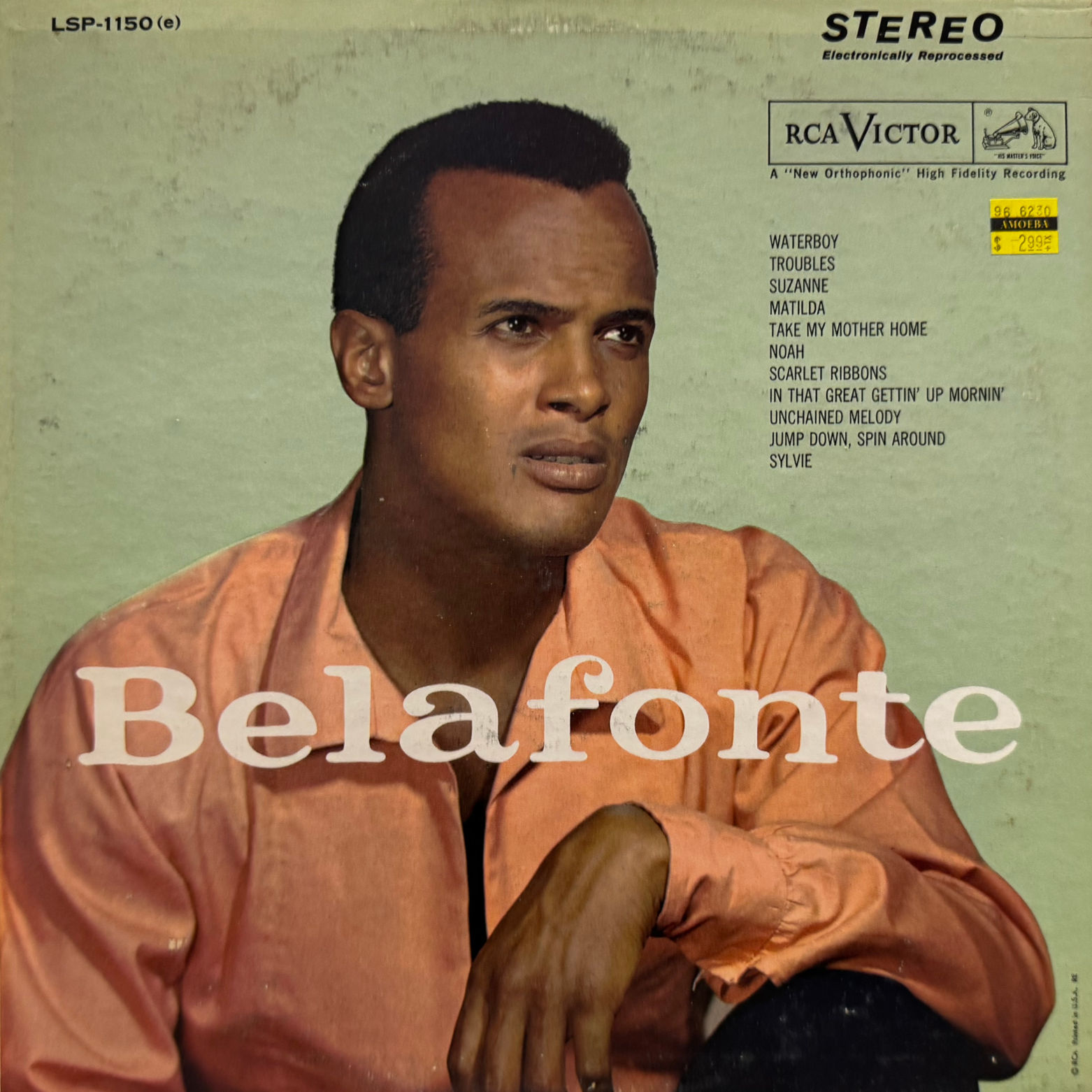
Belafonte
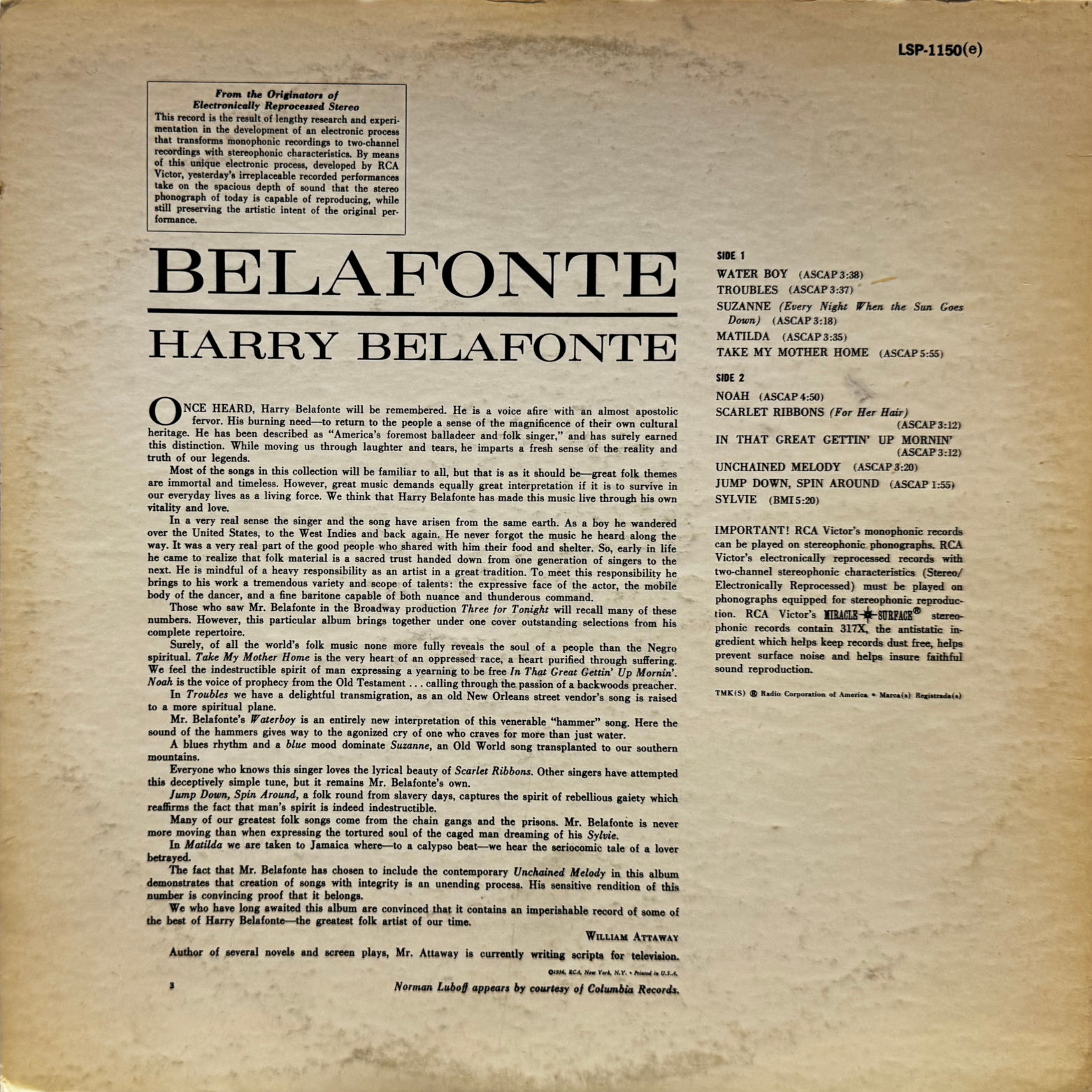
ONCE HEARD, Harry Belafonte will be remembered. He is a voice afire with an almost apostolic fervor. His burning need to return to the people a sense of the magnificence of their own cultural heritage. He has been described as "America's foremost balladeer and folk singer," and has surely earned this distinction. While moving us through laughter and tears, he imparts a fresh sense of the reality and truth of our legends.
Most of the songs in this collection will be familiar to all, but that is as it should be great folk themes are immortal and timeless. However, great music demands equally great interpretation if it is to survive in our everyday lives as a living force. We think that Harry Belafonte has made this music live through his own vitality and love.
In a very real sense the singer and the song have arisen from the same earth. As a boy he wandered over the United States, to the West Indies and back again. He never forgot the music he heard along the way. It was a very real part of the good people who shared with him their food and shelter. So, early in life he came to realize that folk material is a sacred trust handed down from one generation of singers to the next. He is mindful of a heavy responsibility as an artist in a great tradition. To meet this responsibility he brings to his work a tremendous variety and scope of talents: the expressive face of the actor, the mobile body of the dancer, and a fine baritone capable of both nuance and thunderous command.
Those who saw Mr. Belafonte in the Broadway production Three for Tonight will recall many of these numbers. However, this particular album brings together under one cover outstanding selections from his complete repertoire.
Surely, of all the world's folk music none more fully reveals the soul of a people than the Negro spiritual. Take My Mother Home is the very heart of an oppressed race, a heart purified through suffering. We feel the indestructible spirit of man expressing a yearning to be free In That Great Gettin' Up Mornin'. Noah is the voice of prophecy from the Old Testament... calling through the passion of a backwoods preacher.
In Troubles we have a delightful transmigration, as an old New Orleans street vendor's song is raised to a more spiritual plane.
Mr. Belafonte's Waterboy is an entirely new interpretation of this venerable "hammer" song. Here the sound of the hammers gives way to the agonized cry of one who craves for more than just water.
A blues rhythm and a blue mood dominate Suzanne, an Old World song transplanted to our southern mountains.
Everyone who knows this singer loves the lyrical beauty of Scarlet Ribbons. Other singers have attempted this deceptively simple tune, but it remains Mr. Belafonte's own.
Jump Down, Spin Around, a folk round from slavery days, captures the spirit of rebellious gaiety which reaffirms the fact that man's spirit is indeed indestructible.
Many of our greatest folk songs come from the chain gangs and the prisons. Mr. Belafonte is never more moving than when expressing the tortured soul of the caged man dreaming of his Sylvie.
In Matilda we are taken to Jamaica where to a calypso beat we hear the seriocomic tale of a lover betrayed.
The fact that Mr. Belafonte has chosen to include the contemporary Unchained Melody in this album demonstrates that creation of songs with integrity is an unending process. His sensitive rendition of this number is convincing proof that it belongs.
We who have long awaited this album are convinced that it contains an imperishable record of some of the best of Harry Belafonte the greatest folk artist of our time.
William Attaway
Author of several novels and screen plays, Mr. Attaway is currently writing scripts for television.
Side 1
- Waterboy
- Troubles
- Suzanne (Every Night When The Sun Goes Down)
- Matilda
- Take My Mother Home
Side 2
- Noah
- Scarlet Ribbons (For Her Hair)
- in That Great Gettin' Up Mornin'
- Unchained Melody
- Jump Down
- Spin Around
- Sylvie
As an Amazon Associate we earn from qualifying purchases
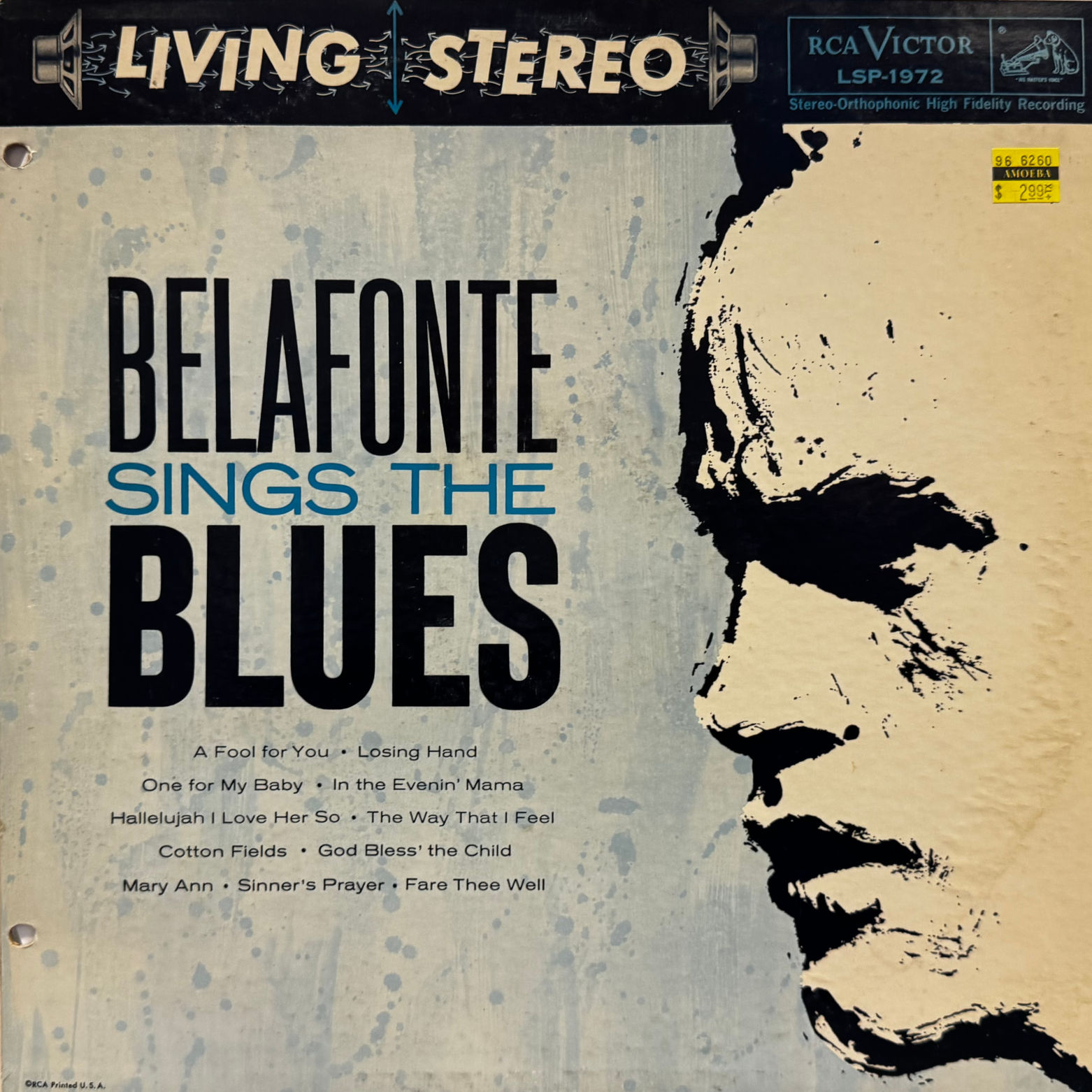
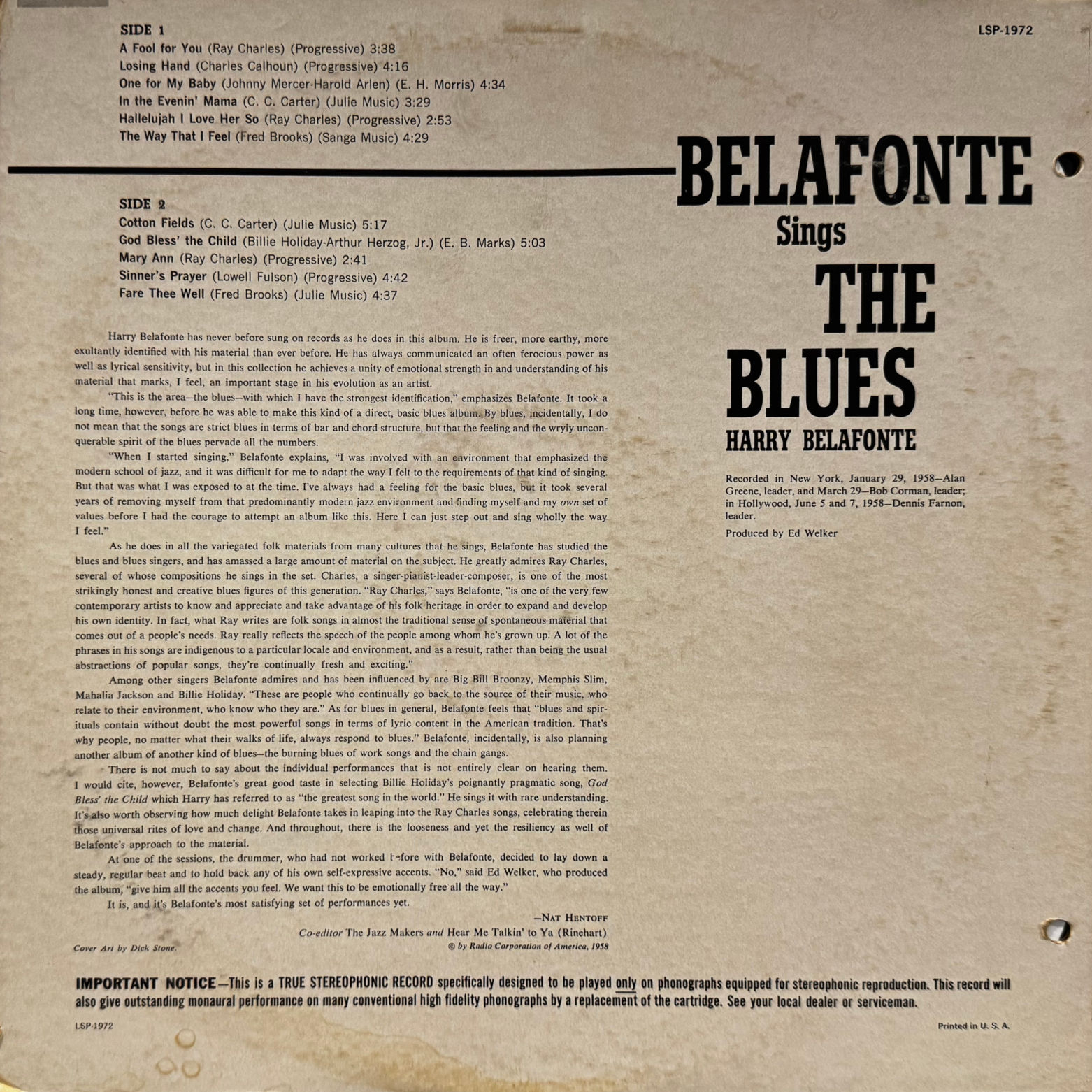
Belafonte Sings the Blues
Harry Belafonte has never before sung on records as he does in this album. He is freer, more earthy, more exultantly identified with his material than ever before. He has always communicated an often ferocious power as well as lyrical sensitivity, but in this collection he achieves a unity of emotional strength in and understanding of his material that marks, I feel, an important stage in his evolution as an artist.
"This is the area - the blues - with which I have the strongest identification," emphasizes Belafonte. It took a long time, however, before he was able to make this kind of a direct, basic blues album. By blues, incidentally, I do not mean that the songs are strict blues in terms of bar and chord structure, but that the feeling and the wryly unconquerable spirit of the blues pervade all the numbers.
"When I started singing" Belafonte explains, "I was involved with an environment that emphasized the modern school of jazz, and it was difficult for me to adapt the way I felt to the requirements of that kind of singing. But that was what I was exposed to at the time. I've always had a feeling for the basic blues, but it took several years of removing myself from that predominantly modern jazz environment and finding myself and my own set of values before I had the courage to attempt an album like this. Here I can just step out and sing wholly the way I feel."
As he does in all the variegated folk materials from many cultures that he sings, Belafonte has studied the blues and blues singers, and has amassed a large amount of material on the subject. He greatly admires Ray Charles, several of whose compositions he sings in the set. Charles, a singer-pianist-leader-composer, is one of the most strikingly honest and creative blues figures of this generation. "Ray Charles," says Belafonte, is one of the very few contemporary artists to know and appreciate and take advantage of his folk heritage in order to expand and develop his own identity. In fact, what Ray writes are folk songs in almost the traditional sense of spontaneous material that comes out of a people's needs. Ray really reflects the speech of the people among whom he's grown up. A lot of the phrases in his songs are indigenous to a particular locale and environment, and as a result, rather than being the usual abstractions of popular songs, they're continually fresh and exciting."
Among other singers Belafonte admires and has been influenced by are Big Bill Broonzy, Memphis Slim, Mahalia Jackson and Billie Holiday. "These are people who continually go back to the source of their music, who relate to their environment, who know who they are." As for blues in general, Belafonte feels that "blues and spirituals contain without doubt the most powerful songs in terms of lyric content in the American tradition. That's why people, no matter what their walks of life, always respond to blues." Belafonte, incidentally, is also planning another album of another kind of blues - the burning blues of work songs and the chain gangs. There is not much to say about the individual performances that is not entirely clear on hearing them. I would cite, however, Belafonte's great good taste in selecting Billie Holiday's poignantly pragmatic song, God Bless' the Child which Harry has referred to as "the greatest song in the world." He sings it with rare understanding. It's also worth observing how much delight Belafonte takes in leaping into the Ray Charles songs, celebrating therein those universal rites of love and change. And throughout, there is the looseness and yet the resiliency as well of Belafonte's approach to the material.
At one of the sessions, the drummer, who had not worked before with Belafonte, decided to lay down a steady, regular beat and to hold back any of his own self-expressive accents. "No," said Ed Welker, who produced the album, "give him all the accents you feel. We want this to be emotionally free all the way."
It is, and it's Belafonte's most satisfying set of performances yet.
-Nat Hentoff
Co-editor The Jazz Makers and Hear Me Talkin' to Ya (Rinehart)
Side 1
- A Fool For You
- Losing Hand
- One For My Baby
- in The Evenin' Mama
- Hallelujah I Love Her So
- The Way That I Feel
Side 2
- Cotton Fields
- God Bless' The Child
- Mary Ann
- Sinner's Prayer
- Fare Thee Well
- YOUTUBE:
[https://www.youtube.com/watch?v=rAa_hXWLaAE&list=PLs5Xr] - SPOTIFY:
[https://open.spotify.com/album/3ManjKq8K3CFZIr97YvU0m] - APPLE MUSIC:
[https://music.apple.com/us/album/1087736455] - AMAZON:
[https://www.amazon.com/dp/B0019AGBU8]
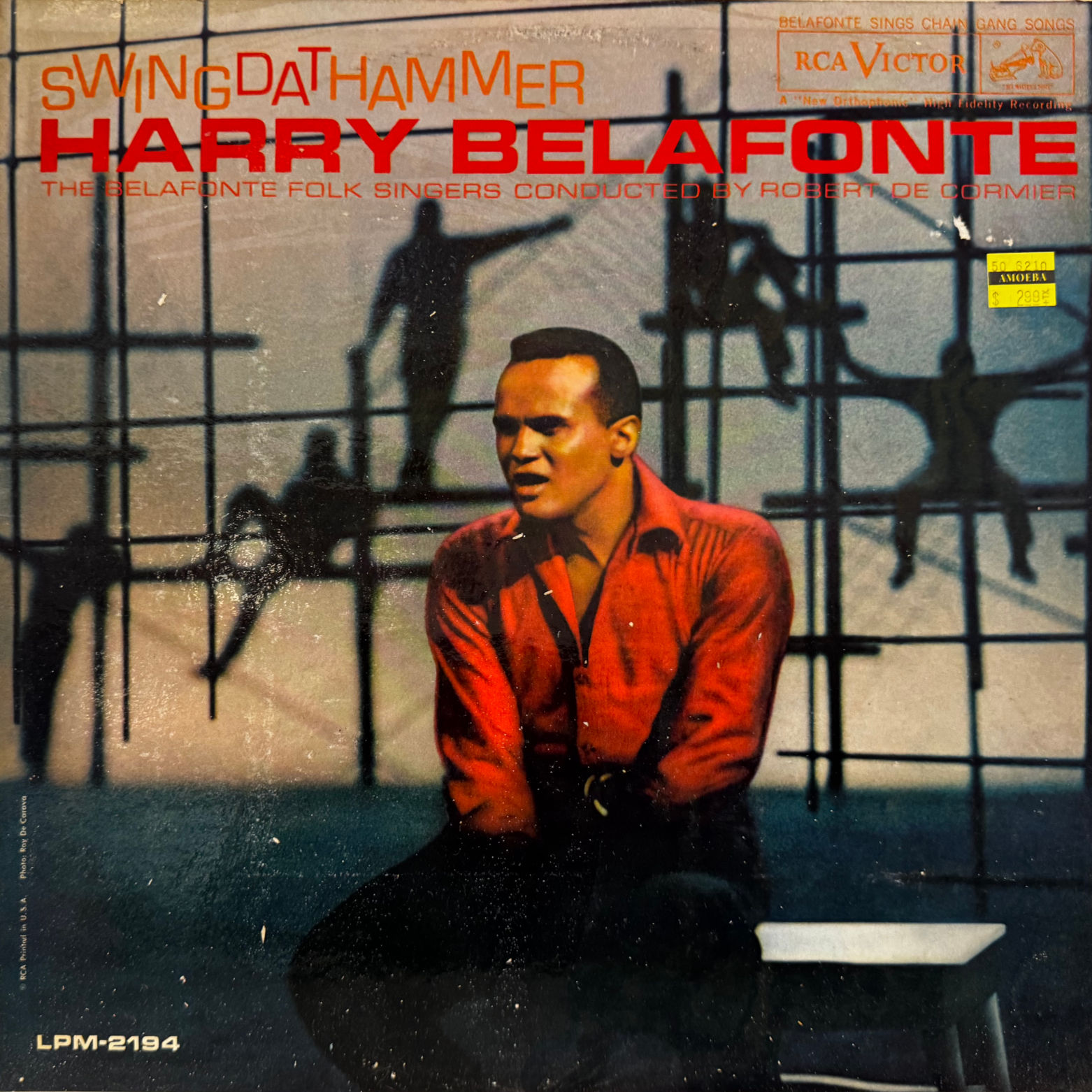
Swing Dat Hammer
And the Belafonte Folk Singers conducted by Robert De Cormier
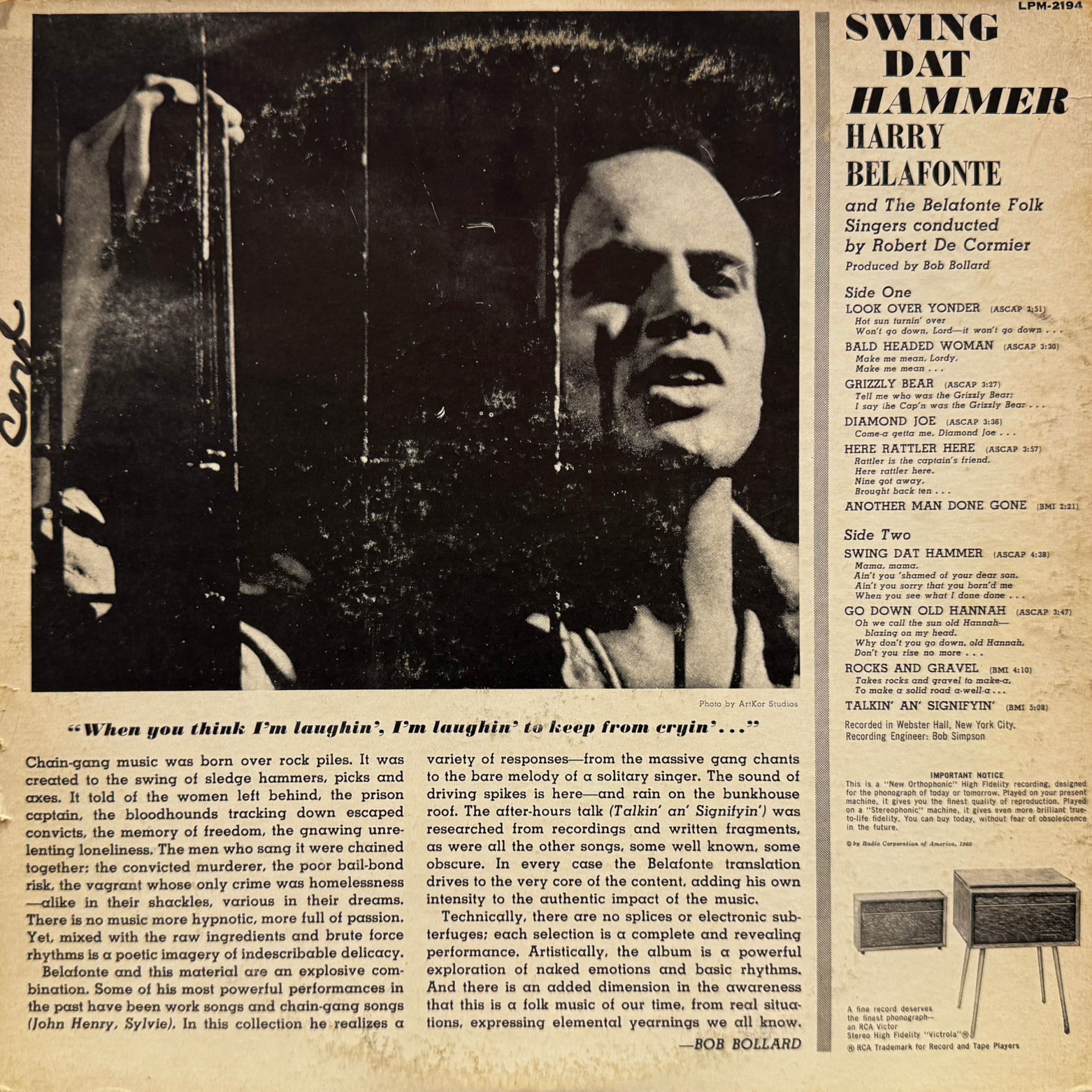
Chain-gang music was born over rock piles. It was created to the swing of sledge hammers, picks and axes. It told of the women left behind, the prison captain, the bloodhounds tracking down escaped convicts, the memory of freedom, the gnawing unrelenting loneliness. The men who sang it were chained together: the convicted murderer, the poor bail-bond risk, the vagrant whose only crime was homelessness - alike in their shackles, various in their dreams. There is no music more hypnotic, more full of passion. Yet mixed with the raw ingredients and brute force rhythms is a poetic imagery of indescribable delicacy.
Belafonte and this material are an explosive combination. Some of his most powerful performances in the past have been work songs and chain-gang songs (John Henry, Sylvie). In this collection he realizes a variety of responses from the massive gang chants to the bare melody of a solitary singer. The sound of driving spikes is here and rain on the bunkhouse roof. The after-hours talk (Talkin' an' Signityin) was researched from recordings and written fragments. as were all the other songs, some well known, some obscure. In every case the Belafonte translation drives to the very core of the content, adding his own intensity to the authentic impact of the music.
Technically, there are no splices or electronic subterfuges; each selection is a complete and revealing performance. Artistically, the album is a powerful exploration of naked emotions and basic rhythms. And there is an added dimension in the awareness that this is a folk music of our time, from real situations, expressing elemental yearnings we all know.
-Bob Bollard
Side One
- Look Over Yonder
- Bald Headed Woman
- Grizzly Bear
- Diamond Joe
- Here Rattler Here
- Another Man Done Good
Side Two
- Swing Dat Hammer
- Go Down Old Hannah
- Rocks and Gravel
- Talkin' An' Signifyin'
- YOUTUBE:
[https://www.youtube.com/watch?v=8NN8RwEUvmo&list=OLAK5uy] - SPOTIFY:
[https://open.spotify.com/album/4HIvA72jYd4OVTeaulv3Lt] - APPLE MUSIC:
[https://music.apple.com/us/album/1087732644] - AMAZON:
[https://www.amazon.com/dp/B00GV31I6A]
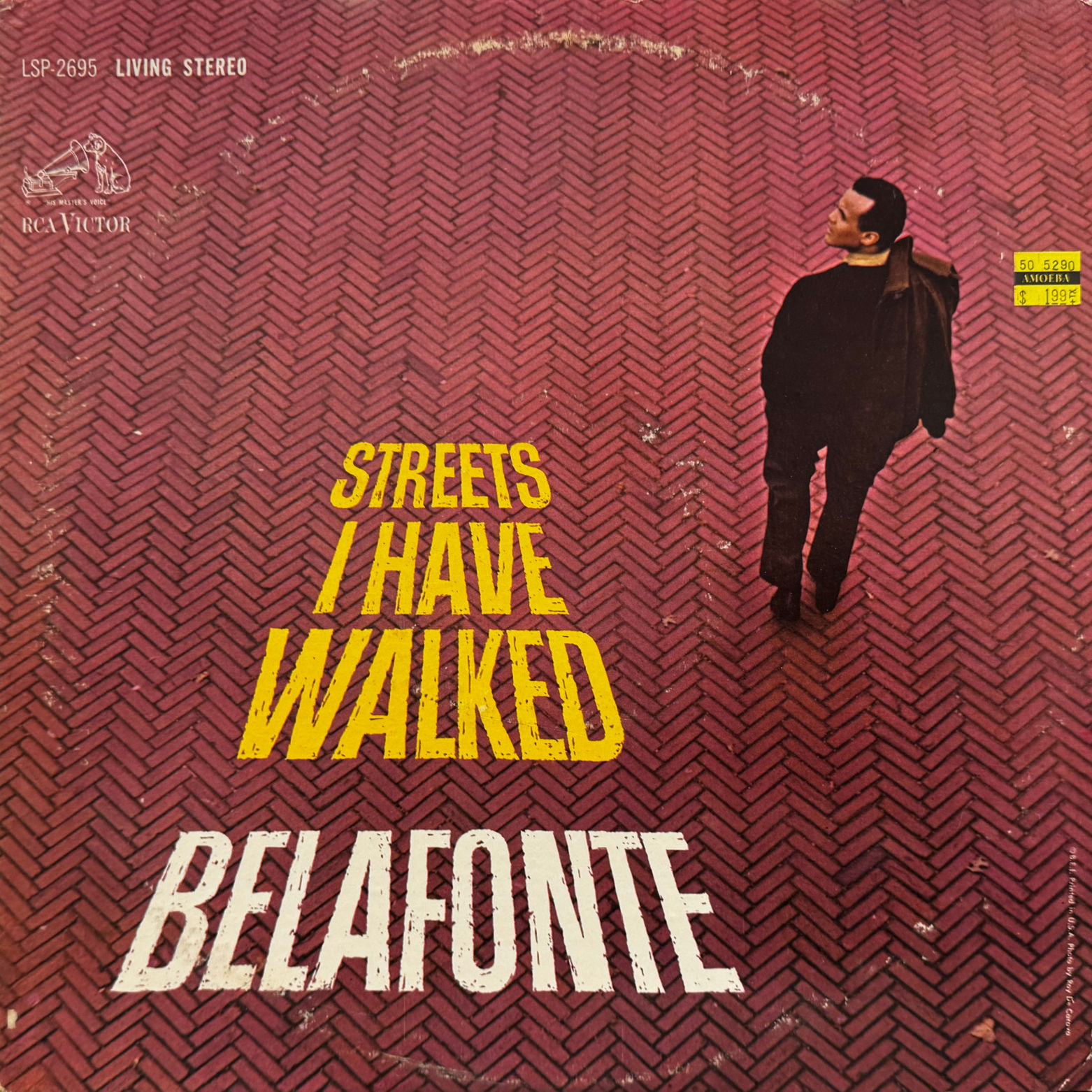
Streets I Have Walked
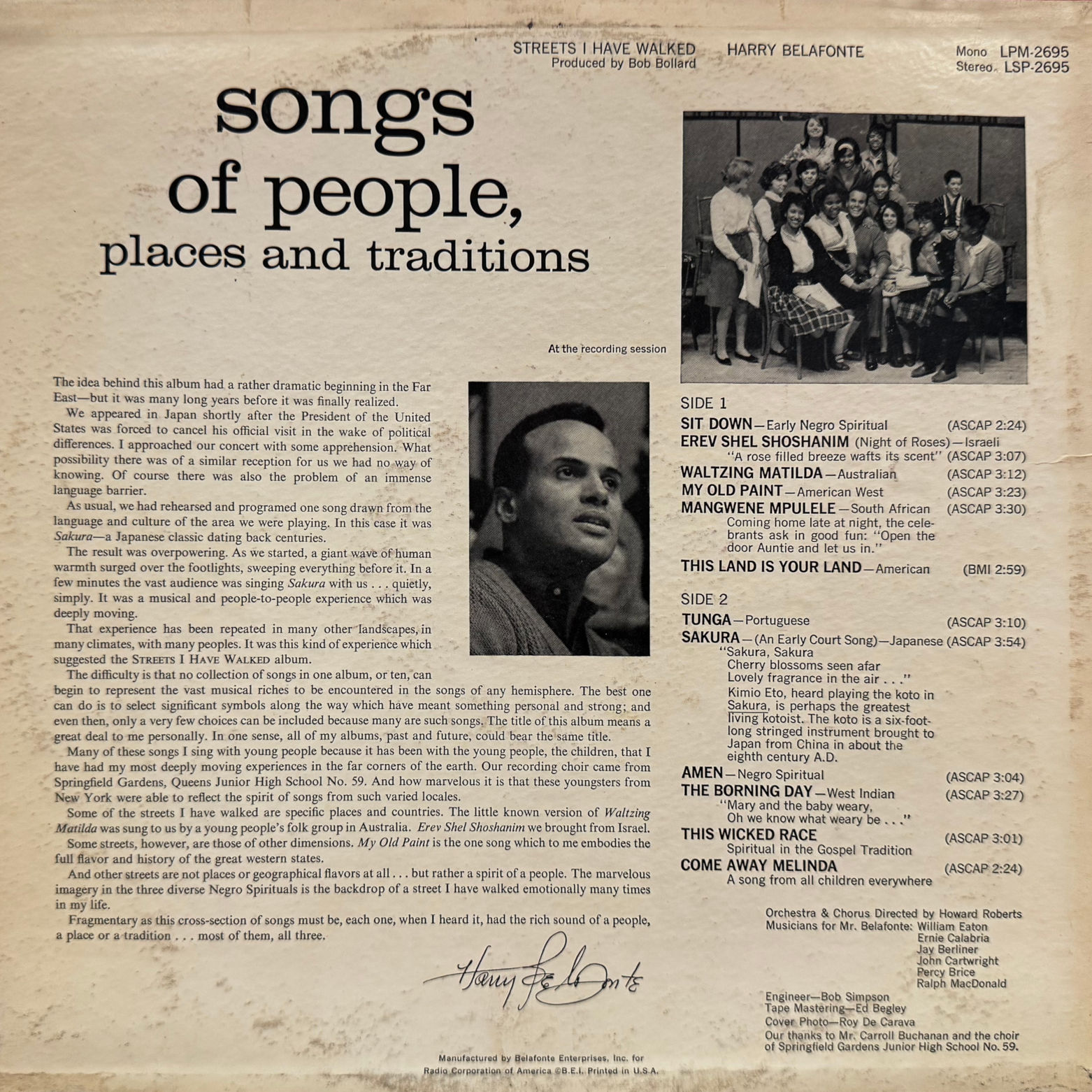
songs of people, places and traditions
The idea behind this album had a rather dramatic beginning in the Far East - but it was many long years before it was finally realized.
We appeared in Japan shortly after the President of the United States was forced to cancel his official visit in the wake of political differences. I approached our concert with some apprehension. What possibility there was of a similar reception for us we had no way of knowing. Of course there was also the problem of an immense language barrier.
As usual, we had rehearsed and programed one song drawn from the language and culture of the area we were playing. In this case it was Sakura a Japanese classic dating back centuries.
The result was overpowering. As we started, a giant wave of human warmth surged over the footlights, sweeping everything before it. In a few minutes the vast audience was singing Sakura with us... quietly, simply. It was a musical and people-to-people experience which was deeply moving.
That experience has been repeated in many other landscapes, in many climates, with many peoples. It was this kind of experience which suggested the STREETS I HAVE WALKED album.
The difficulty is that no collection of songs in one album, or ten, can begin to represent the vast musical riches to be encountered in the songs of any hemisphere. The best one can do is to select significant symbols along the way which have meant something personal and strong; and even then, only a very few choices can be included because many are such songs. The title of this album means a great deal to me personally. In one sense, all of my albums, past and future, could bear the same title.
Many of these songs I sing with young people because it has been with the young people, the children, that I have had my most deeply moving experiences in the far corners of the earth. Our recording choir came from Springfield Gardens, Queens Junior High School No. 59. And how marvelous it is that these youngsters from New York were able to reflect the spirit of songs from such varied locales.
Some of the streets I have walked are specific places and countries. The little known version of Waltzing Matilda was sung to us by a young people's folk group in Australia. Erev Shel Shoshanim we brought from Israel.
Some streets, however, are those of other dimensions. My Old Paint is the one song which to me embodies the full flavor and history of the great western states.
And other streets are not places or geographical flavors at all... but rather a spirit of a people. The marvelous imagery in the three diverse Negro Spirituals is the backdrop of a street I have walked emotionally many times in my life.
Fragmentary as this cross-section of songs must be, each one, when I heard it, had the rich sound of a people, a place or a tradition... most of them, all three.
Harry Belefonte
Side 1
- Sit Down
- Erev Shel Shoshanim (Night of Roses)
- Waltzing Matilda
- My Old Paint
- Mangwene Mpulele
- This Land Is Your Land
Side 2
- Tunga
- Sakura (An Early Court Song)
- Amen
- The Borning Day
- This Wicked Race
- Come Away Melinda
- YOUTUBE:
[https://www.youtube.com/playlist?list=OLAK5uy] - SPOTIFY:
[https://open.spotify.com/album/7ukmuzEDU83oftp8jvSXZp] - APPLE MUSIC:
[https://music.apple.com/us/album/775430363] - AMAZON:
[https://www.amazon.com/dp/B003K2QGLM]
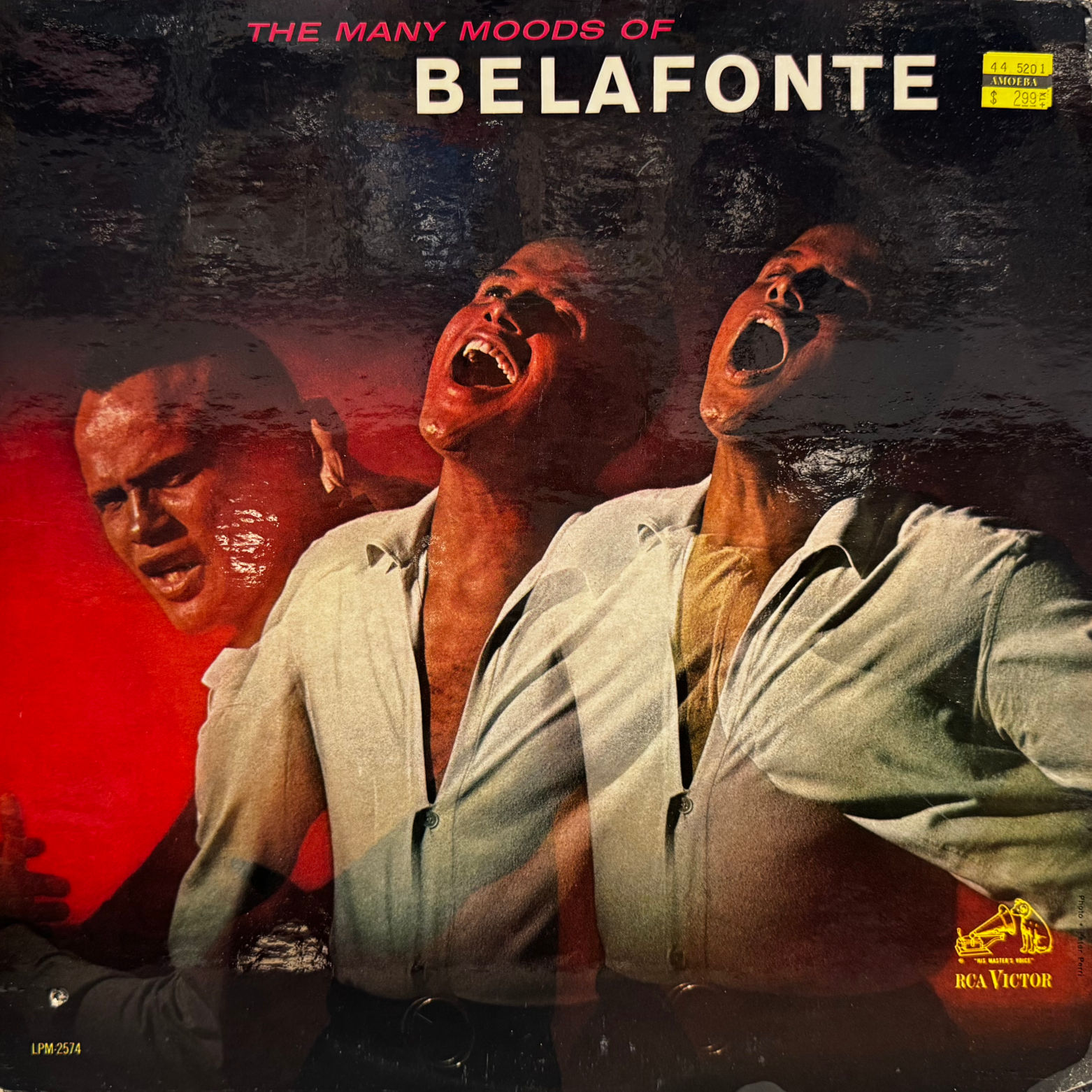
The Many Moods of Belafonte
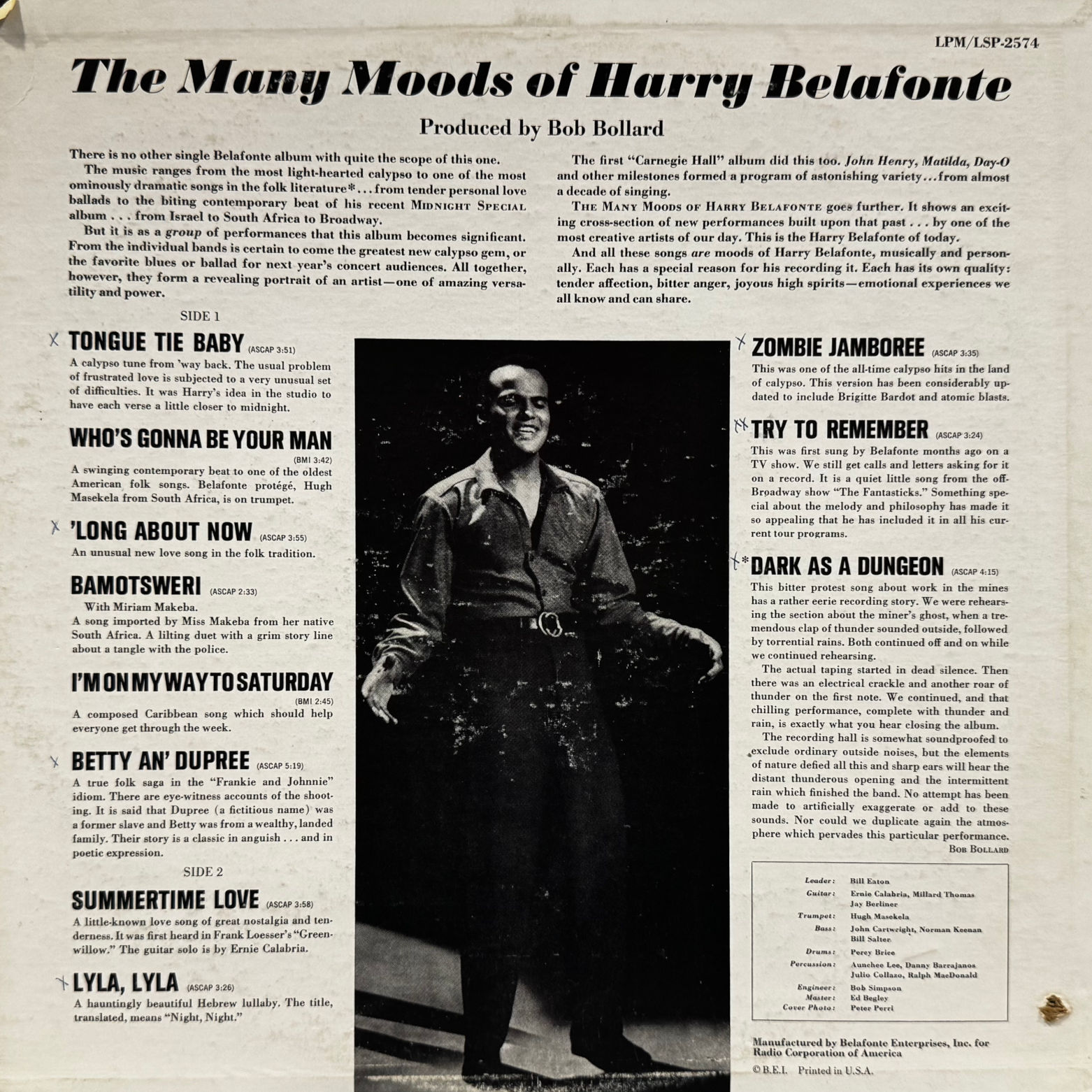
There is no other single Belafonte album with quite the scope of this one.
The music ranges from the most light-hearted calypso to one of the most ominously dramatic songs in the folk literature... from tender personal love ballads to the biting contemporary beat of his recent MIDNIGHT SPECIAL album... from Israel to South Africa to Broadway.
But it is as a group of performances that this album becomes significant. From the individual bands is certain to come the greatest new calypso gem, or the favorite blues or ballad for next year's concert audiences. All together, however, they form a revealing portrait of an artist — one of amazing versatility and power.
The first "Carnegie Hall" album did this too. John Henry, Matilda, Day-O and other milestones formed a program of astonishing variety... from almost a decade of singing.
THE MANY MOODS OF HARRY BELAFONTE goes further. It shows an exciting cross-section of new performances built upon that past... by one of the most creative artists of our day. This is the Harry Belafonte of today.
And all these songs are moods of Harry Belafonte, musically and personally. Each has a special reason for his recording it. Each has its own quality: tender affection, bitter anger, joyous high spirits—emotional experiences we all know and can share.
Side 1
- Tongue Tie Baby
- Who's Gonna Be Your Man
- 'Long About Now
- Bamotsweri
- I'm on My Way to Saturday
- Betty An' Dupree
Side 2
- Summertime Love
- Lyla
- Lyla
- Zombie Jamboree
- Try to Remember
- Dark As a Dungeon
- YOUTUBE:
[https://www.youtube.com/playlist?list=OLAK5uy] - SPOTIFY:
[https://open.spotify.com/album/4jFmuGs9ptYWJ8o0r186M8] - APPLE MUSIC:
[https://music.apple.com/us/album/1088536235] - AMAZON:
[https://www.amazon.com/dp/B00IF8PXLA]
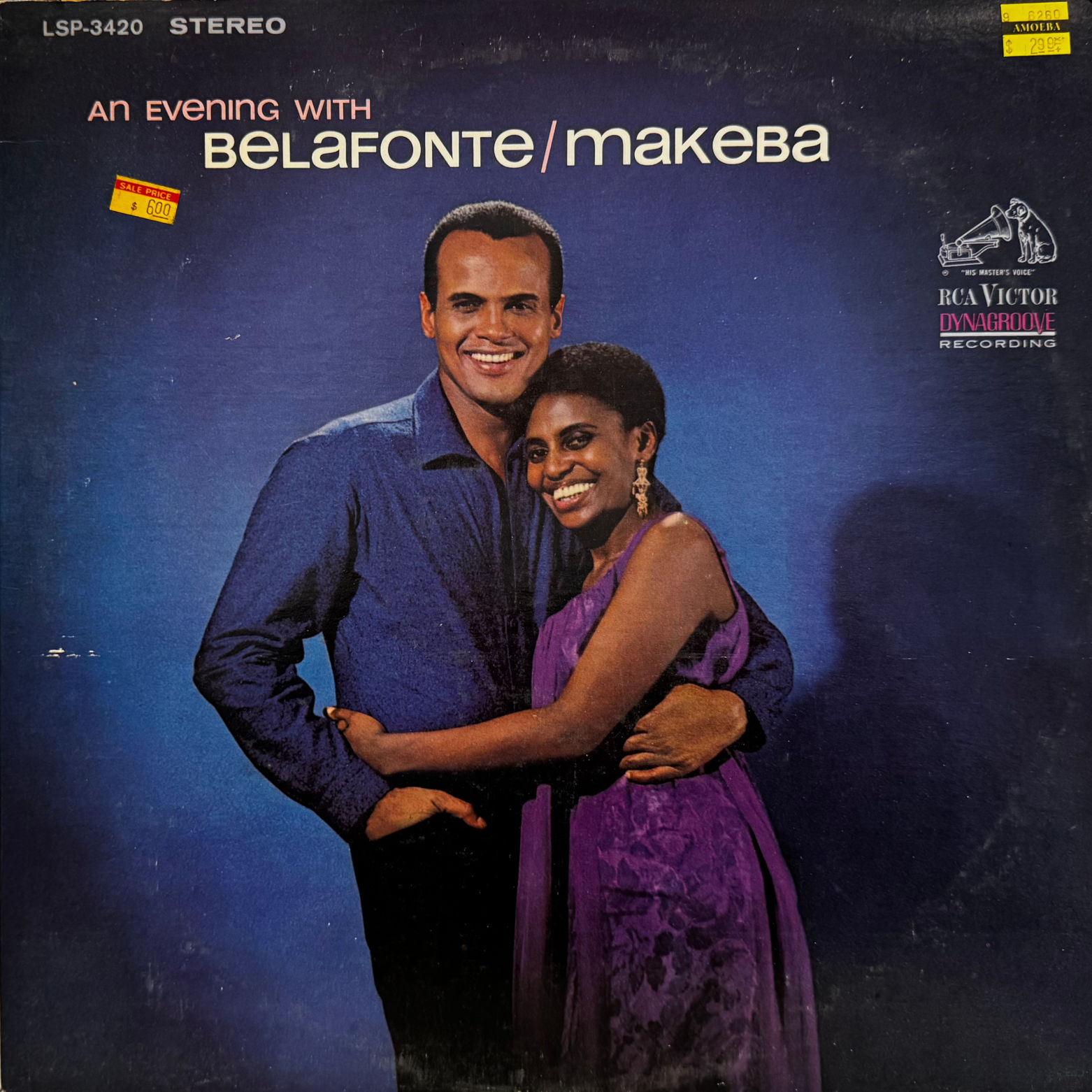
An Evening with Belafonte / Makeba
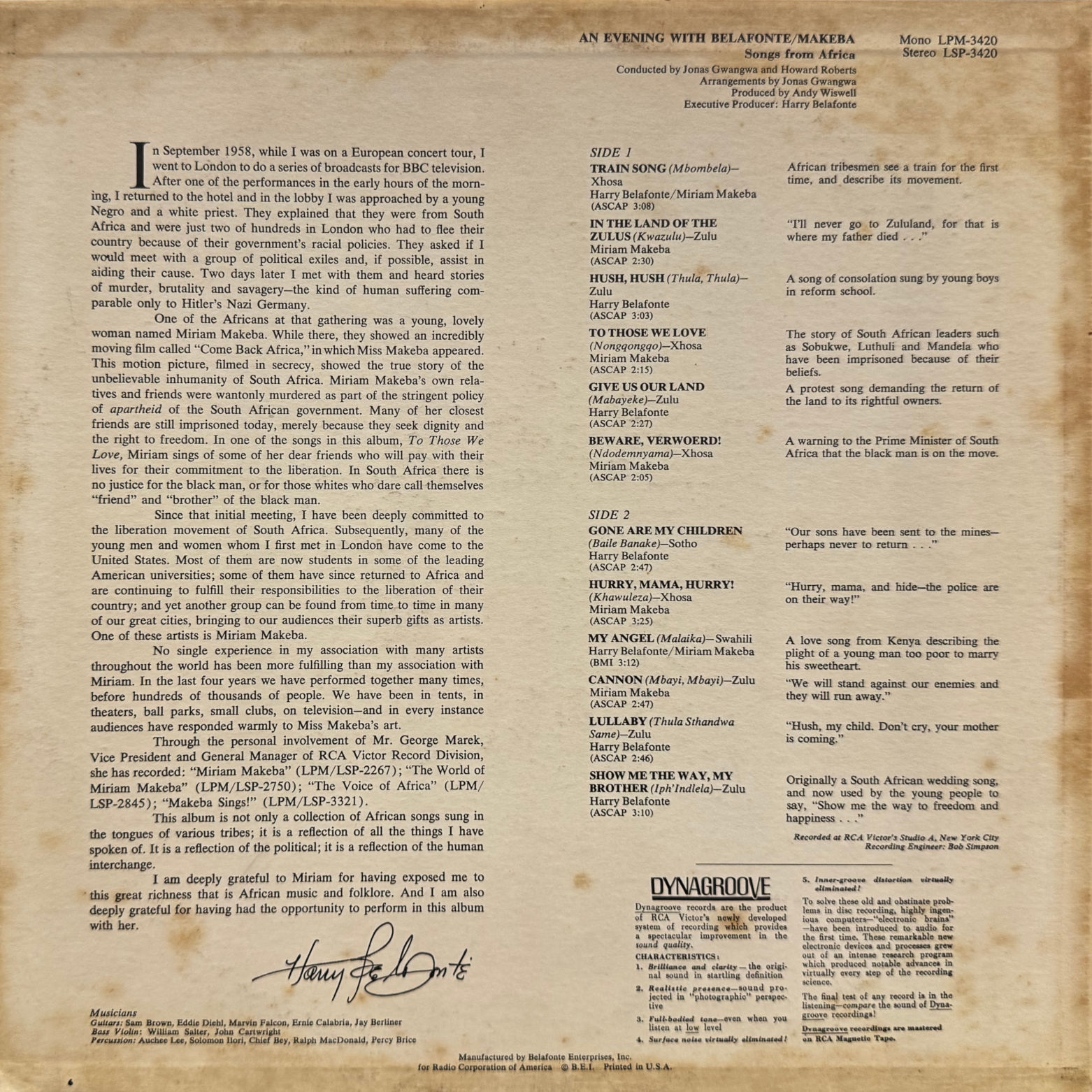
In September 1958, while I was on a European concert tour, I went to London to do a series of broadcasts for BBC television. After one of the performances in the early hours of the morning, I returned to the hotel and in the lobby I was approached by a young Negro and a white priest. They explained that they were from South Africa and were just two of hundreds in London who had to flee their country because of their government's racial policies. They asked if I would meet with a group of political exiles and, if possible, assist in aiding their cause. Two days later I met with them and heard stories of murder, brutality and savagery - the kind of human suffering comparable only to Hitler's Nazi Germany.
One of the Africans at that gathering was a young, lovely woman named Miriam Makeba. While there, they showed an incredibly moving film called "Come Back Africa," in which Miss Makeba appeared. This motion picture, filmed in secrecy, showed the true story of the unbelievable inhumanity of South Africa. Miriam Makeba's own relatives and friends were wantonly murdered as part of the stringent policy of apartheid of the South African government. Many of her closest friends are still imprisoned today, merely because they seek dignity and the right to freedom. In one of the songs in this album, To Those We Love, Miriam sings of some of her dear friends who will pay with their lives for their commitment to the liberation. In South Africa there is no justice for the black man, or for those whites who dare call themselves "friend" and "brother" of the black man.
Since that initial meeting, I have been deeply committed to the liberation movement of South Africa. Subsequently, many of the young men and women whom I first met in London have come to the United States. Most of them are now students in some of the leading American universities; some of them have since returned to Africa and are continuing to fulfill their responsibilities to the liberation of their country; and yet another group can be found from time to time in many of our great cities, bringing to our audiences their superb gifts as artists. One of these artists is Miriam Makeba.
No single experience in my association with many artists throughout the world has been more fulfilling than my association with Miriam. In the last four years we have performed together many times, before hundreds of thousands of people. We have been in tents, in theaters, ball parks, small clubs, on television - and in every instance audiences have responded warmly to Miss Makeba's art.
Through the personal involvement of Mr. George Marek, Vice President and General Manager of RCA Victor Record Division, she has recorded: "Miriam Makeba" (LPM/LSP-2267); "The World of Miriam Makeba" (LPM/LSP-2750); "The Voice of Africa" (LPM/ LSP-2845); "Makeba Sings!" (LPM/LSP-3321).
This album is not only a collection of African songs sung in the tongues of various tribes; it is a reflection of all the things I have spoken of. It is a reflection of the political; it is a reflection of the human interchange.
I am deeply grateful to Miriam for having exposed me to this great richness that is African music and folklore. And I am also deeply grateful for having had the opportunity to perform in this album with her.
Harry Belafonte
Side A
- Train Song
- In The Land of The Zulus
- Hush
- Hush
- To Those We Love
- Give Us Our Land
- Beware, Verwoerd!
Side B
- Gone are My Children
- Hurry, Mama, Hurry!
- My Angel
- Cannon
- Lullaby
- Show Me The Way, My Brother
- YOUTUBE:
[https://www.youtube.com/watch?v=_1OJvqKNGg4] - SPOTIFY:
[https://open.spotify.com/album/27SMV8TOEzD5NvCI6dK7Xc] - APPLE MUSIC:
[https://music.apple.com/us/album/275141860] - AMAZON:
[https://www.amazon.com/dp/B0018AXY4A]
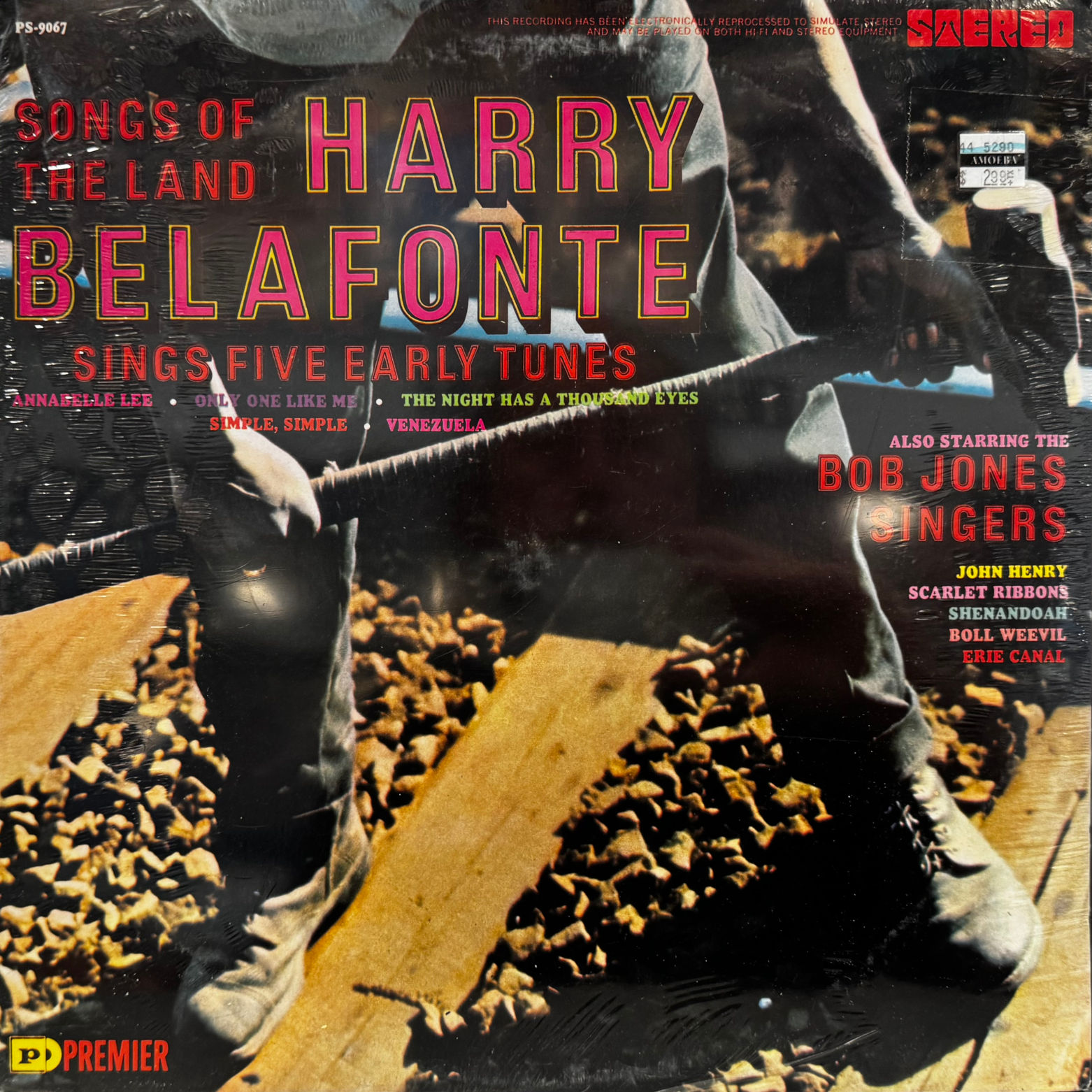
Songs of the Land
Harry Belafonte Sings Five Early Songs
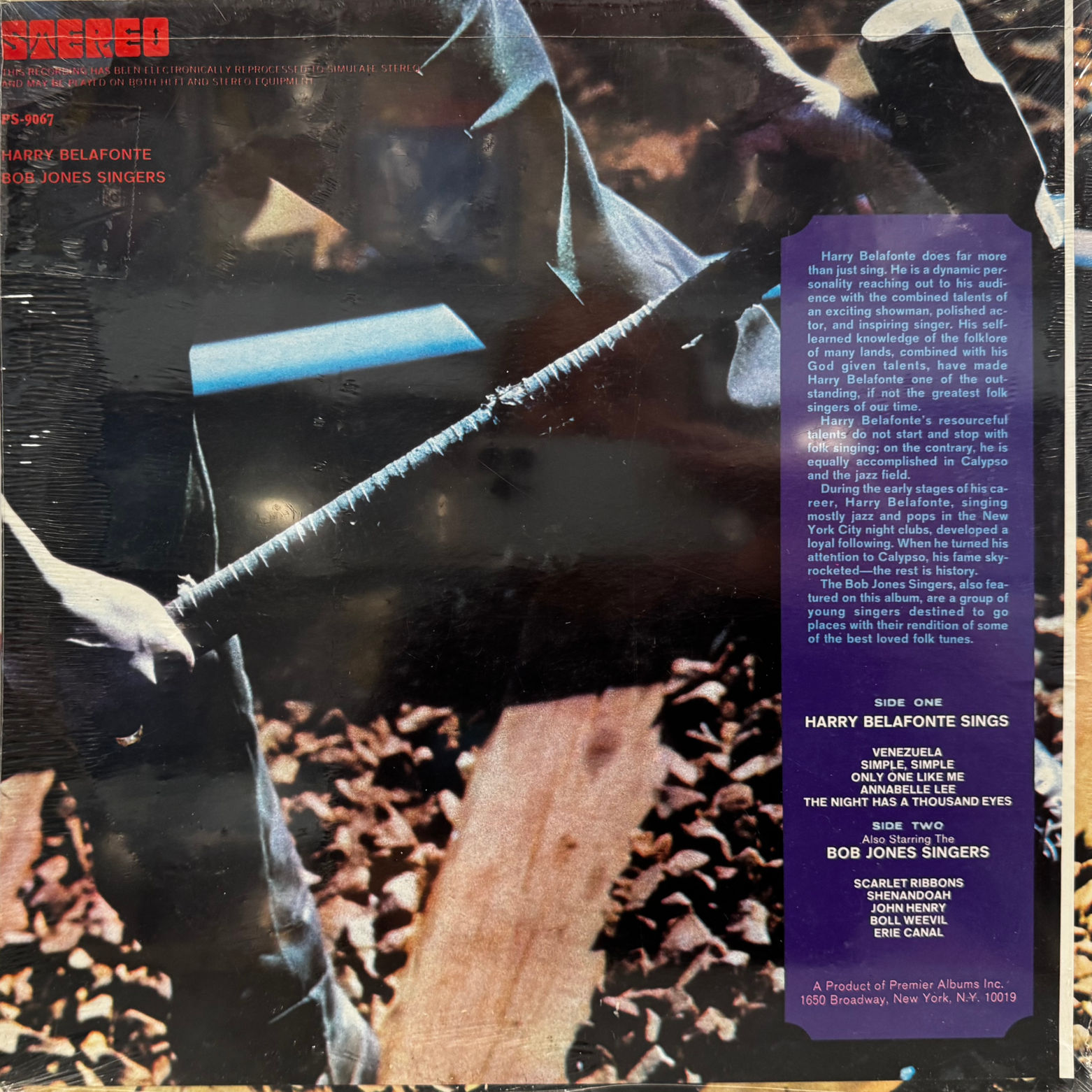
Harry Belafonte does far more than just sing. He is a dynamic personality reaching out to his audience with the combined talents of an exciting showman, polished actor, and inspiring singer. His self-learned knowledge of the folklore of many lands, combined with his God given talents, have made Harry Belafonte one of the outstanding, if not the greatest folk singers of our time.
Harry Belafonte's resourceful talents do not start and stop with folk singing; on the contrary, he is equally accomplished in Calypso and the jazz field.
During the early stages of his career, Harry Belafonte, singing mostly jazz and pops in the New York City night clubs, developed a loyal following. When he turned his attention to Calypso, his fame skyrocketed the rest is history.
The Bob Jones Singers, also featured on this album, are a group of young singers destined to go places with their rendition of some of the best loved folk tunes.
Harry Belafonte Sings
- Venezuela
- Simple
- Simple
- Only One Like Me
- Annabelle Lee
- The Night Has a Thousand Eyes
Also Starring The Bob Jones Singers
- Scarlet Ribbons
- Shenandoah
- John Henry
- Boll Weevil
- Erie Canal
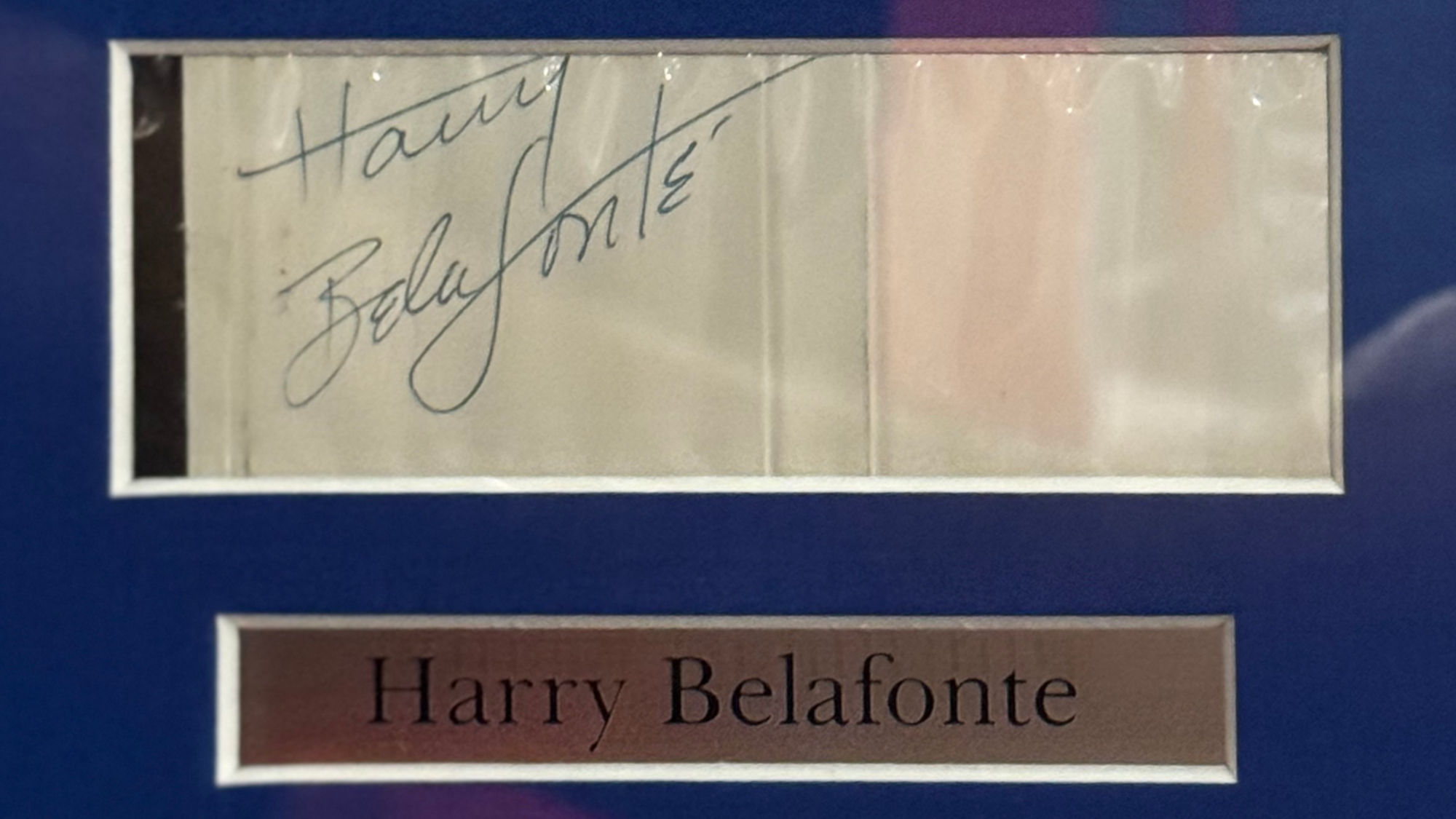
Harry Belafonte
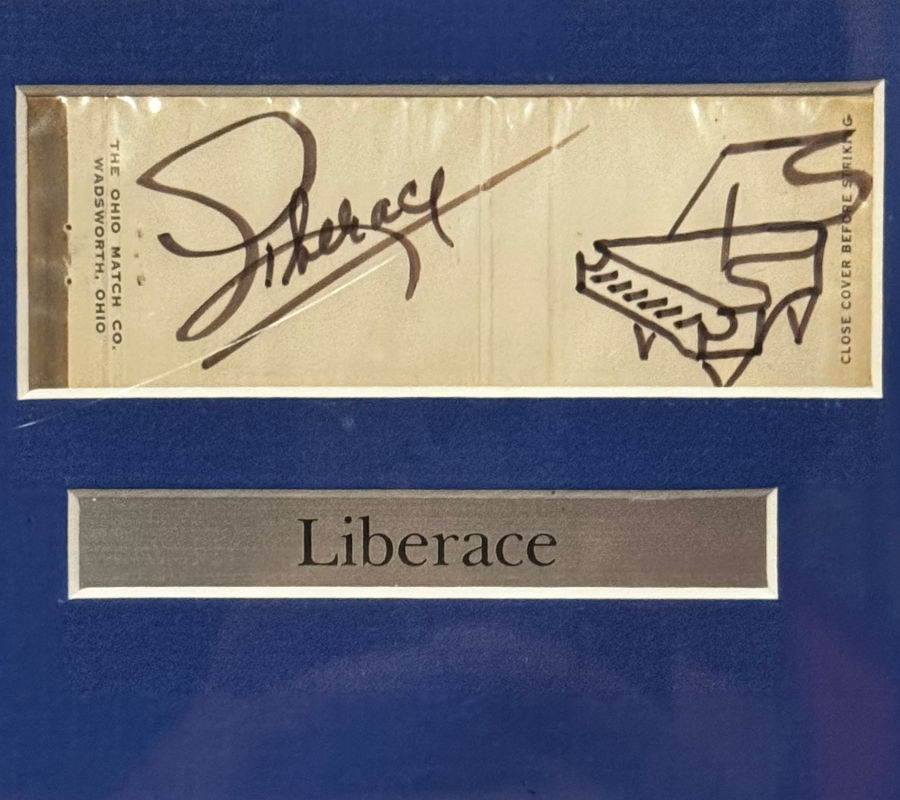
Autographed Matchbook