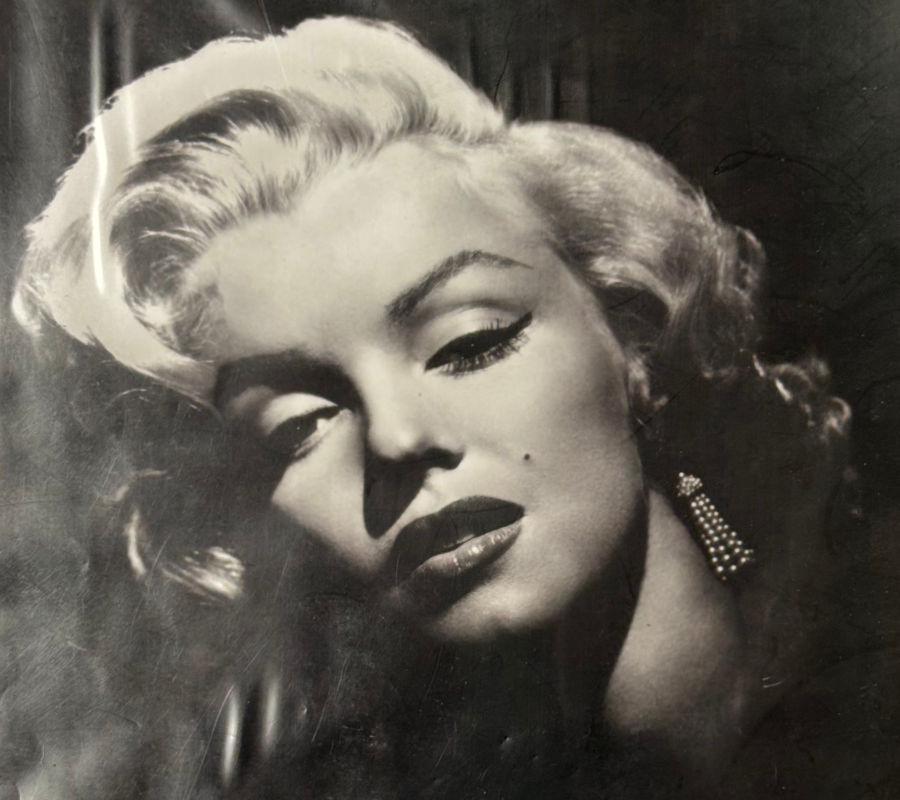


Actor / Singer
1930s through the 1970s
- He acted in over 100 Movies and TV Shows!
- He was also producer in about 50!
- In 1945 he won the Best Actor in a Leading Role Oscar for Going My Way! He was Father Chuck O'Malley! In the Bells of St. Mary's too!
- He was Jeff Peters in those Road movies with Bob Hope!
- He was Bob Wallace in White Christmas! He sang that song White Christmas!
- He made about 100s of record albums!
AKA
- Harry Lillis Crosby Jr.
Bing Crosby
Motion Pictures Category Star
- Ceremony was on February 8, 1960

Bing Crosby
Radio Category Star
- Ceremony was on February 8, 1960
Bing Crosby
Recording Category Star
- Ceremony was on February 8, 1960
Holiday Inn
⭐ ⭐ ⭐ ⭐ Bing Crosby plus 3 other Hollywood Walk of Famers!
- EAT LIFE:
[https://www.eatlife.net/movies/holiday-inn.php] - AMAZON PRIME VIDEO:
[https://www.amazon.com/dp/B00D5E5LPM] - BLU RAY AT AMAZON:
[https://www.amazon.com/dp/B00NV69K9W]
Going My Way
⭐ ⭐ ⭐ ⭐ ⭐ Bing Crosby plus 4 other Hollywood Walk of Famers!
- EAT LIFE:
[https://www.eatlife.net/movies/going-my-way.php] - AMAZON PRIME VIDEO:
[https://www.amazon.com/dp/B00D5UGJAC] - BLU RAY AT AMAZON:
[https://www.amazon.com/dp/B07T5WBHGX]
The Bells of St. Mary's
⭐ ⭐ ⭐ Bing Crosby plus 2 other Hollywood Walk of Famers!
- EAT LIFE:
[https://www.eatlife.net/movies/bells-of-st-marys.php] - AMAZON PRIME VIDEO:
[https://www.amazon.com/dp/B0B7CFHWKM] - MULTI FORMAT DISK AT AMAZON:
[https://www.amazon.com/dp/B00F6SHG5S]
White Christmas
Famous entertainer Army buddies meet a couple of sisters who are entertainers and they all travel to Vermont where the sisters' next show is and it just happens to be at an inn owned by the Army buddies' former General.
⭐ ⭐ ⭐ ⭐ ⭐ Bing Crosby plus 4 other Hollywood Walk of Famers!
- EAT LIFE:
[https://www.eatlife.net/movies/white-christmas.php] - AMAZON PRIME VIDEO:
[https://www.amazon.com/dp/B0C4VQH5H1] - BLU RAY AT AMAZON:
[https://www.amazon.com/dp/B00440CX9S]
The Frank Sinatra Show
Happy Holidays with Bing and Frank
⭐ ⭐ ⭐ Bing Crosby plus 2 other Hollywood Walk of Famers!
- EAT LIFE:
[https://www.eatlife.net/movies/happy-holidays-with-bing-and-frank.php] - AMAZON PRIME VIDEO:
[https://www.amazon.com/dp/B0CP4KLQBM] - DVD AT AMAZON:
[https://www.amazon.com/dp/B00009QGEG]
The Hollywood Palace
Bing Crosby Christmas Show
⭐ ⭐ Bing Crosby and another Hollywood Walk of Famer!
- EAT LIFE:
[https://www.eatlife.net/movies/hollywood-palace-bing-crosby-christmas-show.php] - AMAZON PRIME VIDEO:
[https://www.amazon.com/dp/B00ESFTNHO]
The Ed Sullivan Show
A Classic Christmas
⭐ ⭐ ⭐ ⭐ ⭐ ⭐ ⭐ ⭐ ⭐ ⭐ ⭐ ⭐ Bing Crosby plus 11 other Hollywood Walk of Famers! As an Amazon Associate we earn from qualifying purchases
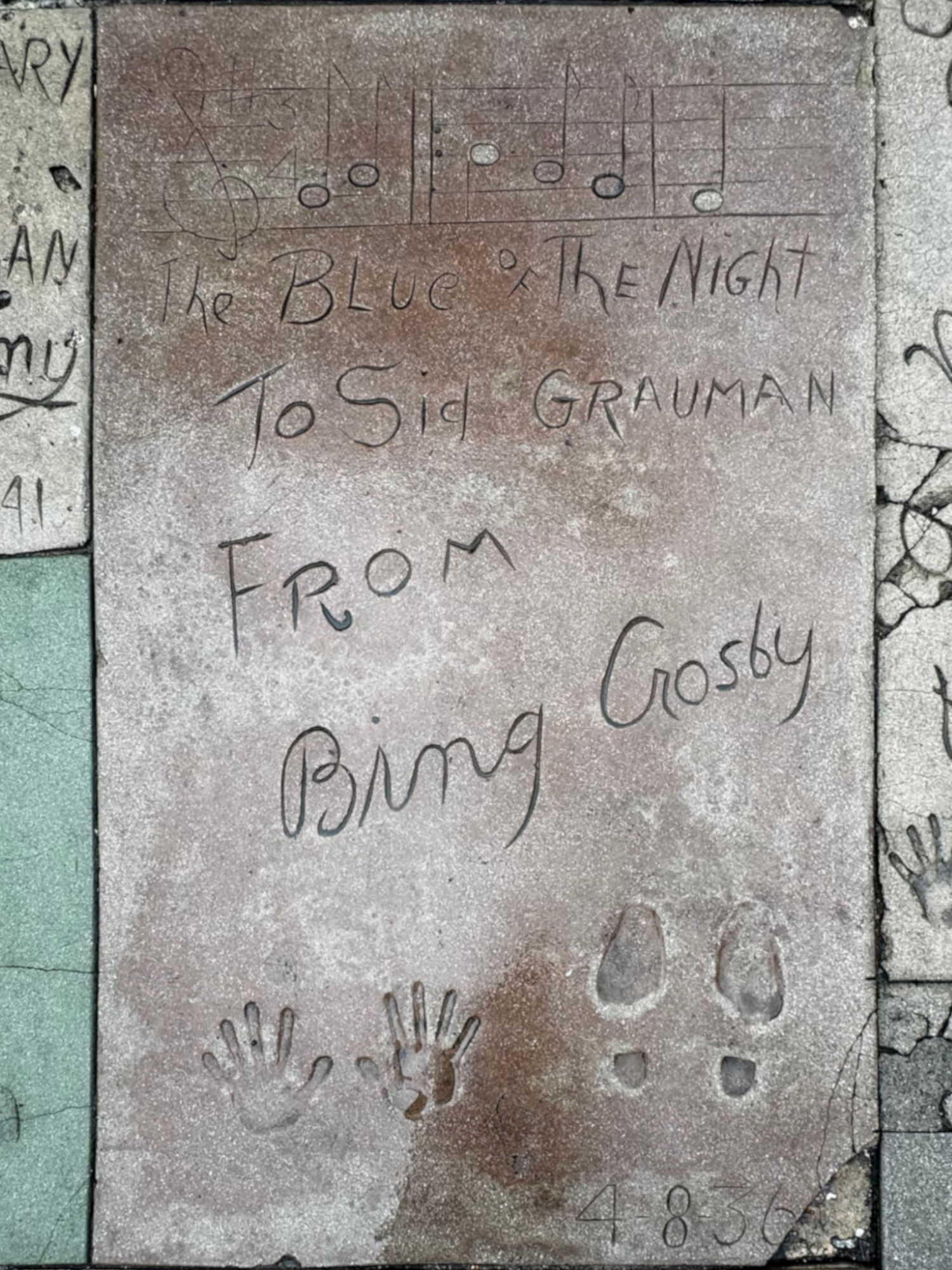
Grauman's Chinese Theatre
He drew music notes too
- *Music Notes*
- The Blue of The Night
- To Sid GRAUMAN
- FROM
- Bing Crosby
- *Handprints*
- *Footprints*
- 4-8-36
He drew the opening bars for Where the Blue of the Night (Meets the Gold of the Day)

Bing Crosby's Footprints
Right Side Middle


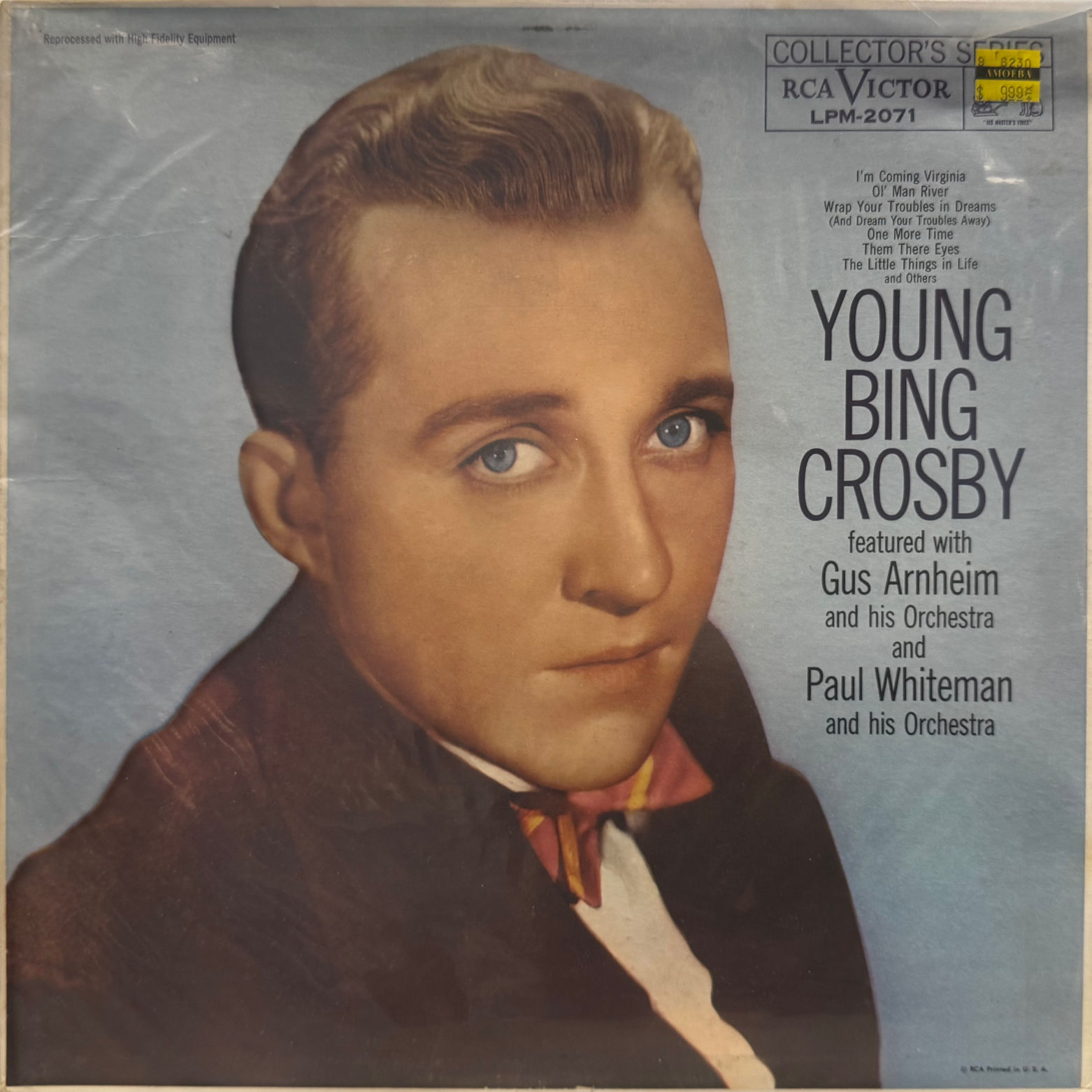
Young Bing Crosby
Featured with Gus Arnheim and his Orchestra and Paul Whiteman and his Orchestra
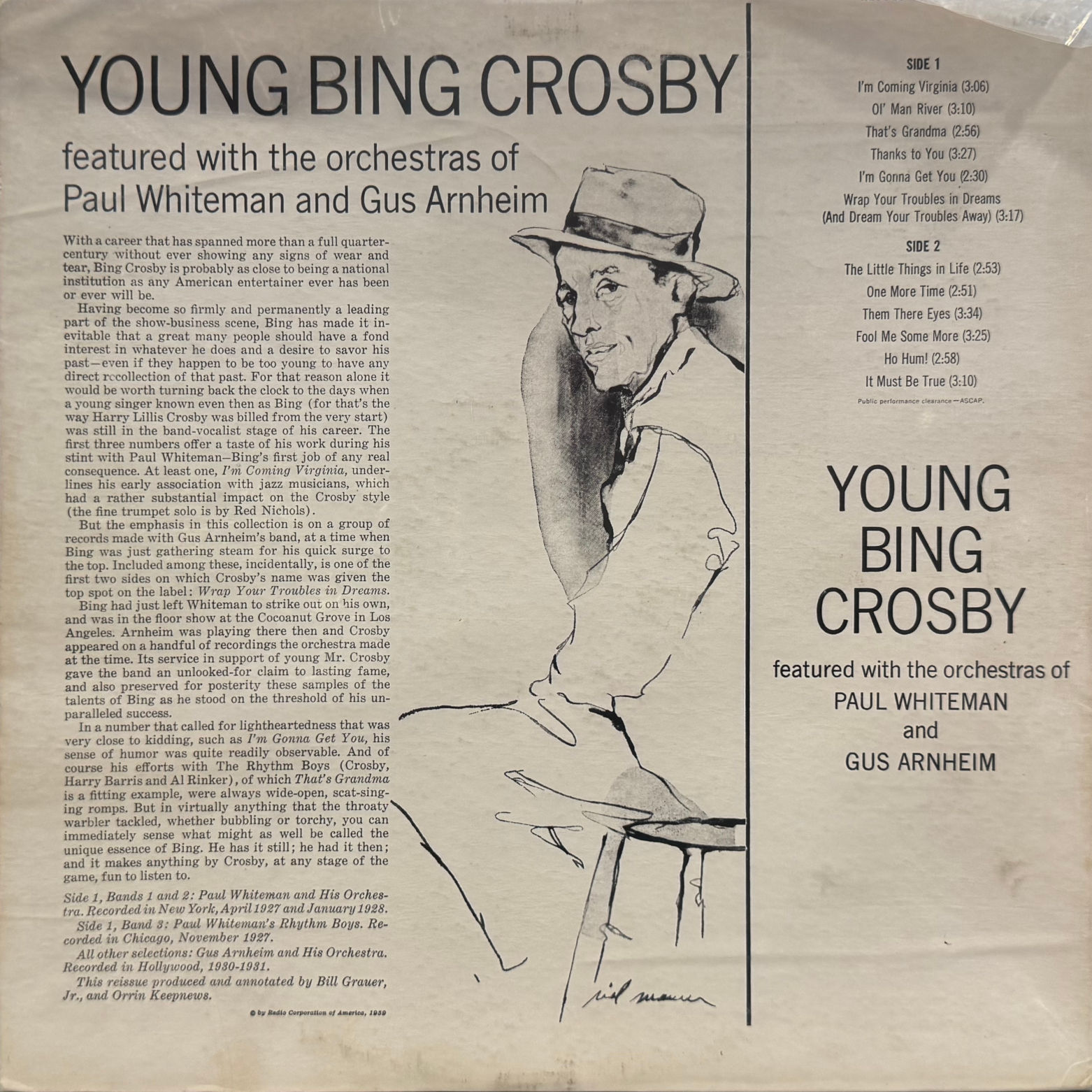
With a career that has spanned more than a full quarter-century without ever showing any signs of wear and tear, Bing Crosby is probably as close to being a national institution as any American entertainer ever has been or ever will be.
Having become so firmly and permanently a leading part of the show-business scene, Bing has made it inevitable that a great many people should have a fond interest in whatever he does and a desire to savor his past-even if they happen to be too young to have any direct recollection of that past. For that reason alone it would be worth turning back the clock to the days when a young singer known even then as Bing (for that's the way Harry Lillis Crosby was billed from the very start) was still in the band-vocalist stage of his career. The first three numbers offer a taste of his work during his stint with Paul Whiteman-Bing's first job of any real consequence. At least one, I'm Coming Virginia, underlines his early association with jazz musicians, which had a rather substantial impact on the Crosby style (the fine trumpet solo is by Red Nichols).
But the emphasis in this collection is on a group of records made with Gus Arnheim's band, at a time when Bing was just gathering steam for his quick surge to the top. Included among these, incidentally, is one of the first two sides on which Crosby's name was given the top spot on the label: Wrap Your Troubles in Dreams.
Bing had just left Whiteman to strike out on his own, and was in the floor show at the Cocoanut Grove in Los Angeles. Arnheim was playing there then and Crosby appeared on a handful of recordings the orchestra made at the time. Its service in support of young Mr. Crosby gave the band an unlooked-for claim to lasting fame, and also preserved for posterity these samples of the talents of Bing as he stood on the threshold of his unparalleled success.
In a number that called for lightheartedness that was very close to kidding, such as I'm Gonna Get You, his sense of humor was quite readily observable. And of course his efforts with The Rhythm Boys (Crosby, Harry Barris and Al Rinker), of which That's Grandma is a fitting example, were always wide-open, scat-sing-ing romps. But in virtually anything that the throaty warbler tackled, whether bubbling or torchy, you can immediately sense what might as well be called the unique essence of Bing. He has it still; he had it then; and it makes anything by Crosby, at any stage of the game, fun to listen to.
Side 1
- I'm Coming Virginia (3:06)
- Of Man River (3:10)
- Thanks to You (3:27)
- I'm Gonna Get You (2:30)
- Wrap Your Troubles in Dreams (and Dream Your Troubles Away) (3:17)
Side 2
- The Little Things in Life (2:53)
- One more Time (2:51)
- Them There Eyes (3:34)
- Fool Me Some more (3:25)
- Ho Hum! (2:58)
- It Must Be True (3:10)
As an Amazon Associate we earn from qualifying purchases
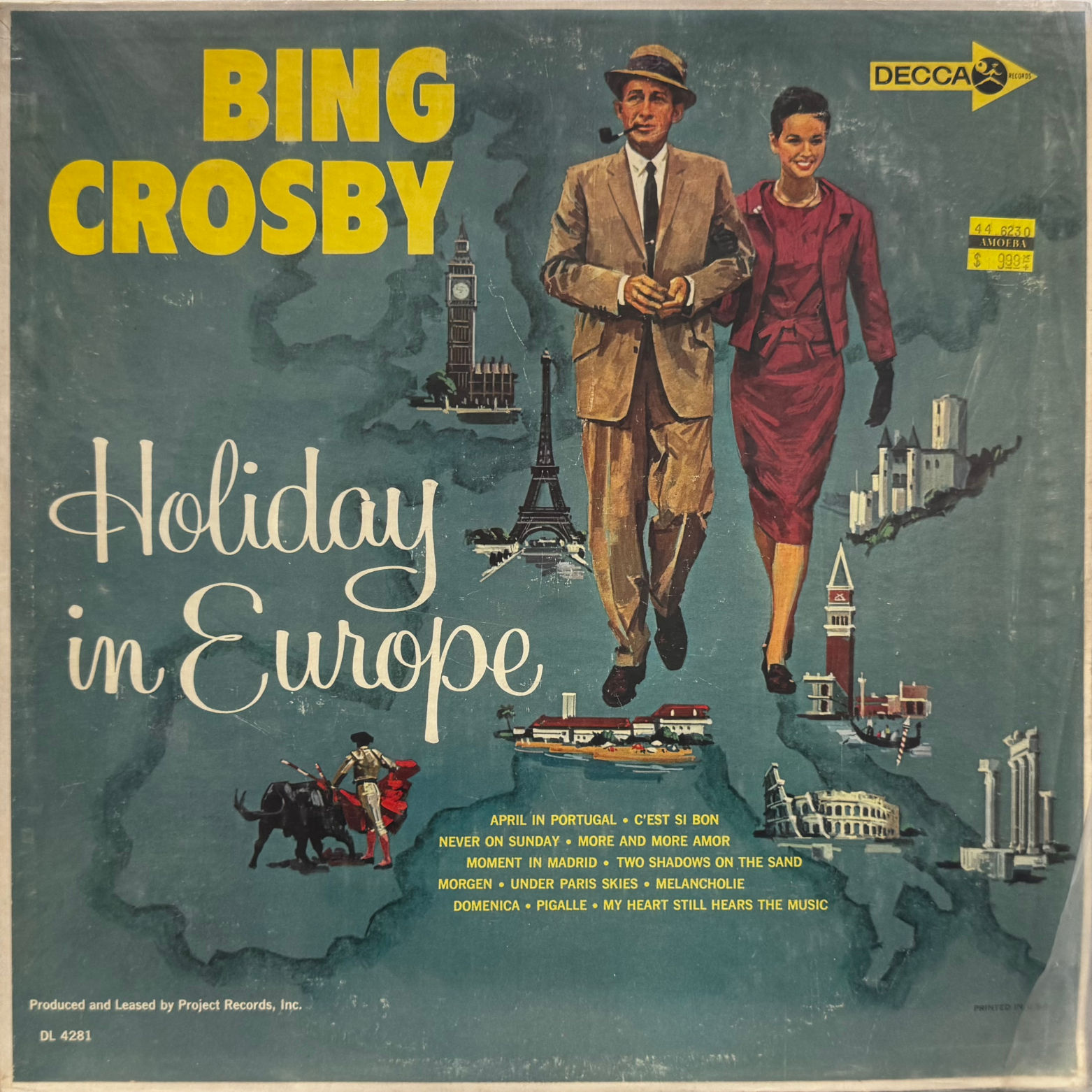
Holiday in Europe
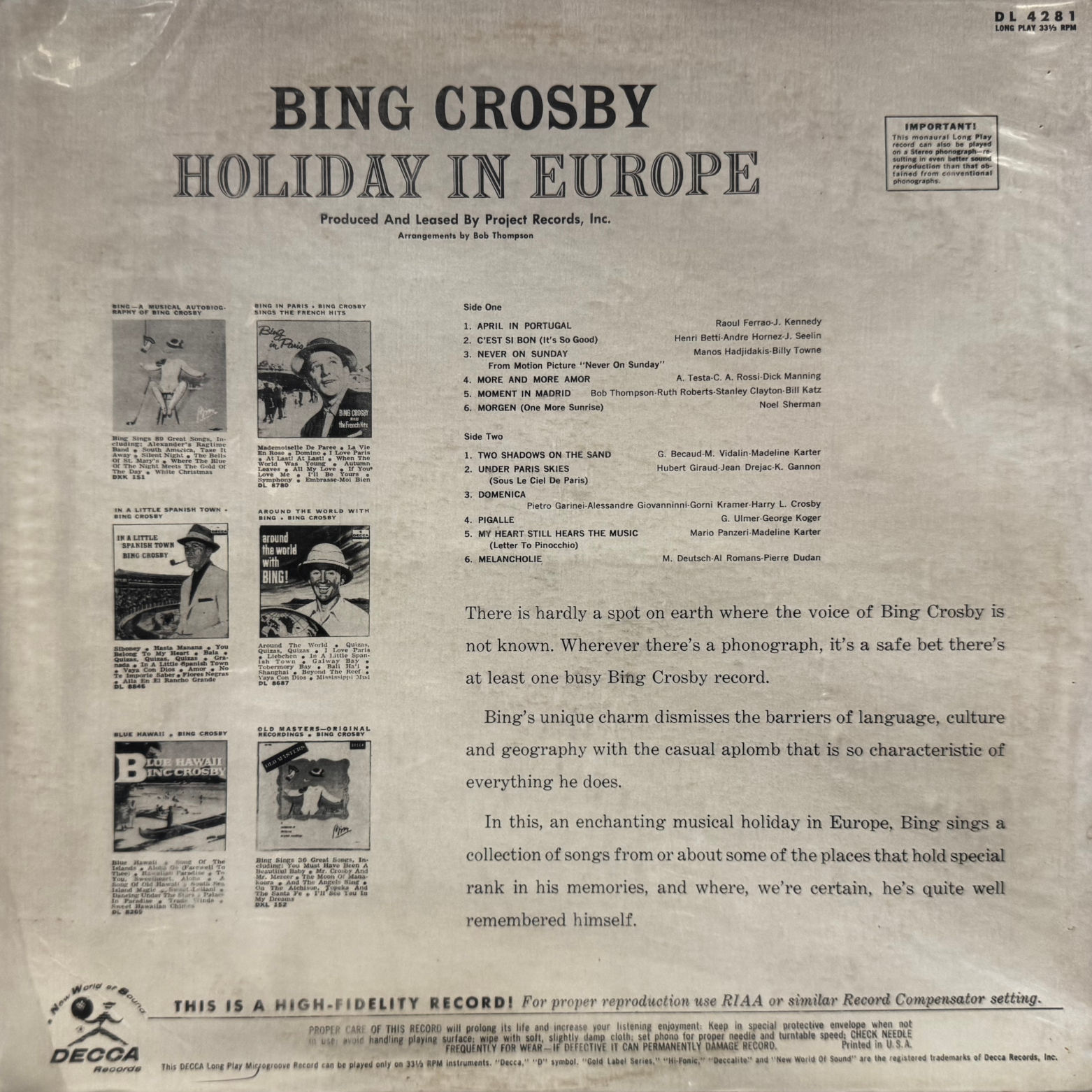
There is hardly a spot on earth where the voice of Bing Crosby is not known. Wherever there's a phonograph, it's a safe bet there's at least one busy Bing Crosby record.
Bing's unique charm dismisses the barriers of language, culture and geography with the casual aplomb that is so characteristic of everything he does.
In this, an enchanting musical holiday in Europe, Bing sings a collection of songs from or about some of the places that hold special rank in his memories, and where, we're certain, he's quite well remembered himself.
Side One
- April in Portugal
- C'est si bon (It's So Good)
- Never on Sunday
- More and More
- Moment in Madrid
- Morgen
Side Two
- Two Shadows on the Sand
- Under Paris Skies
- Domenica
- Pigalle
- A Letter to Pinocchio
- Melancholie
As an Amazon Associate we earn from qualifying purchases
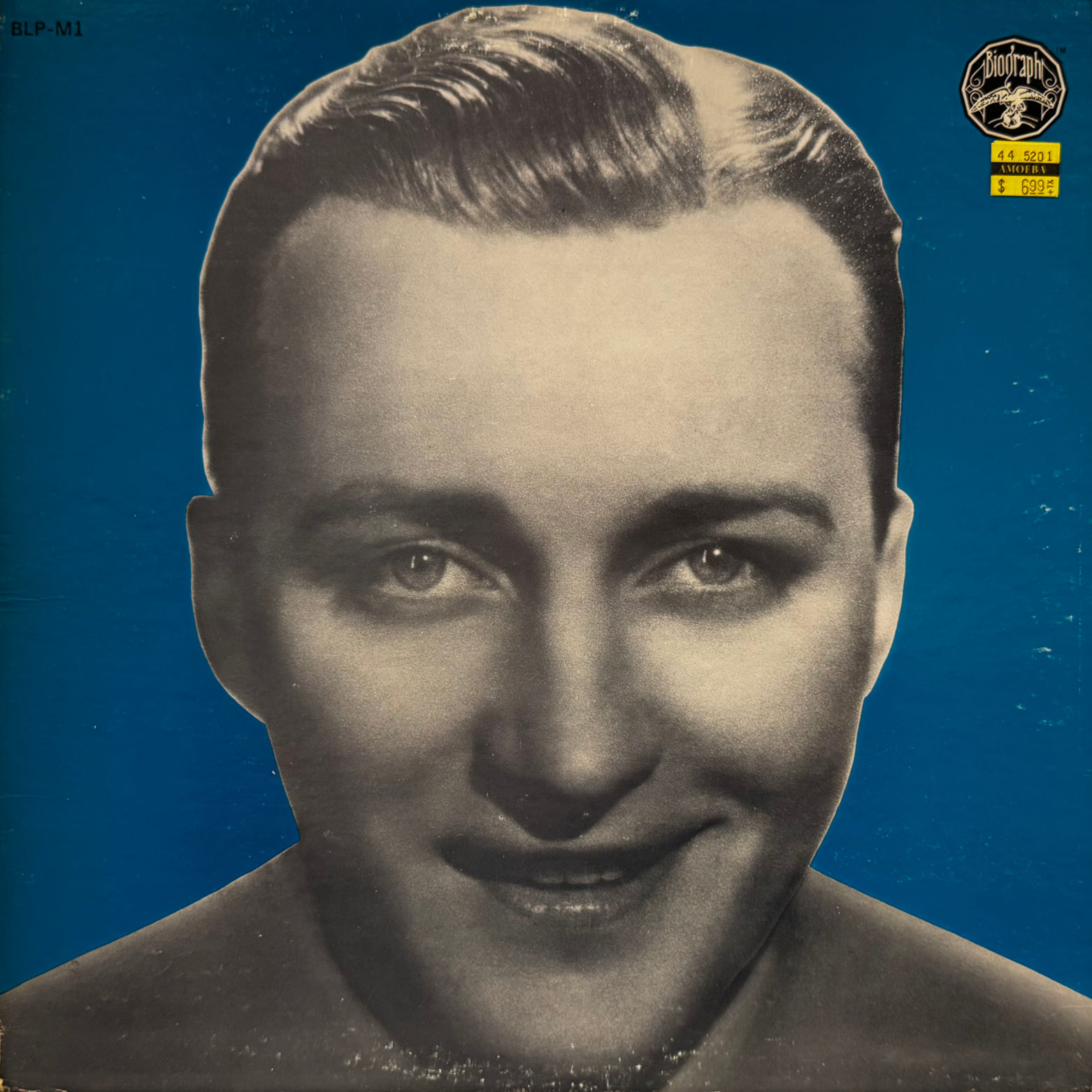
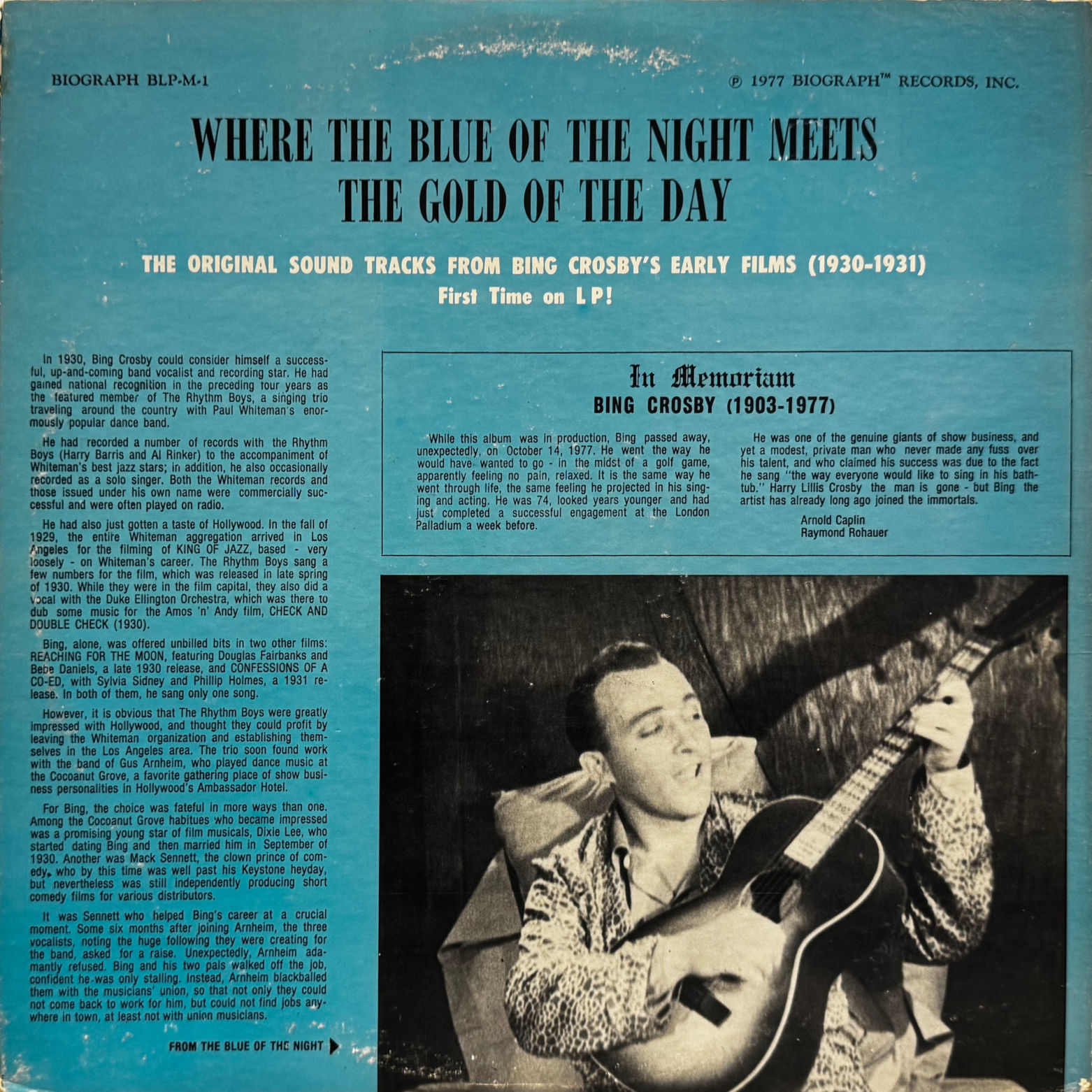
Where the Blue of the Night Meets the Gold of the Day
The original sound tracks from Bing Crosby's early films (1930-1031)
In 1930, Bing Crosby could consider himself a successful, up-and-coming band vocalist and recording star. He had gained national recognition in the preceding tour years as the featured member of The Rhythm Boys, a singing trio traveling around the country with Paul Whiteman's enormously popular dance band.
He had recorded a number of records with the Rhythm Boys (Harry Barris and Al Rinker) to the accompaniment of Whiteman's best jazz stars; in addition, he also occasionally recorded as a solo singer. Both the Whiteman records and those issued under his own name were commercially successful and were often played on radio.
He had also just gotten a taste of Hollywood. In the fall of 1929, the entire Whiteman aggregation arrived in Los Angeles for the filming of KING OF JAZZ, based - very loosely - on Whiteman's career. The Rhythm Boys sang a few numbers for the film, which was released in late spring of 1930. While they were in the film capital, they also did a vocal with the Duke Ellington Orchestra, which was there to dub some music for the Amos 'n' Andy film, CHECK AND DOUBLE CHECK (1930).
Bing, alone, was offered unbilled bits in two other films: REACHING FOR THE MOON, featuring Douglas Fairbanks and Bebe Daniels, a late 1930 release, and CONFESSIONS OF A CO-ED, with Sylvia Sidney and Phillips Holmes, a 1931 release. In both of them, he sang only one song.
However, it is obvious that The Rhythm Boys were greatly impressed with Hollywood, and thought they could profit by leaving the Whiteman organization and establishing themselves in the Los Angeles area. The trio soon found work with the band of Gus Arnheim, who played dance music at the Coconut Grove, a favorite gathering place of show business personalities in Hollywood's Ambassador Hotel.
For Bing, the choice was fateful in more ways than one. Among the Cocoanut Grove habitues who became impressed was a promising young star of film musicals, Dixie Lee, who started dating Bing and then married him in September of 1930. Another was Mack Sennett, the clown prince of comedy, who by this time was well past his Keystone heyday, but nevertheless was still independently producing short comedy films for various distributors.
It was Sennett who helped Bing's career at a crucial moment. Some six months after joining Arnheim, the three vocalists, noting the huge following they were creating for the band, asked for a raise. Unexpectedly, Arnheim adamantly refused. Bing and his two pals walked off the job, confident he was only stalling. Instead, Arnheim blackballed them with the musicians' union, so that not only they could not come back to work for him, but could not find jobs anywhere in town, at least not with union musicians.
BING CROSBY (1903-1977)
While this album was in production, Bing passed away, unexpectedly, on October 14, 1977. He went the way he would have wanted to gọ - in the midst of a golf game, apparently feeling no pain, relaxed. It is the same way he went through life, the same feeling he projected in his singing and acting. He was 74, looked years younger and had just completed a successful engagement at the London Palladium a week before.
He was one of the genuine giants of show business, and yet a modest, private man who never made any fuss over his talent, and who claimed his success was due to the fact he sang "the way everyone would like to sing in his bath-tub." Harry Lillis Crosby the man is gone - but Bing the artist has already long ago joined the immortals.
Arnold Caplin
Raymond Rohauer
As an Amazon Associate we earn from qualifying purchases
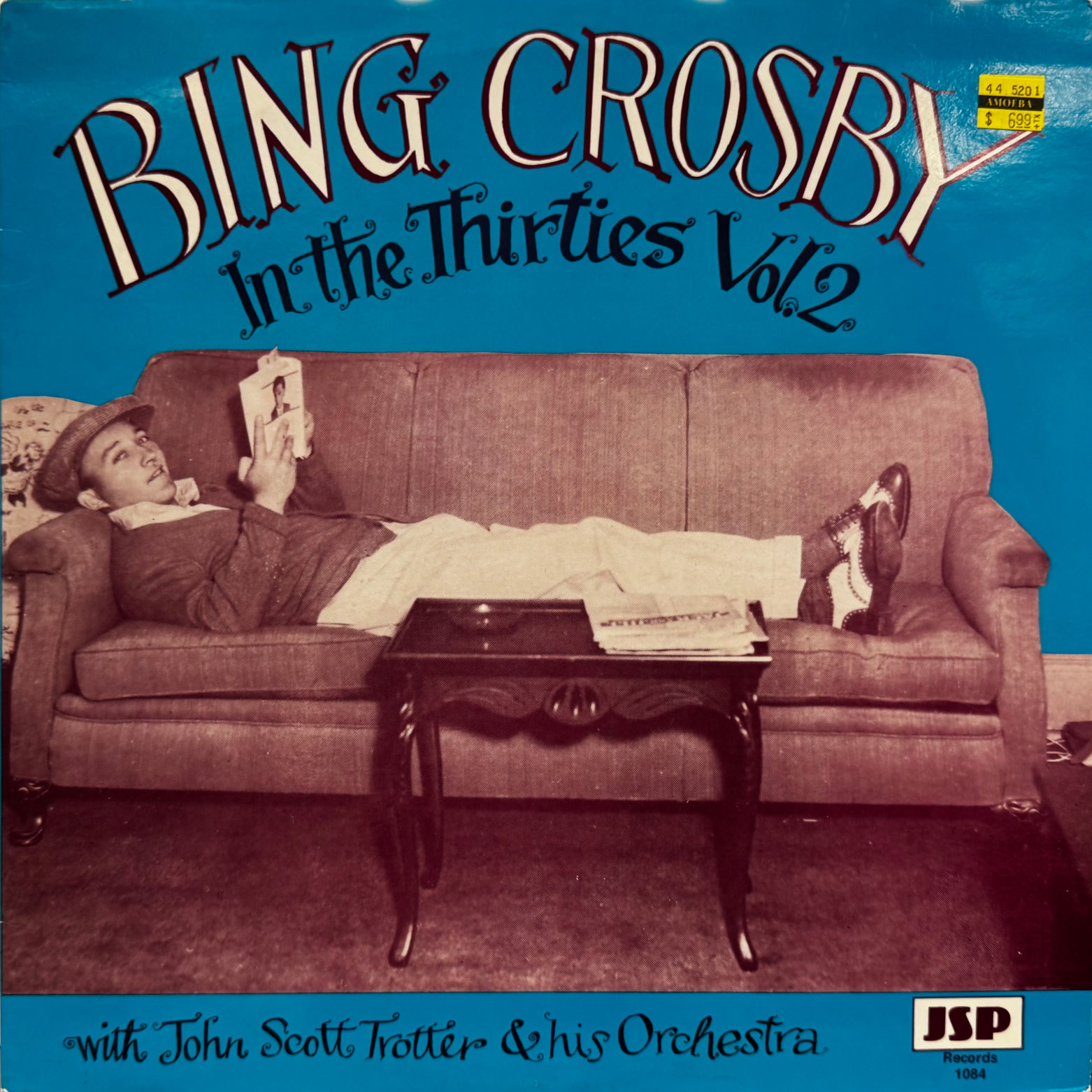
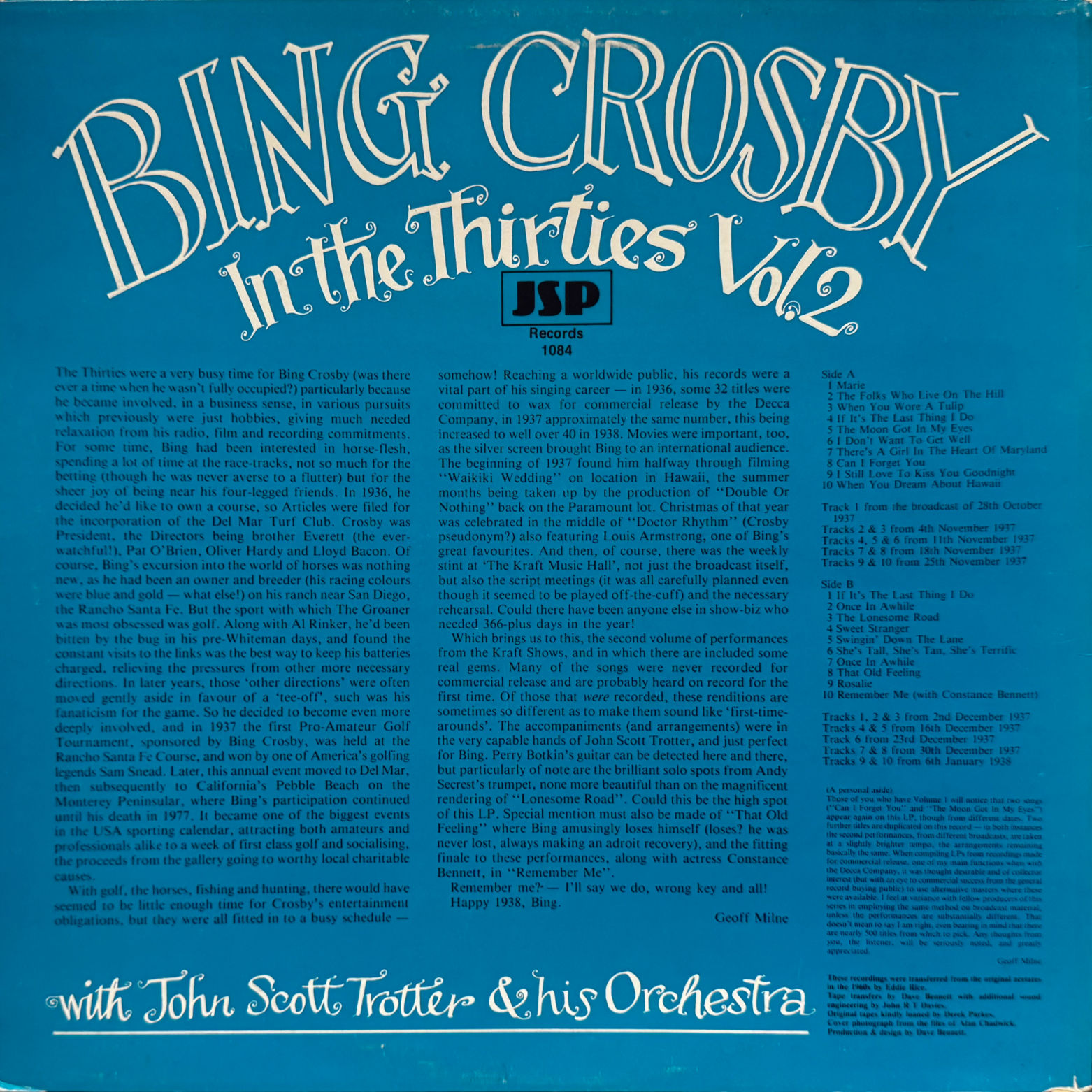
In the Thirties Vol 2
With John Scott Trotter & his Orchestra
The Thirties were a very busy time for Bing Crosby (was there ever a time when he wasn't fully occupied?) particularly because he became involved, in a business sense, in various pursuits which previously were just hobbies, giving much needed relaxation from his radio, film and recording commitments.
For some time, Bing had been interested in horse-flesh, spending a lot of time at the race-tracks, not so much for the betting (though he was never averse to a flutter) but for the sheer joy of being near his four-legged friends. In 1936, he decided he'd like to own a course, so Articles were filed for the incorporation of the Del Mar Turf Club. Crosby was President, the Directors being brother Everett (the ever-watchful!), Pat O'Brien, Oliver Hardy and Lloyd Bacon. Of course, Bing's excursion into the world of horses was nothing new, as he had been an owner and breeder (his racing colors were blue and gold — what else!) on his ranch near San Diego, the Rancho Santa Fe. But the sport with which The Groaner was most obsessed was golf. Along with Al Rinker, he'd been bitten by the bug in his pre-Whiteman days, and found the constant visits to the links was the best way to keep his batteries charged, relieving the pressures from other more necessary directions. In later years, those 'other directions' were often moved gently aside in favour of a 'tee-off, such was his fanaticism for the game. So he decided to become even more deeply involved, and in 1937 the first Pro-Amateur Golf Tournament, sponsored by Bing Crosby, was held at the Rancho Santa Fe Course, and won by one of America's golfing legends Sam Snead. Later, this annual event moved to Del Mar, then subsequently to California's Pebble Beach on the Monterey Peninsular, where Bing's participation continued until his death in 1977. It became one of the biggest events in the USA sporting calendar, attracting both amateurs and professionals alike to a week of first class golf and socializing, the proceeds from the gallery going to worthy local charitable causes.
With golf, the horses, fishing and hunting, there would have seemed to be little enough time for Crosby's entertainment obligations, but they were all fitted in to a busy schedule - somehow! Reaching a worldwide public, his records were a vital part of his singing career — in 1936, some 32 titles were committed to wax for commercial release by the Decca Company, in 1937 approximately the same number, this being increased to well over 40 in 1938. Movies were important, too, as the silver screen brought Bing to an international audience.
The beginning of 1937 found him halfway through filming "Waikiki Wedding" on location in Hawaii, the summer months being taken up by the production of "Double Or Nothing" back on the Paramount lot. Christmas of that year was celebrated in the middle of "Doctor Rhythm" (Crosby pseudonym?) also featuring Louis Armstrong, one of Bing's great favorites. And then, of course, there was the weekly stint at 'The Kraft Music Hall', not just the broadcast itself, but also the script meetings (it was all carefully planned even though it seemed to be played off-the-cuff) and the necessary rehearsal. Could there have been anyone else in show-biz who needed 366-plus days in the year!
Which brings us to this, the second volume of performances from the Kraft Shows, and in which there are included some real gems. Many of the songs were never recorded for commercial release and are probably heard on record for the first time. Of those that were recorded, these renditions are sometimes so different as to make them sound like 'first-time-arounds'. The accompaniments (and arrangements) were in the very capable hands of John Scott Trotter, and just perfect for Bing. Perry Botkin's guitar can be detected here and there, but particularly of note are the brilliant solo spots from Andy Secrest's trumpet, none more beautiful than on the magnificent rendering of "Lonesome Road". Could this be the high spot of this LP. Special mention must also be made of "That Old Feeling" where Bing amusingly loses himself (loses? he was never lost, always making an adroit recovery, and the fitting finale to these performances, along with actress Constance Bennett, in "Remember Me".
Remember me? - I'll say we do, wrong key and all!
Happy 1938, Bing.
Geoff Milne
Side A
- 1 Marie
- 2 The Folks Who Live on The Hill
- 3 When You Wore a Tulip
- 4 If It's The Last Thing I Do
- 5 The Moon Got in My Eyes
- 6 I Don't Want to Get Well
- 7 There's a Gil in The Heart of Maryland
- 8 Can I Forget You
- 9 I Still Love to Kiss You Goodnight
- 10 When You Dream About Hawaii
Side B
- 1 If It's The Last Thing I Do
- 2 Once in Awhile
- 3 The Lonesome Road
- 4 Sweet Stranger
- 5 Swingin' Down The Lane
- 6 She's Tall, She's Tan, She's Terrific
- 7 Once in Awhile
- 8 That Old Feeling
- 9 Rosalie
- 10 Remember Me (with Constance Bennett)
As an Amazon Associate we earn from qualifying purchases
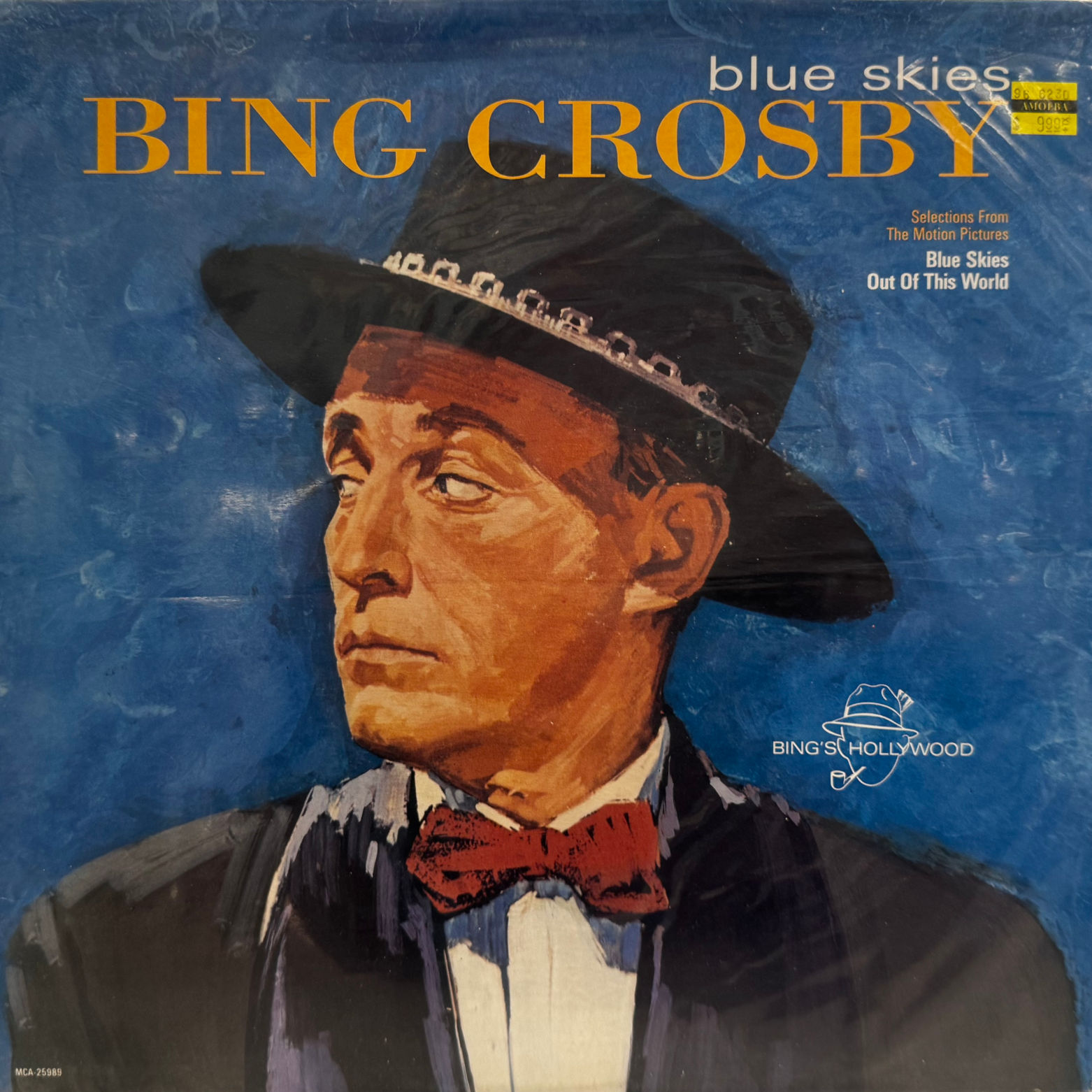
Blue Skies
Selections From The Motion Pictures
Blue Skies
Out of this World
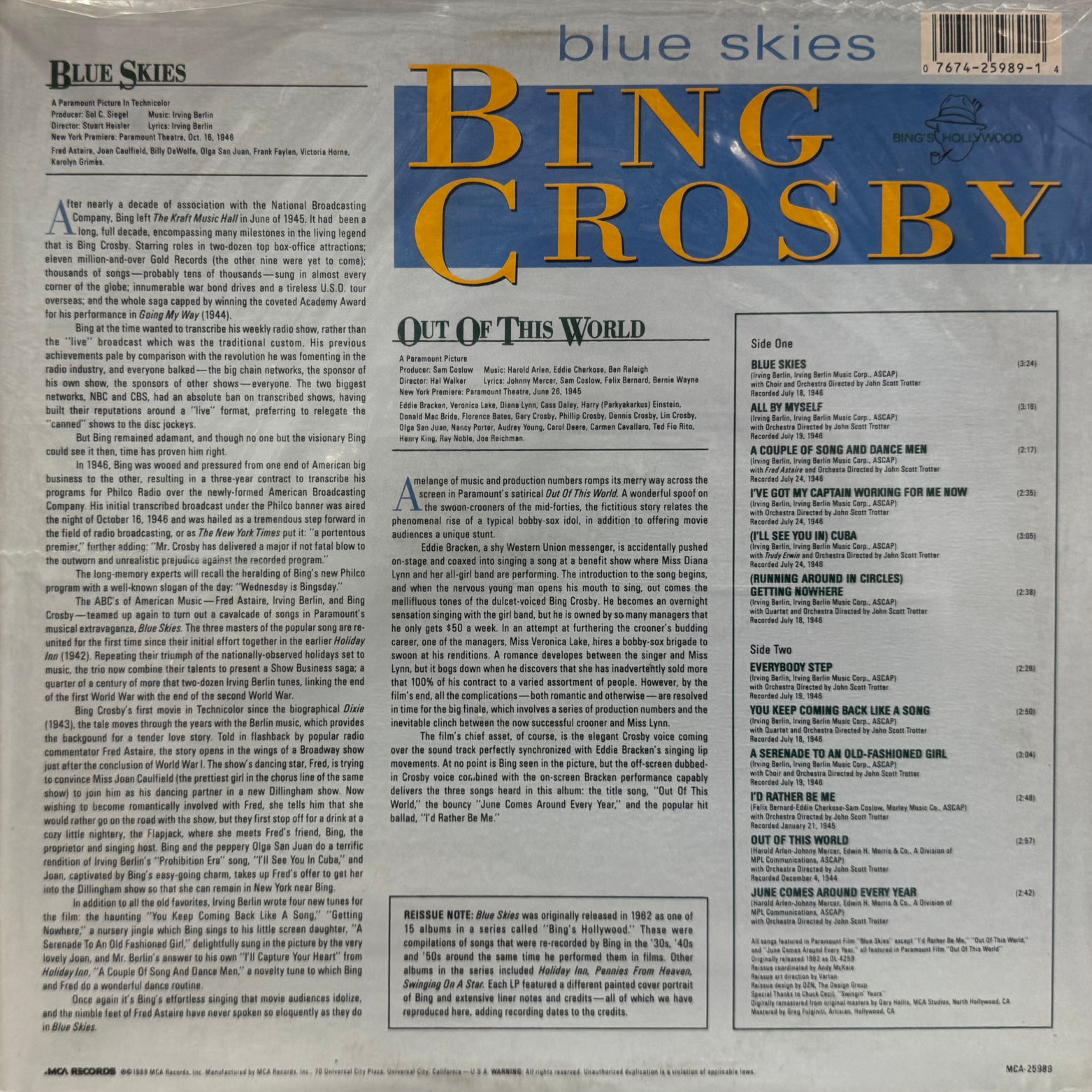
After nearly a decade of association with the National Broadcasting Company, Bing left The Kraft Music Hall in June of 1945. It had been a long, full decade, encompassing many milestones in the living legend that is Bing Crosby. Starring roles in two-dozen top box-office attractions; eleven million-and-over Gold Records (the other nine were yet to come); thousands of songs-probably tens of thousands-sung in almost every corner of the globe; innumerable war bond drives and a tireless U.S.O. tour overseas; and the whole saga capped by winning the coveted Academy Award for his performance in Going My Way (1944).
Bing at the time wanted to transcribe his weekly radio show, rather than the "live" broadcast which was the traditional custom. His previous achievements pale by comparison with the revolution he was fomenting in the radio industry, and everyone balked -the big chain networks, the sponsor of his own show, the sponsors of other shows-everyone. The two biggest networks, NBC and CBS, had an absolute ban on transcribed shows, having built their reputations around a "live" format, preferring to relegate the "canned" shows to the disc jockeys.
But Bing remained adamant, and though no one but the visionary Bing could see it then, time has proven him right.
In 1946, Bing was wooed and pressured from one end of American big business to the other, resulting in a three-year contract to transcribe his programs for Philco Radio over the newly-formed American Broadcasting Company. His initial transcribed broadcast under the Philco banner was aired the night of October 16, 1946 and was hailed as a tremendous step forward in the field of radio broadcasting, or as The New York Times put it: "a portentous premier" further adding: "Mr. Crosby has delivered a major if not fatal blow to the outworn and unrealistic prejudice against the recorded program."
The long-memory experts will recall the heralding of Bing's new Philco program with a well-known slogan of the day: "Wednesday is Bingsday."
The ABC's of American Music- Fred Astaire, Irving Berlin, and Bing Crosby - teamed up again to turn out a cavalcade of songs in Paramount's musical extravaganza, Blue Skies. The three masters of the popular song are reunited for the first time since their initial effort together in the earlier Holiday Inn (1942). Repeating their triumph of the nationally-observed holidays set to music, the trio now combine their talents to present a Show Business saga; a quarter of a century of more that two-dozen Irving Berlin tunes, linking the end of the first World War with the end of the second World War.
Bing Crosby's first movie in Technicolor since the biographical Dixie (1943), the tale moves through the years with the Berlin music, which provides the background for a tender love story. Told in flashback by popular radio commentator Fred Astaire, the story opens in the wings of a Broadway show just after the conclusion of World War I. The show's dancing star, Fred, is trying to convince Miss Joan Caulfield (the prettiest girl in the chorus line of the same show) to join him as his dancing partner in a new Dillingham show. Now wishing to become romantically involved with Fred, she tells him that she would rather go on the road with the show, but they first stop off for a drink at a cozy little nightery, the Flapjack, where she meets Fred's friend, Bing, the proprietor and singing host. Bing and the peppery Olga San Juan do a terrific rendition of Irving Berlin's "Prohibition Era" song, "I'll See You In Cuba," and Joan, captivated by Bing's easy-going charm, takes up Fred's offer to get her into the Dillingham show so that she can remain in New York near Bing.
In addition to all the old favorites, Irving Berlin wrote four new tunes for the film: the haunting "You Keep Coming Back Like A Song." "Getting Nowhere," a nursery jingle which Bing sings to his little screen daughter, "A Serenade To An Old Fashioned Girl," delightfully sung in the picture by the very lovely Joan, and Mr. Berlin's answer to his own "Fll Capture Your Heart" from Holiday Inn, "A Couple Of Song And Dance Men," a novelty tune to which Bing and Fred do a wonderful dance routine.
Once again it's Bing's effortless singing that movie audiences idolize, and the nimble feet of Fred Astaire have never spoken so eloquently as they do in Blue Skies.
A melange of music and production numbers romps its merry way across the screen in Paramount's satirical Out Of This World. A wonderful spoof on the swoon-crooners of the mid-forties, the fictitious story relates the phenomenal rise of a typical bobby-sox idol, in addition to offering movie audiences a unique stunt.
Eddie Bracken, a shy Western Union messenger, is accidentally pushed on-stage and coaxed into singing a song at a benefit show where Miss Diana Lynn and her all-girl band are performing. The introduction to the song begins, and when the nervous young man opens his mouth to sing, out comes the mellifluous tones of the dulcet-voiced Bing Crosby. He becomes an overnight sensation singing with the girl band, but he is owned by so many managers that he only gets $50 a week. In an attempt at furthering the crooner's budding career, one of the managers, Miss Veronica Lake, hires a bobby-sox brigade to swoon at his renditions. A romance develops between the singer and Miss Lynn, but it bogs down when he discovers that she has inadvertently sold more that 100% of his contract to a varied assortment of people. However, by the film's end, all the complications - both romantic and otherwise are resolved in time for the big finale, which involves a series of production numbers and the inevitable clinch between the now successful crooner and Miss Lynn.
The film's chief asset, of course, is the elegant Crosby voice coming over the sound track perfectly synchronized with Eddie Bracken's singing lip movements. At no point is Bing seen in the picture, but the off-screen dubbed-in Crosby voice combined with the on-screen Bracken performance capably delivers the three songs heard in this album: the title song, "Out Of This World," the bouncy "June Comes Around Every Year," and the popular hit ballad, "I'd Rather Be Me."
Side A
- 1 Blue Skies 3:24
- 2 All By Myself 3:18
- 3 A Couple of Song and Dance Men (feat. Fred Astaire) 2:17
- 4 I've Got My Captain Working For Me Now 2:35
- 5 (I'll See You In) Cuba [feat. Trudy Erwin] 3:05
- 6 (Running Around in Circles) Getting Nowhere 2:38
Side B
- 7 Everybody Step 2:26
- 8 You Keep Coming Back Like a Song 2:50
- 9 A Serenade to an Old-Fashioned Girl 3:04
- 10 I'd Rather Be Me 2:48
- 11 Out of This World 2:57
- 12 June Comes Around Every Year 2:42
Blue Skies was originally released in 1962 as one of 15 albums in a series called "Bing's Hollywood." These were compilations of songs that were re-recorded by Bing in the '30s. and '50s around the same time he performed them in films. Other albums in the series included Holiday Ian, Pennies From Heaven. Swinging on a Star. Each LP featured a different painted cover portrait of Bing and extensive liner notes and credits - all of which we have reproduced here, adding recording dates to the credits.
- YOUTUBE:
[https://www.youtube.com/watch?v=RiWS5gibtks&list=PLd82...] - SPOTIFY:
[https://open.spotify.com/album/1eP8vLIPbvSKy08tT5jTHy] - APPLE MUSIC:
[https://music.apple.com/us/album/1478970377] - AMAZON:
[https://www.amazon.com/dp/B07XFJ7RN9]
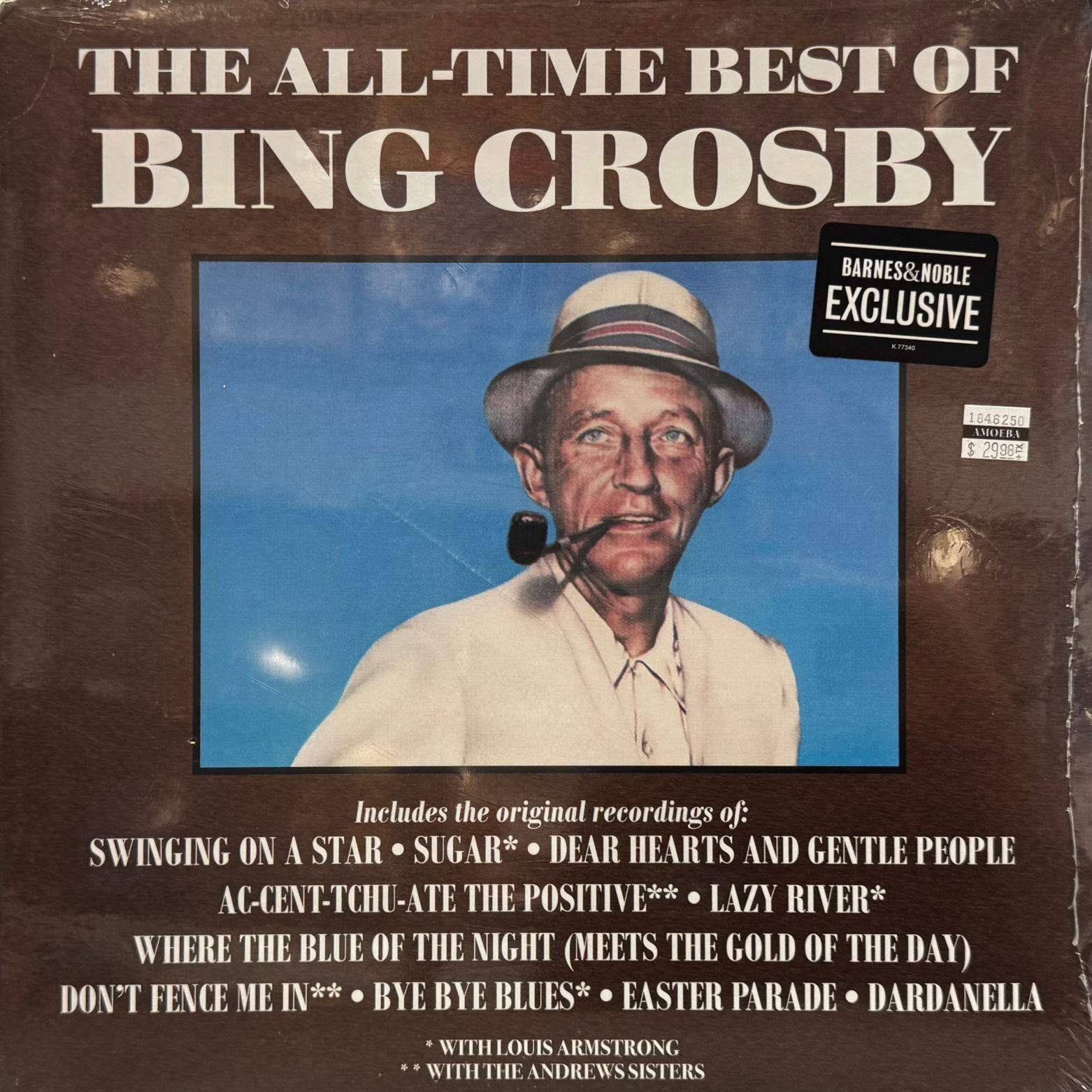
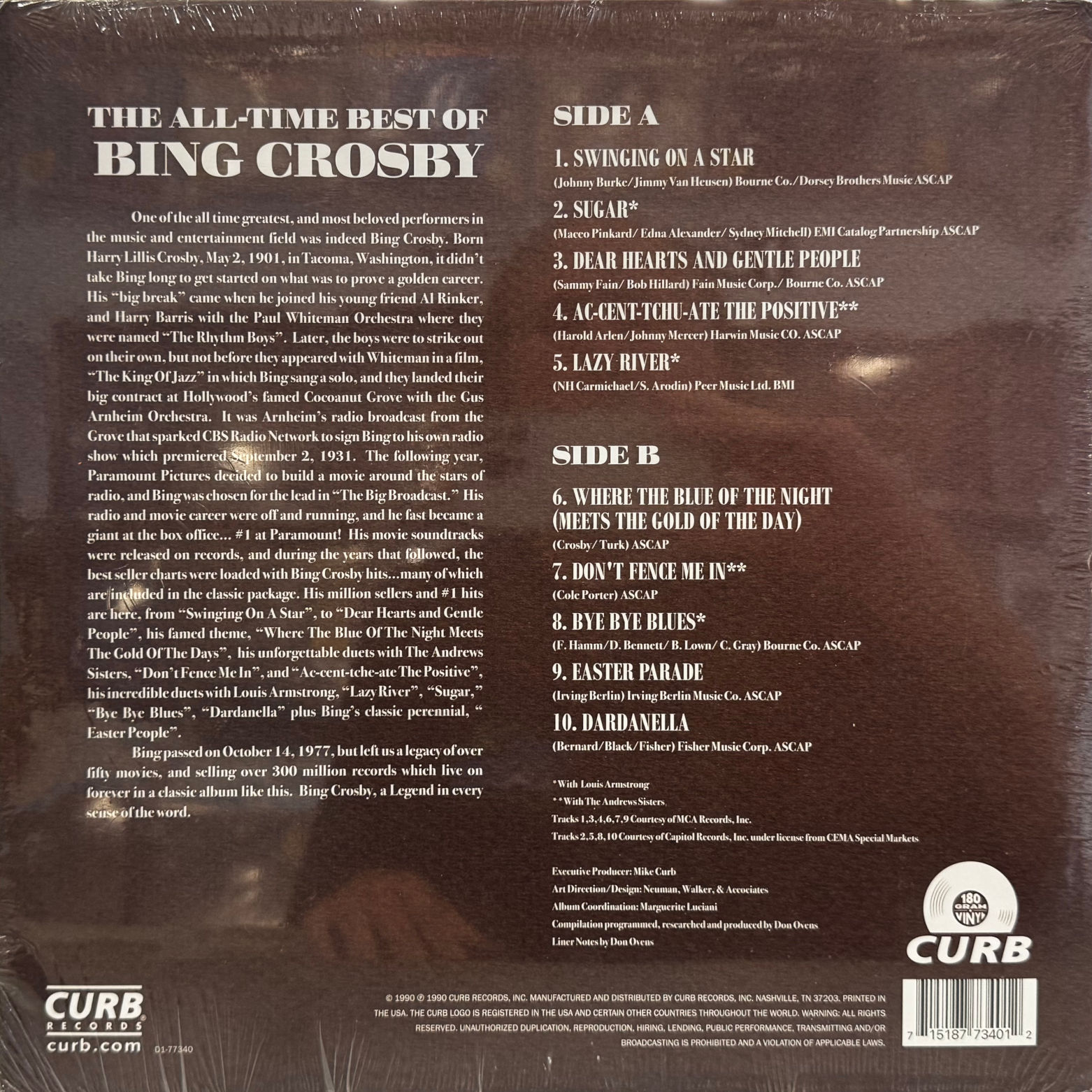
The All-Time Best of Bing Crosby
One of the all time greatest, and most beloved performers in the mousic and entertainment field was indeed Bing Crosby. Born Harry Lillis Crosby, May 2, 1901, in Tacoma, Washington, it didn't take Bing long to get started on what was to prove a golden career.
His "big break" came when he joined his young friend Al Rinker, and Harry Barris with the Paul Whiteman Orchestra where they were named "The Rhythm Boys". Later, the boys were to strike out on their own, but not before they appeared with Whiteman in a film, "The King Of Jazz" in which Bing sang a solo, and they landed their big contract at Hollywood's famed Cocoanut Grove with the Gus Arnheim Orchestra. It was Arnheim's radio broadcast from the Grove that sparked CBS Radio Network to sign Bing to his own radio show which premiered September 2, 1931.
The following year, Paramount Pictures decided to build a movie around the stars of radio, and Bing was chosen for the lead in "The Big Broadeast."
His radio and movie career were off and running, and he fast became a giant at the box office... #1 at Paramount!
His movie soundtracks were released on records, and during the years that followed, the best seller charts were loaded with Bing Crosby hits...many of which are included in the classic package. His million sellers and #1 hits are here, from "Swinging On A Star", to "Dear Hearts and Gentle People", his famed theme, "Where The Blue Of The Night Meets The Gold Of The Days", his unforgettable duets with The Andrews Sisters, "Don't Fence Me In", and "Ac-cent-tche-ate The Positive" his incredible duets with Louis Armstrong, "Lazy River", "Sugar," "Bye Bye Blues", "Dardanella" plus Bing's classic perennial, "Easter People".
Bing passed on October 14, 1977, but left us a legacy of over fifty movies, and selling over 300 million records which live on forever in a classic album like this, Bing Crosby, a Legend in every sense of the word.
Side A
- 1. Swinging on a Star
- 2. Sugar
- 3. Dear Hearts and Gentle People
- 4. Ac-Cent-Tchu-Ate the Positive
- 5. Lazy River
Side B
- 6. Where The Blue of the Night (Meets the Gold of the Day)
- 7. Don't Fence Me In
- 8. Bye Bye Blues
- 9. Easter Parade
- 10. Dardanella
- SPOTIFY:
[https://open.spotify.com/album/4H5XP98kf4ii3wCvUVWSzS] - APPLE MUSIC:
[https://music.apple.com/us/album/1799562325] - AMAZON:
[https://www.amazon.com/dp/B00V0GUDZU]