

The Chairman of the Board
1940s through the 1980s
- He was in about 75 Movies and TV Shows and made about 75 Record Albums!
- He was Major Bennett Marco in The Manchurian Candidate!
- He sang My Way!
- He was Danny Ocean in Ocean's Eleven!
- He sang New York New York!
- He was Nathan Detroit in Guys and Dolls!
- He sang Fly Me to the Moon!
- He was Clarence Doolittle in Anchors Aweigh!
- He sang Strangers in the Night!
- In 1954 he won the Best Actor in a Supporting Role Oscar for From Here to Eternity!
- He sang That's Life!
- In 1971 he won the Jean Hersholt Humanitarian Award Oscar!
- He sang I've Got You Under My Skin!
AKA
- Francis Albert Sinatra
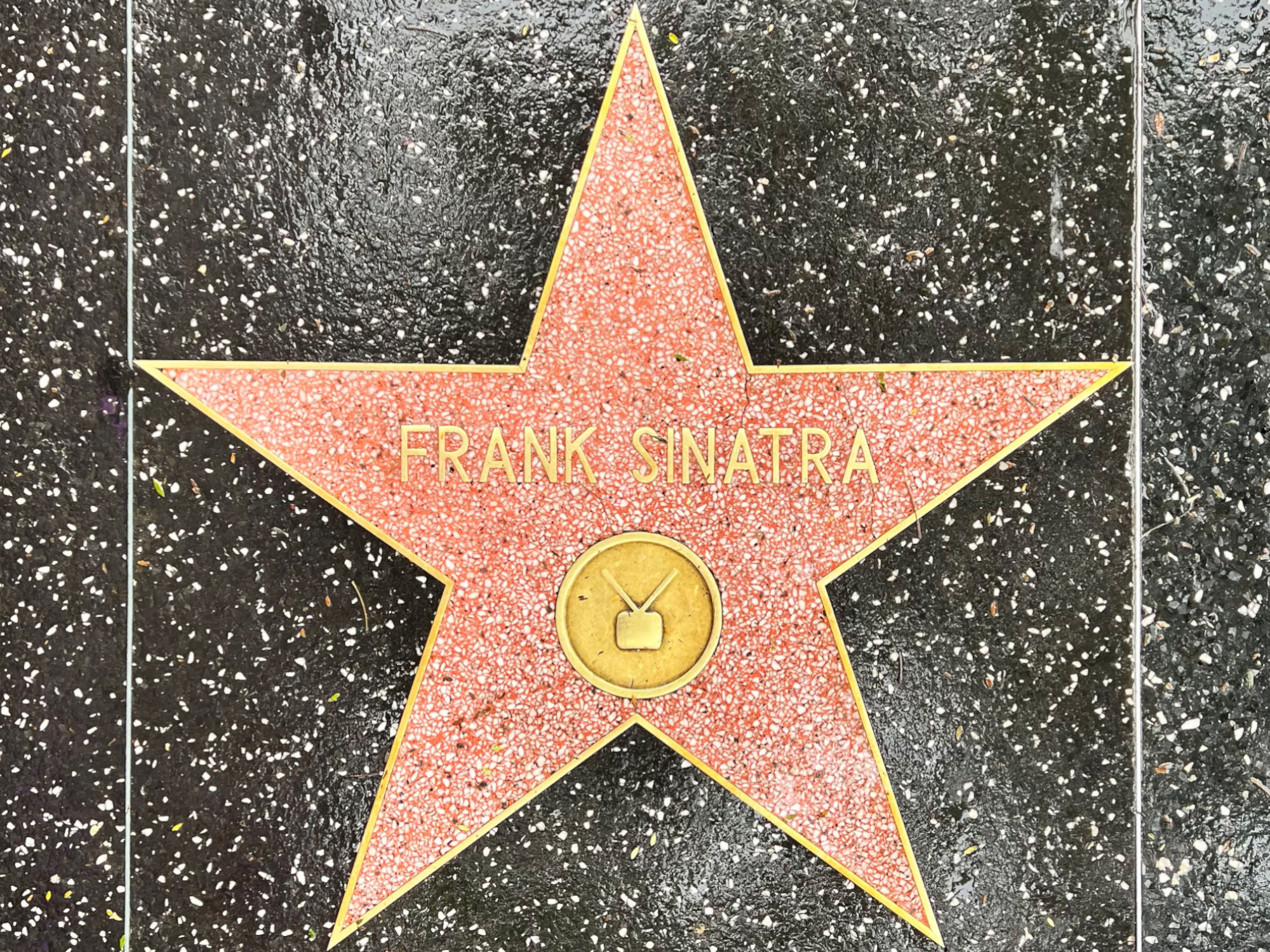
Frank Sinatra
Motion Pictures Category Star
- Ceremony was on February 8, 1960

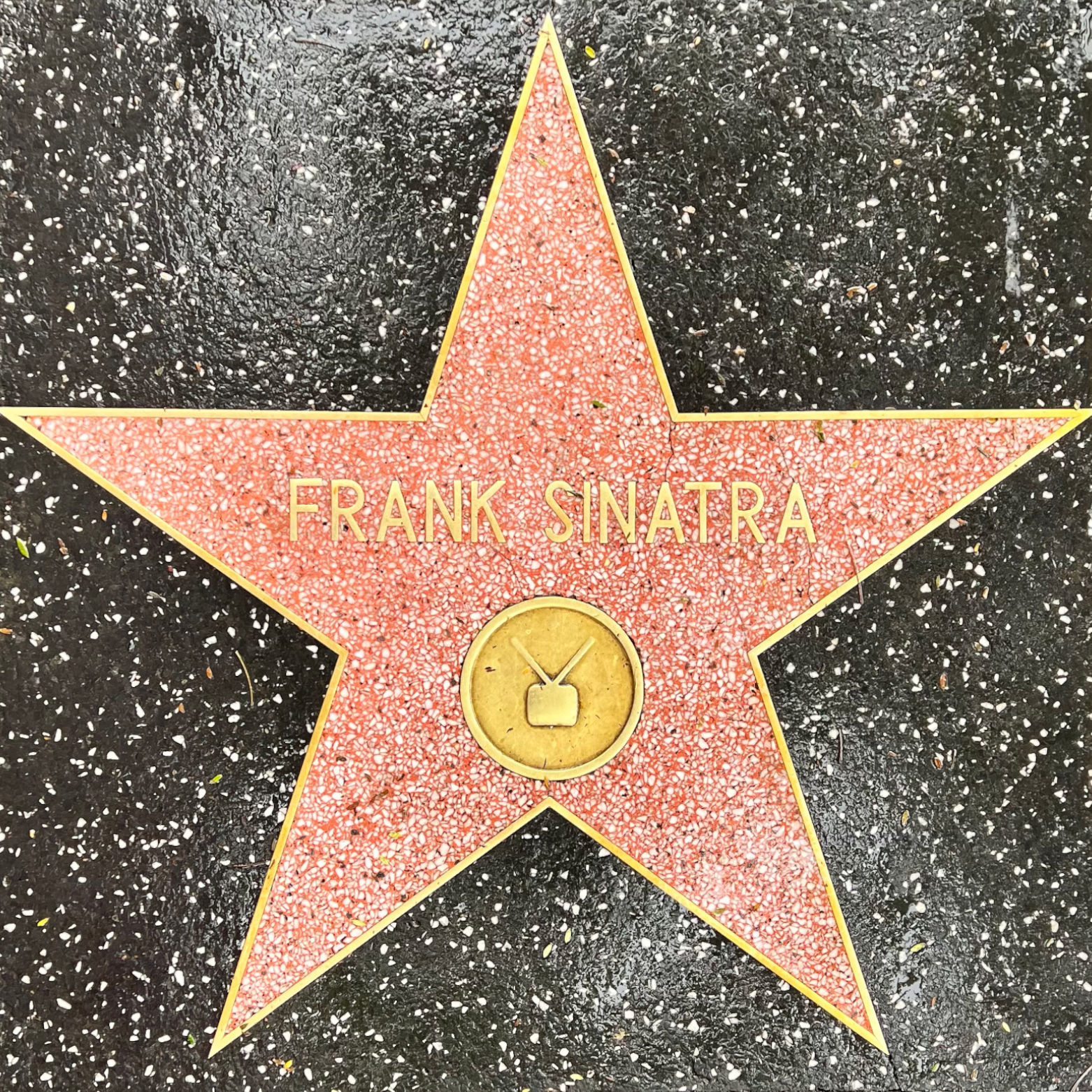
Frank Sinatra
Television Category Star
- Ceremony was on February 8, 1960
Frank Sinatra
Recording Category Star
- Ceremony was on February 8, 1960
From Here to Eternity
⭐ ⭐ ⭐ ⭐ ⭐ ⭐ ⭐ Frank Sinatra plus 6 other Hollywood Walk of Famers!
- EAT LIFE:
[https://www.eatlife.net/movies/from-here-to-eternity.php] - AMAZON PRIME VIDEO:
[https://www.amazon.com/video/detail/amzn1.dv.gti.20aa7790-616d-dc71-e316-22e4ec1abb6a] - BLU RAY AT AMAZON:
[https://www.amazon.com/dp/B00E21QTL2]
The Frank Sinatra Show
Happy Holidays with Bing and Frank
⭐ ⭐ ⭐ Frank Sinatra plus 2 other Hollywood Walk of Famers!
- EAT LIFE:
[https://www.eatlife.net/movies/happy-holidays-with-bing-and-frank.php] - AMAZON PRIME VIDEO:
[https://www.amazon.com/dp/B0CP4KLQBM] - DVD AT AMAZON:
[https://www.amazon.com/dp/B00009QGEG]
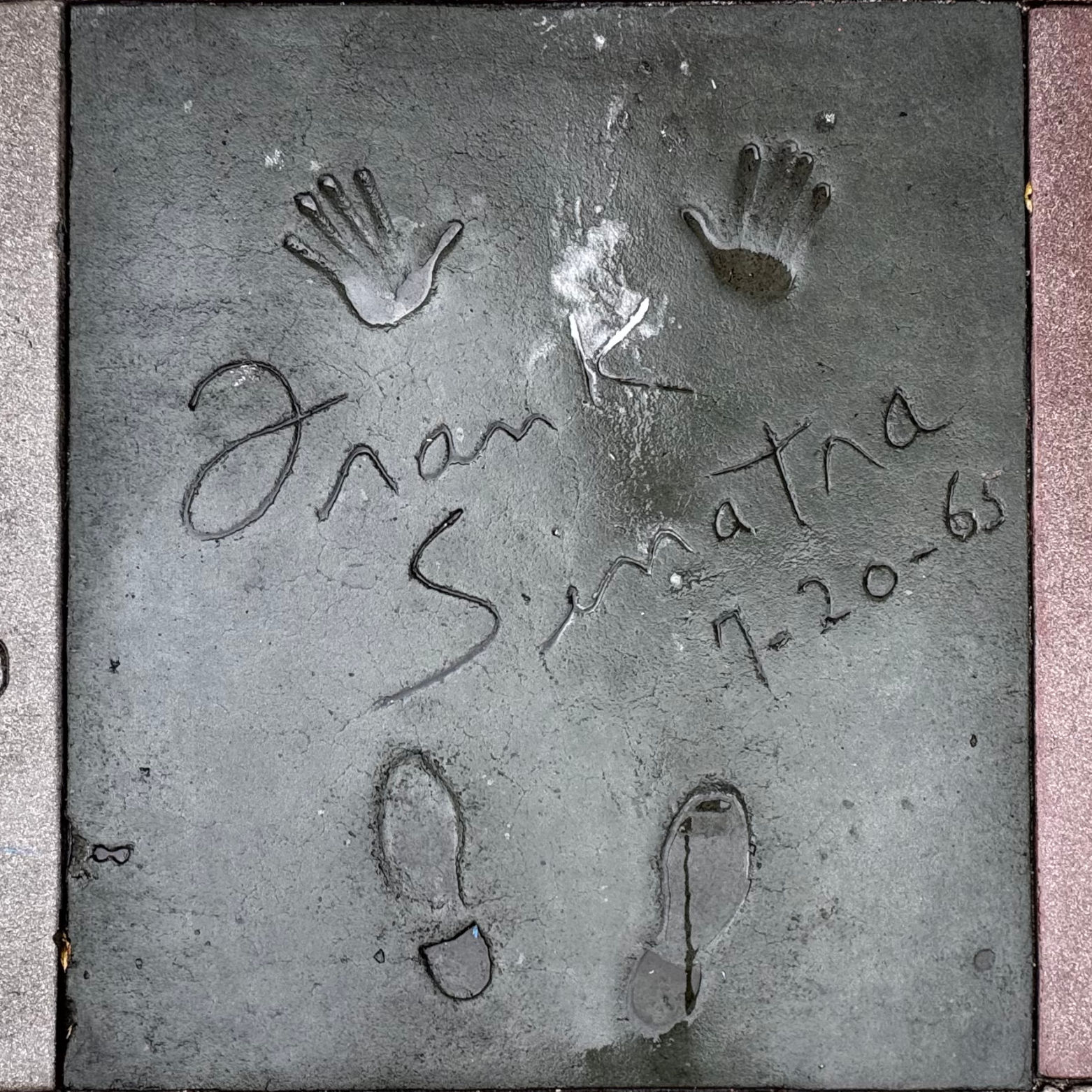
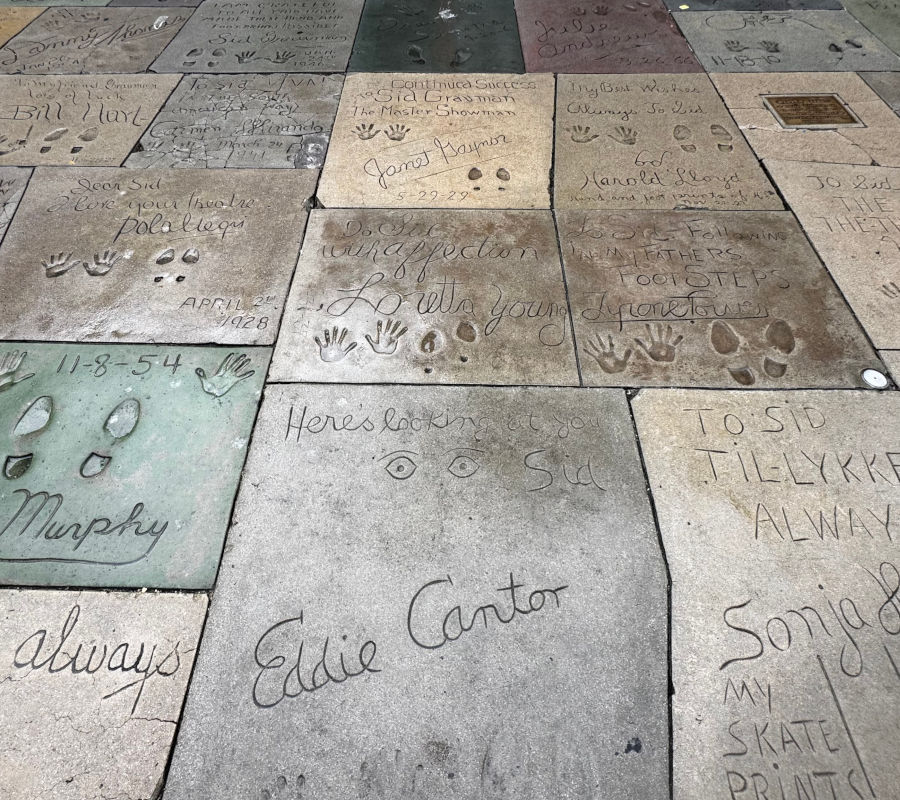
Grauman's Chinese Theatre
He was there for Von Ryan's Express
- *Handprints*
- Frank Sinatra
- 7-20-65
- *Footprints*

Frank Sinatra's Footprints
Left Side Front Edge of Dog Statue


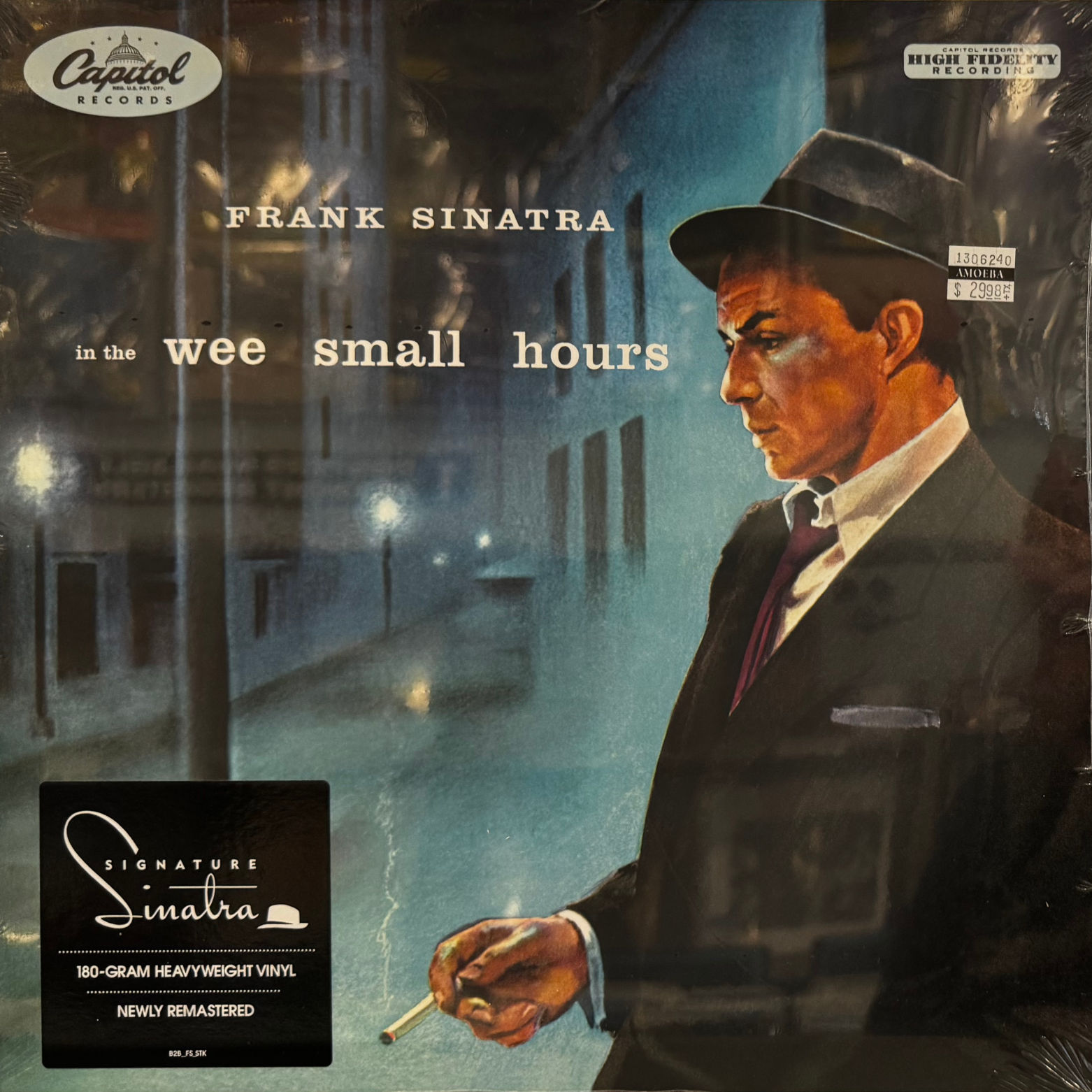
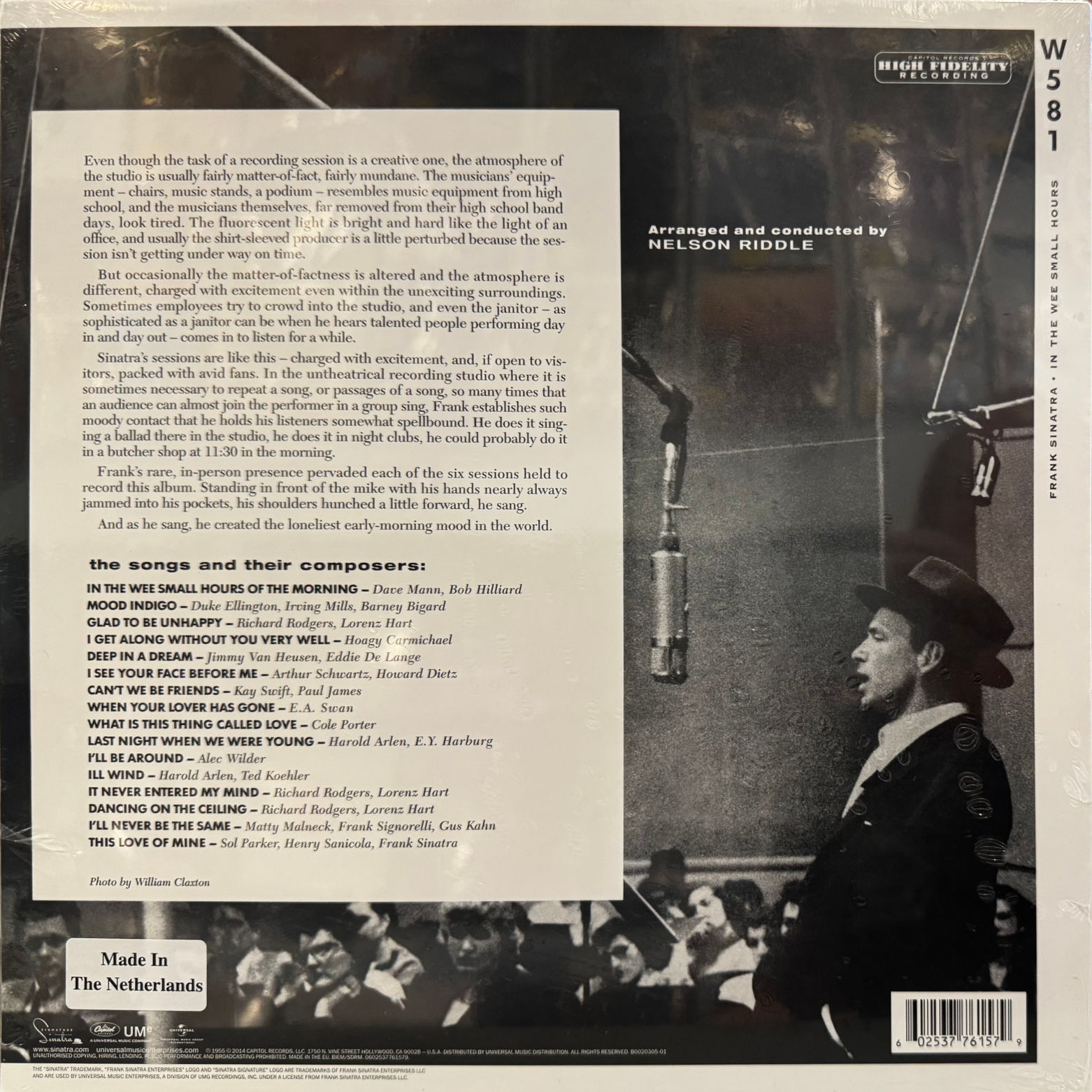
In the Wee Small Hours
Arranged and Conducted by Nelson Riddle
Even though the task of a recording session is a creative one, the atmosphere of the studio is usually fairly matter-of-fact, fairly mundane. The musicians' equipment - chairs, music stands, a podium - resembles music equipment from high school, and the musicians themselves, far removed from their high school band days, look tired. The fluorescent light is bright and hard like the light of an office, and usually the shirt-sleeved producer is a little perturbed because the session isn't getting under way on time.
But occasionally the matter-of-factness is altered and the atmosphere is different, charged with excitement even within the unexciting surroundings. Sometimes employees try to crowd into the studio, and even the janitor - as sophisticated as a janitor can be when he hears talented people performing day in and day out - comes in to listen for a while.
Sinatra's sessions are like this - charged with excitement, and, if open to visitors, packed with avid fans. In the untheatrical recording studio where it is sometimes necessary to repeat a song, or passages of a song, so many times that an audience can almost join the performer in a group sing, Frank establishes such moody contact that he holds his listeners somewhat spellbound. He does it singing a ballad there in the studio, he does it in night clubs, he could probably do it in a butcher shop at 11:30 in the morning.
Frank's rare, in-person presence pervaded each of the six sessions held to record this album. Standing in front of the mike with his hands nearly always jammed into his pockets, his shoulders hunched a little forward, he sang.
And as he sang, he created the loneliest early-morning mood in the world.
- In The Wee Small Hours of The Morning
- Mood Indigo
- Glad to Be Unhappy
- I Get Along Without You Very Well
- Deep in a Dream
- I See Your Face Before Me
- Can't We Be Friends
- When Your Lover Has Gone
- What Is This Thing Called Love
- Last Night When We Were Young
- I'll Be Around
- Ill Wind
- It Never Entered My Mind
- Dancing on The Ceiling
- I'll Never Be The Same
- This Love of Mine
As an Amazon Associate we earn from qualifying purchases
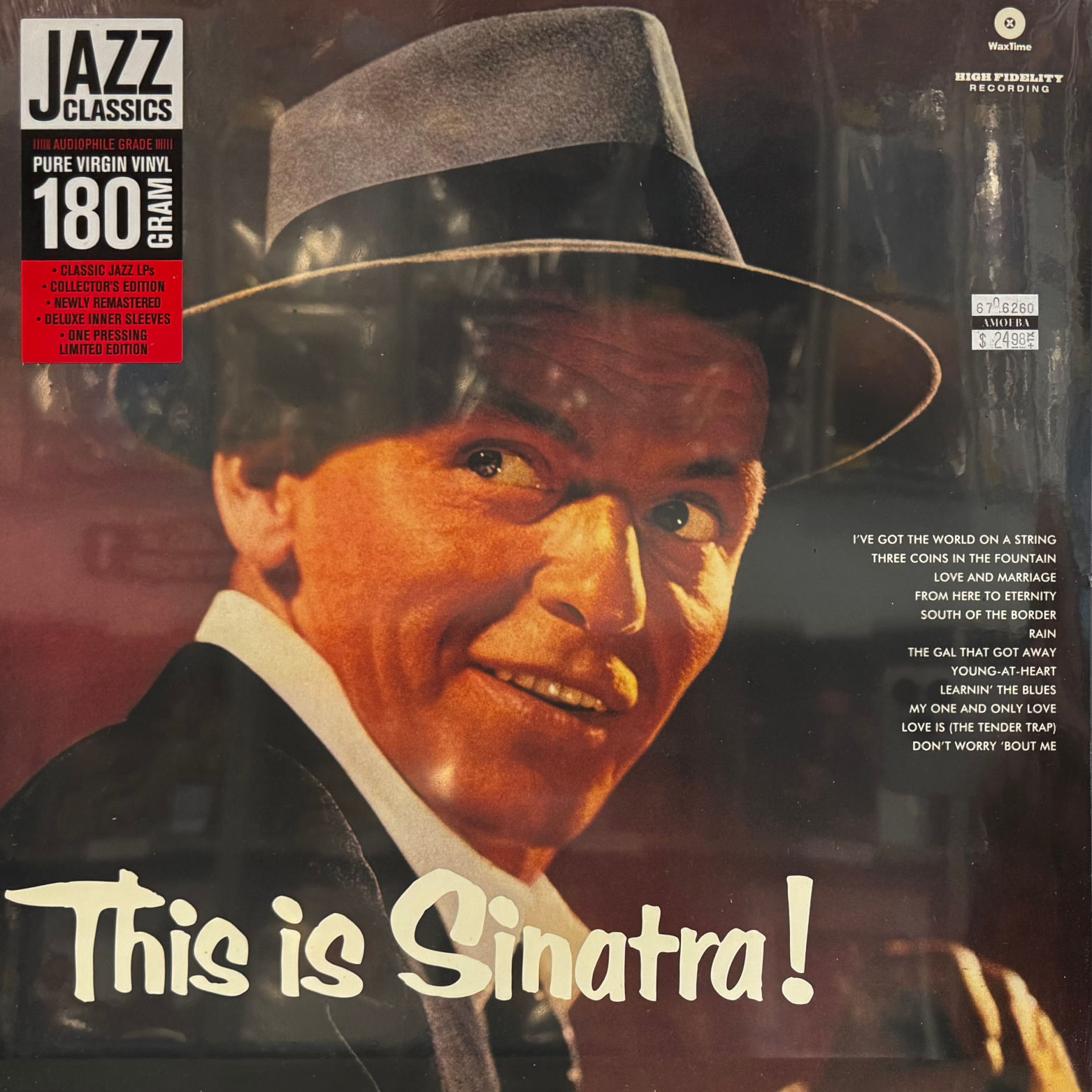
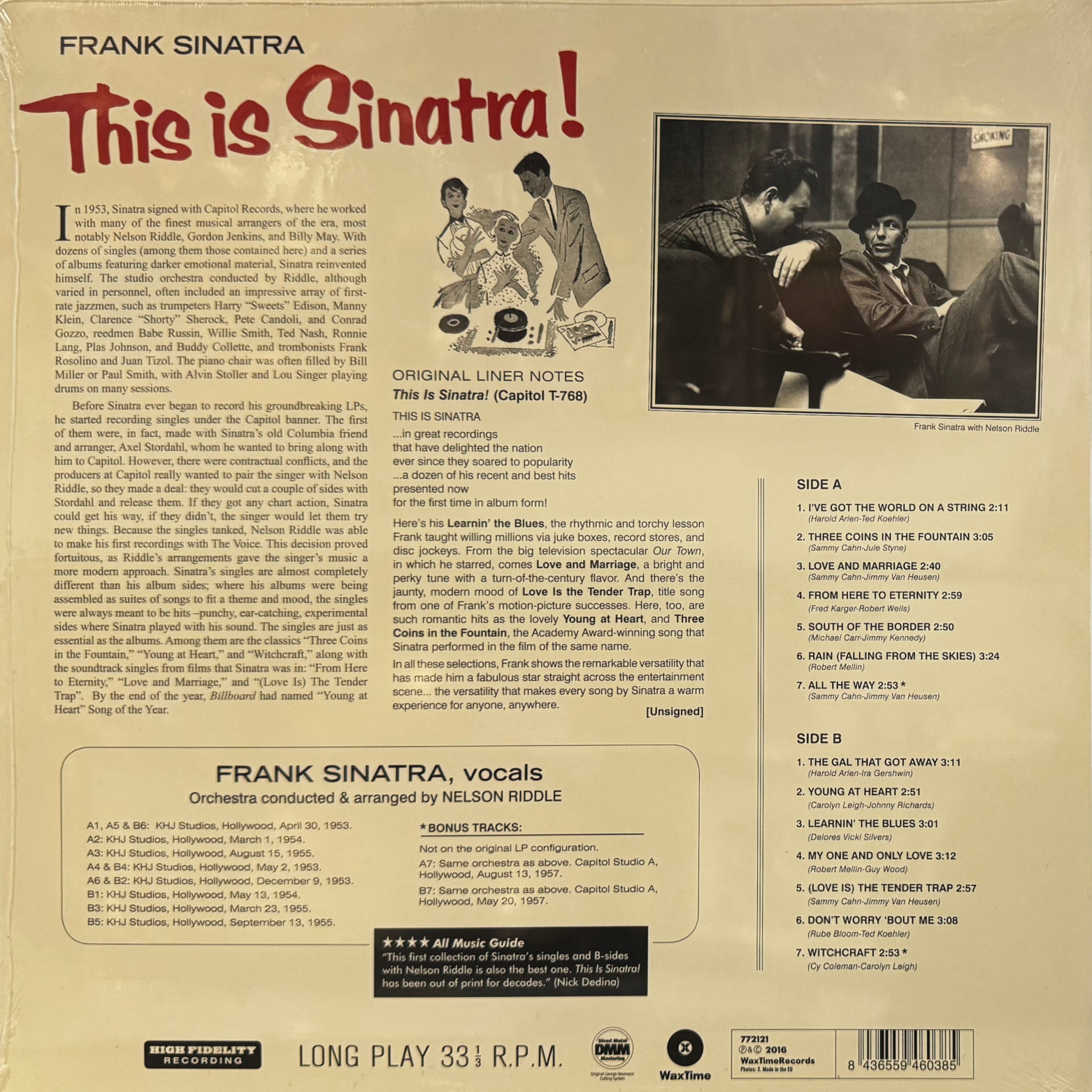
This Is Sinatra!
In 1953, Sinatra signed with Capitol Records, where he worked with many of the finest musical arrangers of the era, most notably Nelson Riddle, Gordon Jenkins, and Billy May. With dozens of singles (among them those contained here) and a series of albums featuring darker emotional material, Sinatra reinvented himself. The studio orchestra conducted by Riddle, although varied in personnel, often included an impressive array of first-rate jazzmen, such as trumpeters Harry "Sweets" Edison, Manny Klein, Clarence "Shorty" Sherock, Pete Candoli, and Conrad Gozzo, reedmen Babe Russin, Willie Smith, Ted Nash, Ronnie Lang, Plas Johnson, and Buddy Collette, and trombonists Frank Rosolino and Juan Tizol. The piano chair was often filled by Bill Miller or Paul Smith, with Alvin Stoller and Lou Singer playing drums on many sessions.
Before Sinatra ever began to record his groundbreaking LPs, he started recording singles under the Capitol banner. The first of them were, in fact, made with Sinatra's old Columbia friend and arranger, Axel Stordahl, whom he wanted to bring along with him to Capitol. However, there were contractual conflicts, and the producers at Capitol really wanted to pair the singer with Nelson Riddle, so they made a deal: they would cut a couple of sides with Stordahl and release them. If they got any chart action, Sinatra could get his way, if they didn't, the singer would let them try new things. Because the singles tanked, Nelson Riddle was able to make his first recordings with The Voice. This decision proved fortuitous, as Riddle's arrangements gave the singer's music a more modern approach. Sinatra's singles are almost completely different than his album sides; where his albums were being assembled as suites of songs to fit a theme and mood, the singles were always meant to be hits - punchy, ear-catching, experimental sides where Sinatra played with his sound. The singles are just as essential as the albums. Among them are the classics "Three Coins in the Fountain," "Young at Heart," and "Witchcraft," along with the soundtrack singles from films that Sinatra was in: "From Here to Eternity," "Love and Marriage," and "(Love Is) The Tender Trap". By the end of the year, Billboard had named "Young at Heart" Song of the Year.
THIS IS SINATRA ...in great recordings that have delighted the nation ever since they soared to popularity ...a dozen of his recent and best hits presented now for the first time in album form!
Here's his Learnin' the Blues, the rhythmic and torchy lesson Frank taught willing millions via juke boxes, record stores, and disc jockeys. From the big television spectacular Our Town, in which he starred, comes Love and Marriage, a bright and perky tune with a turn-of-the-century flavor. And there's the jaunty, modern mood of Love Is the Tender Trap, title song from one of Frank's motion-picture successes. Here, too, are such romantic hits as the lovely Young at Heart, and Three Coins in the Fountain, the Academy Award-winning song that Sinatra performed in the film of the same name.
In all these selections, Frank shows the remarkable versatility that has made him a fabulous star straight across the entertainment scene... the versatility that makes every song by Sinatra a warm experience for anyone, anywhere.
Side A
- I've Got The World on a String
- Three Coins in The Fountain
- Love and Marriage
- From Here to Eternity
- South of The Border
- Rain (Falling from The Skies)
- All The Way
Side B
- The Gal That Got Away
- Young At Heart
- Learnin' The Blues
- My One and Only Love
- (Love Is) The Tender Trap
- Don't Worry 'Bout Me
- Witchcraft
As an Amazon Associate we earn from qualifying purchases
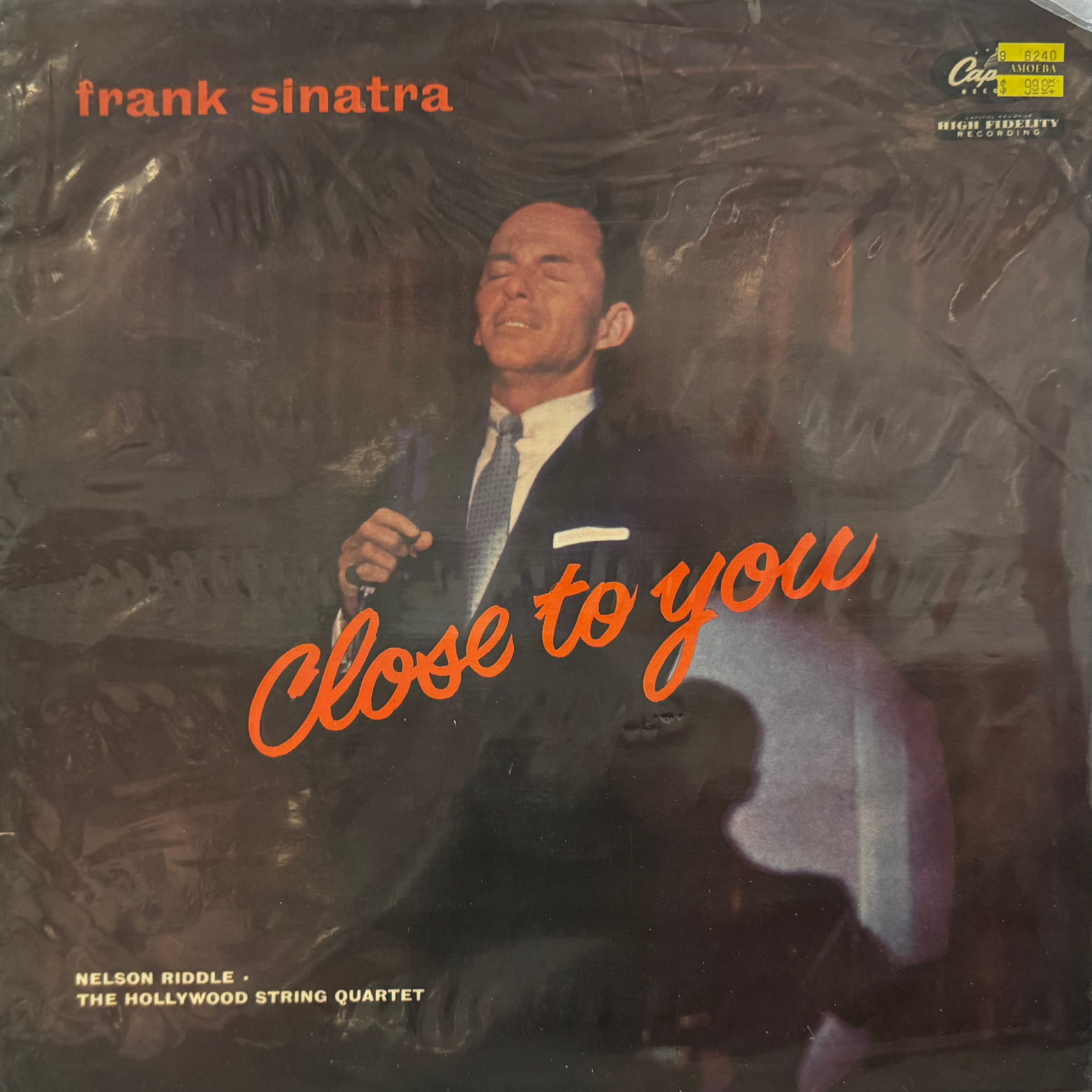
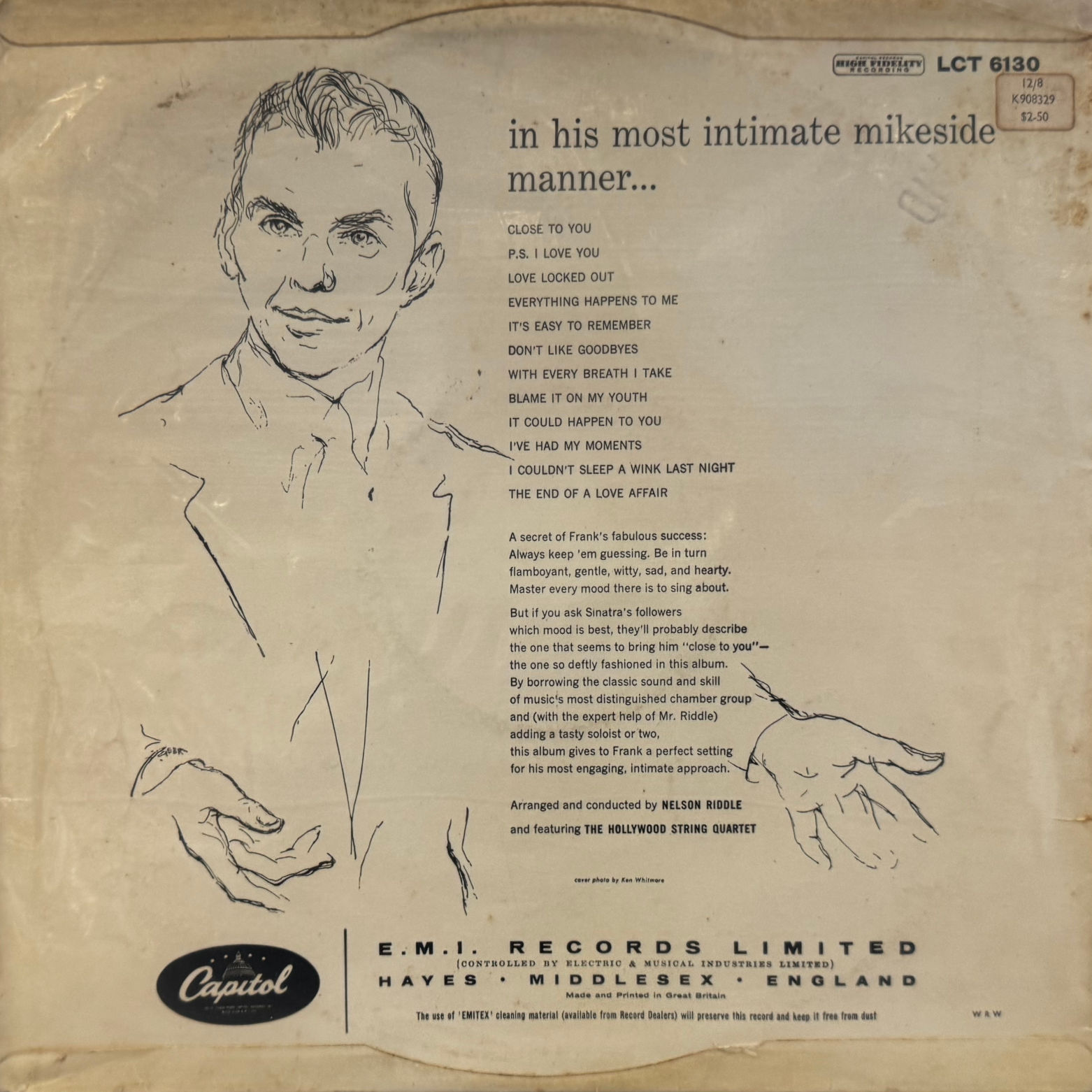
Close to You
Nelson Riddle - the Hollywood String Quartet
in his most intimate mikeside manner...
A secret of Frank's fabulous success:
Always keep 'em guessing. Be in turn flamboyant, gentle, witty, sad, and hearty. Master every mood there is to sing about.
But if you ask Sinatra's followers which mood is best, they'll probably describe the one that seems to bring him "close to you" - the one so deftly fashioned in this album. By borrowing the classic sound and skill of music's most distinguished chamber group and (with the expert help of Mr. Riddle) adding a tasty soloist or two, this album gives to Frank a perfect setting for his most engaging, intimate approach.
- Close to You
- P.S. I Love You
- Love Locked Out
- Everything Happens to Me
- It's Easy to Remember
- Don't Like Goodbyes
- With Every Breath I Take
- Blame It on My Youth
- It Could Happen to You
- I've Had My Moments
- I Couldn't Sleep a Wink Last Night
- The End of a Love Affair
- YOUTUBE:
[https://www.youtube.com/watch?v=tk87rq] - SPOTIFY:
[https://open.spotify.com/album/0ntYrgH2CUtgdpuEsqKzEn] - APPLE MUSIC:
[https://music.apple.com/us/album/1443204548] - AMAZON:
[https://www.amazon.com/dp/B00O3RQHVM]
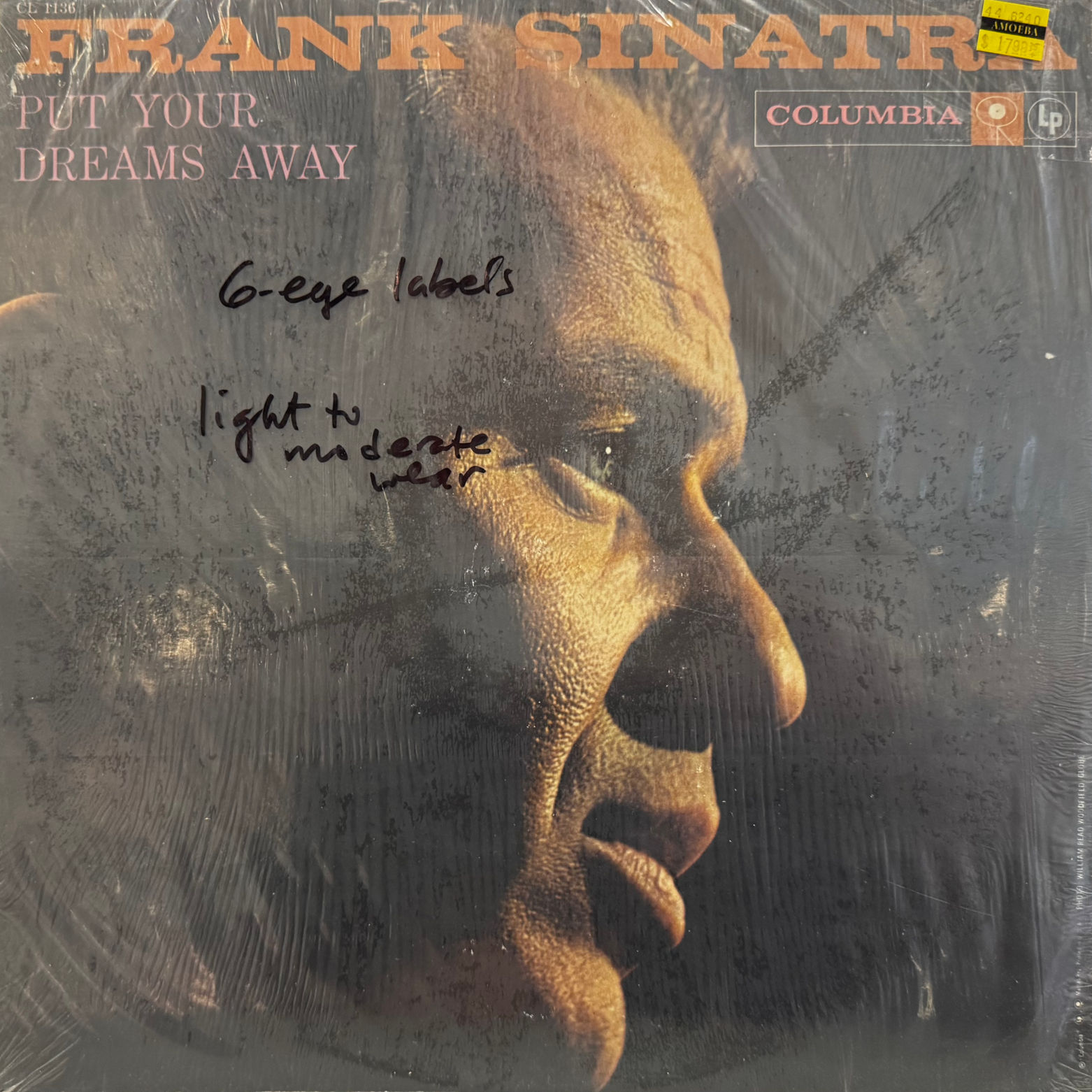
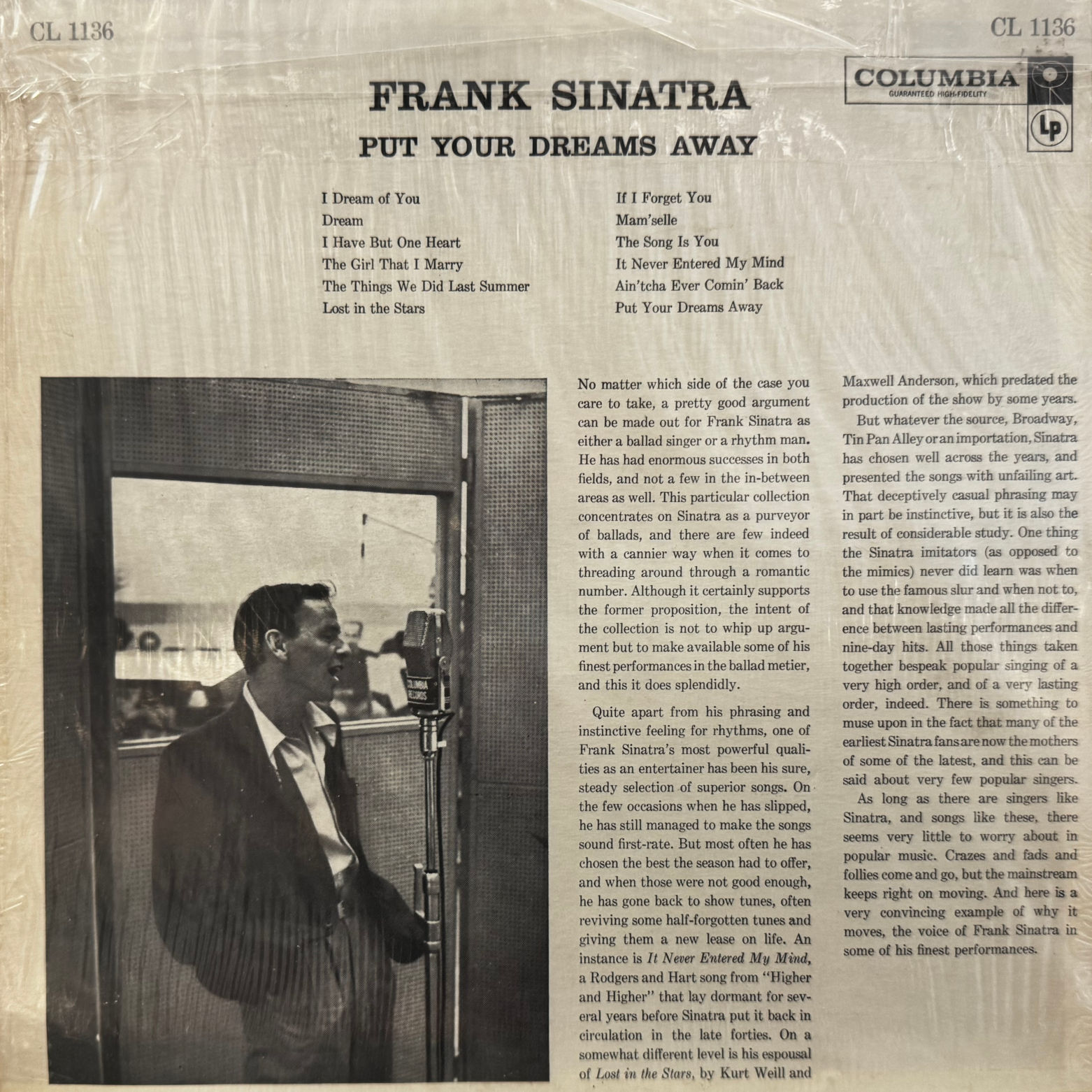
Put Your Dreams Away
No matter which side of the case you care to take, a pretty good argument can be made out for Frank Sinatra as either a ballad singer or a rhythm man. He has had enormous successes in both fields, and not a few in the in-between areas as well. This particular collection concentrates on Sinatra as a purveyor of ballads, and there are few indeed with a cannier way when it comes to threading around through a romantic number. Although it certainly supports the former proposition, the intent of the collection is not to whip up argument but to make available some of his finest performances in the ballad metier, and this it does splendidly.
Quite apart from his phrasing and instinctive feeling for rhythms, one of Frank Sinatra's most powerful qualities as an entertainer has been his sure, steady selection of superior songs. On the few occasions when he has slipped, he has still managed to make the songs sound first-rate. But most often he has chosen the best the season had to offer, and when those were not good enough, he has gone back to show tunes, often reviving some half-forgotten tunes and giving them a new lease on life. An instance is It Never Entered My Mind, a Rodgers and Hart song from "Higher and Higher" that lay dormant for several years before Sinatra put it back in circulation in the late forties. On a somewhat different level is his espousal of Lost in the Stars, by Kurt Weill and Maxwell Anderson, which predated the production of the show by some years.
But whatever the source, Broadway, Tin Pan Alley or an importation, Sinatra has chosen well across the years, and presented the songs with unfailing art. That deceptively casual phrasing may in part be instinctive, but it is also the result of considerable study. One thing the Sinatra imitators (as opposed to the mimics) never did learn was when to use the famous slur and when not to, and that knowledge made all the difference between lasting performances and nine-day hits. All those things taken together bespeak popular singing of a very high order, and of a very lasting order, indeed. There is something to muse upon in the fact that many of the earliest Sinatra fans are now the mothers of some of the latest, and this can be said about very few popular singers.
As long as there are singers like Sinatra, and songs like these, there seems very little to worry about in popular music. Crazes and fads and follies come and go, but the mainstream keeps right on moving. And here is a very convincing example of why it moves, the voice of Frank Sinatra in some of his finest performances.
- I Dream of You
- Dream
- I Have But One Heart
- The Girl That I Marry
- The Things We Did Last Summer
- Lost in The Stars
- If I Forget You
- Mam'selle
- The Song Is You
- It Never Entered My Mind
- Ain'tcha Ever Comin' Back
- Put Your Dreams Away
- YOUTUBE:
[https://www.youtube.com/playlist?list=PLGq] - AMAZON:
[https://www.amazon.com/dp/B00JGZ4TNE]
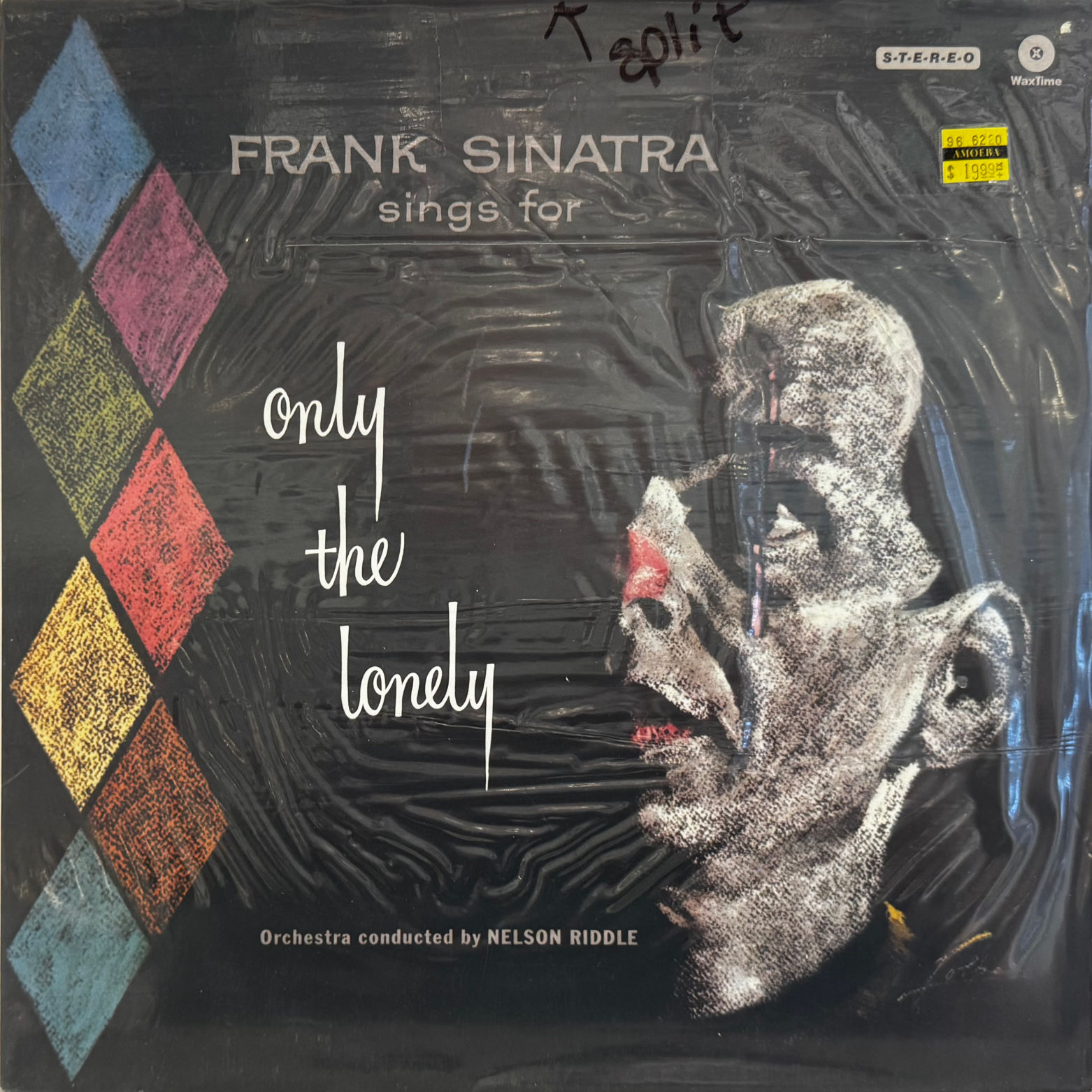
Sings for Only the Lonely
Orchestra Conducted by Nelson Riddle
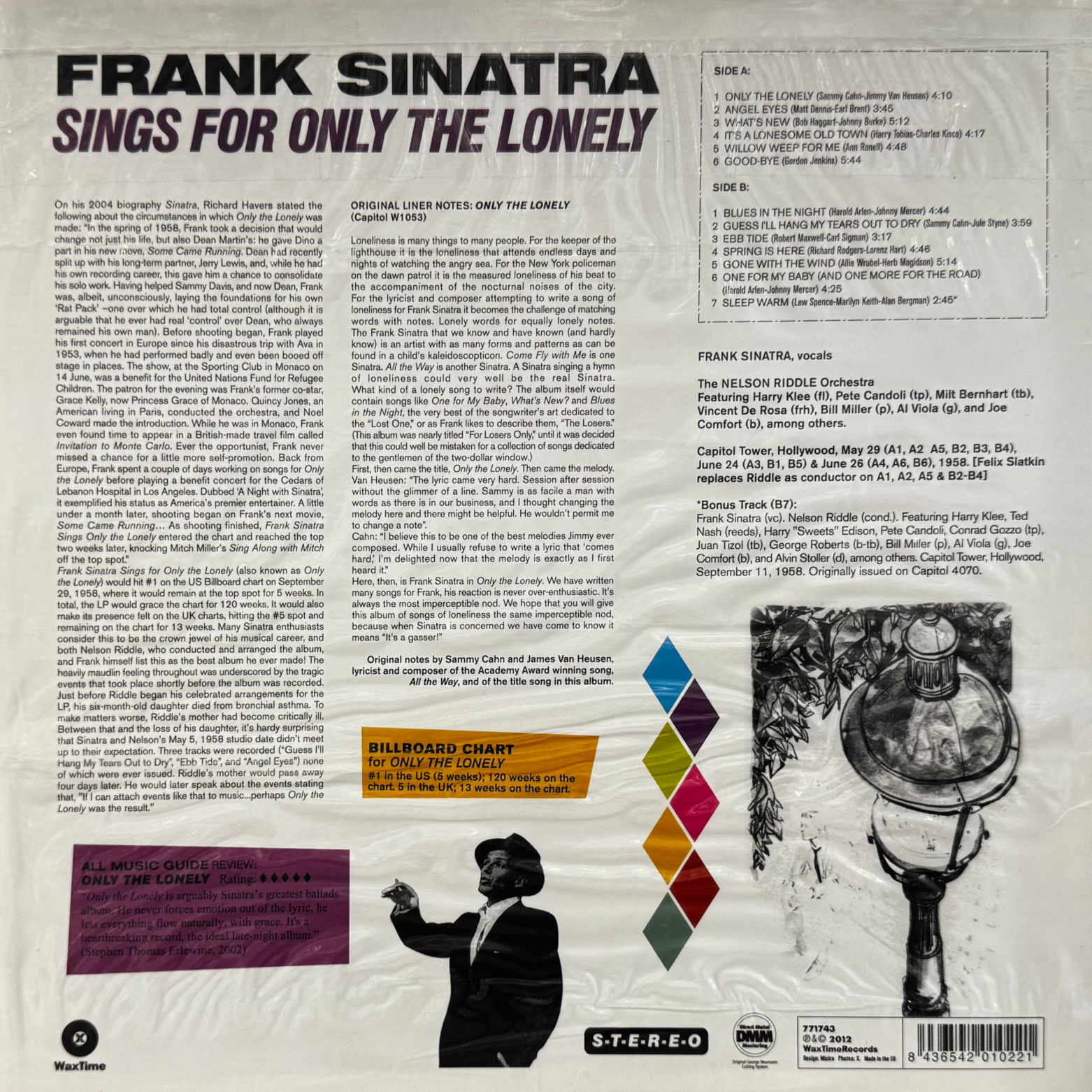
On his 2004 biography Sinatra
Frank Sinatra Sings for Only the Lonely (also known as Only the Lonely) would hit #1 on the US Billboard chart on September 29, 1958, where it would remain at the top spot for 5 weeks. In total, the LP would grace the chart for 120 weeks. It would also make its presence felt on the UK charts, hitting the #5 spot and remaining on the chart for 13 weeks. Many Sinatra enthusiasts consider this to be the crown jewel of his musical career, and both Nelson Riddle, who conducted and arranged the album, and Frank himself list this as the best album he ever made! The heavily maudlin feeling throughout was underscored by the tragic events that took place shortly before the album was recorded. Just before Riddle began his celebrated arrangements for the LP, his six-month-old daughter died from bronchial asthma. To make matters worse, Riddle's mother had become critically ill. Between that and the loss of his daughter, it's hardy surprising that Sinatra and Nelson's May 5, 1958 studio date didn't meet up to their expectation. Three tracks were recorded ("Guess I'll Hang My Tears Out to Dry", "Ebb Tide", and "Angel Eyes") none of which were ever issued. Riddle's mother would pass away four days later. He would later speak about the events stating that. "If I can attach events like that to music...perhaps Only the Lonely was the result."
Loneliness is many things to many people. For the keeper of the lighthouse it is the loneliness that attends endless days and nights of watching the angry sea. For the New York policeman on the dawn patrol it is the measured loneliness of his beat to the accompaniment of the nocturnal noises of the city. For the lyricist and composer attempting to write a song of loneliness for Frank Sinatra it becomes the challenge of matching words with notes. Lonely words for equally lonely notes. The Frank Sinatra that we know and have known (and hardly know is an artist with as many forms and patterns as can be found in a child's kaleidoscopticon. Come Fly with Me is one Sinatra. All the Way is another Sinatra. A Sinatra singing a hymn of loneliness could very well be the real Sinatra. What kind of a lonely song to write? The album itself would contain songs like One for My Baby, What's New? and Blues in the Night, the very best of the songwriter's art dedicated to the "Lost One," or as Frank likes to describe them, "The Losers." (This album was nearly titled "For Losers Only, until it was decided that this could well be mistaken for a collection of songs dedicated to the gentlemen of the two-dollar window.)
First, then came the title, Only the Lonely. Then came the melody. Van Heusen: "The lyric came very hard. Session after session without the glimmer of a line. Sammy is as facile a man with words as there is in our business, and I thought changing the melody here and there might be helpful. He wouldn't permit me to change a note".
Cahn: "I believe this to be one of the best melodies Jimmy ever composed. While I usually refuse to write a lyric that 'comes hard, I'm delighted now that the melody is exactly as I first heard it."
Here, then, is Frank Sinatra in Only the Lonely. We have written many songs for Frank, his reaction is never over-enthusiastic. It's always the most imperceptible nod. We hope that you will give this album of songs of loneliness the same imperceptible nod, because when Sinatra is concerned we have come to know it means "It's a gasser!"
Original notes by Sammy Cahn and James Van Heusen, lyricist and composer of the Academy Award winning song, All the Way, and of the title song in this album.
Side A
- Only The Lonely
- Angel Eyes
- What's New?
- It's a Lonesome Old Town
- Willow Weep For Me
- Good-Bye
Side B
- Blues in The Night
- Guess I'll Hang My Tears Out to Dry
- Ebb Tide
- Spring Is Here
- Gone with The Wind
- One For My Baby (and One more For The Road)
- Sleep Warm
- YOUTUBE:
[https://www.youtube.com/watch?v=JLCU1jqdhy8&list=OLAK5uy] - SPOTIFY:
[https://open.spotify.com/album/3Pwg6fBaMoPmgfNNVJ5y8O] - APPLE MUSIC:
[https://music.apple.com/kw/album/724727840] - AMAZON:
[https://www.amazon.com/dp/B07GRJJVMW]
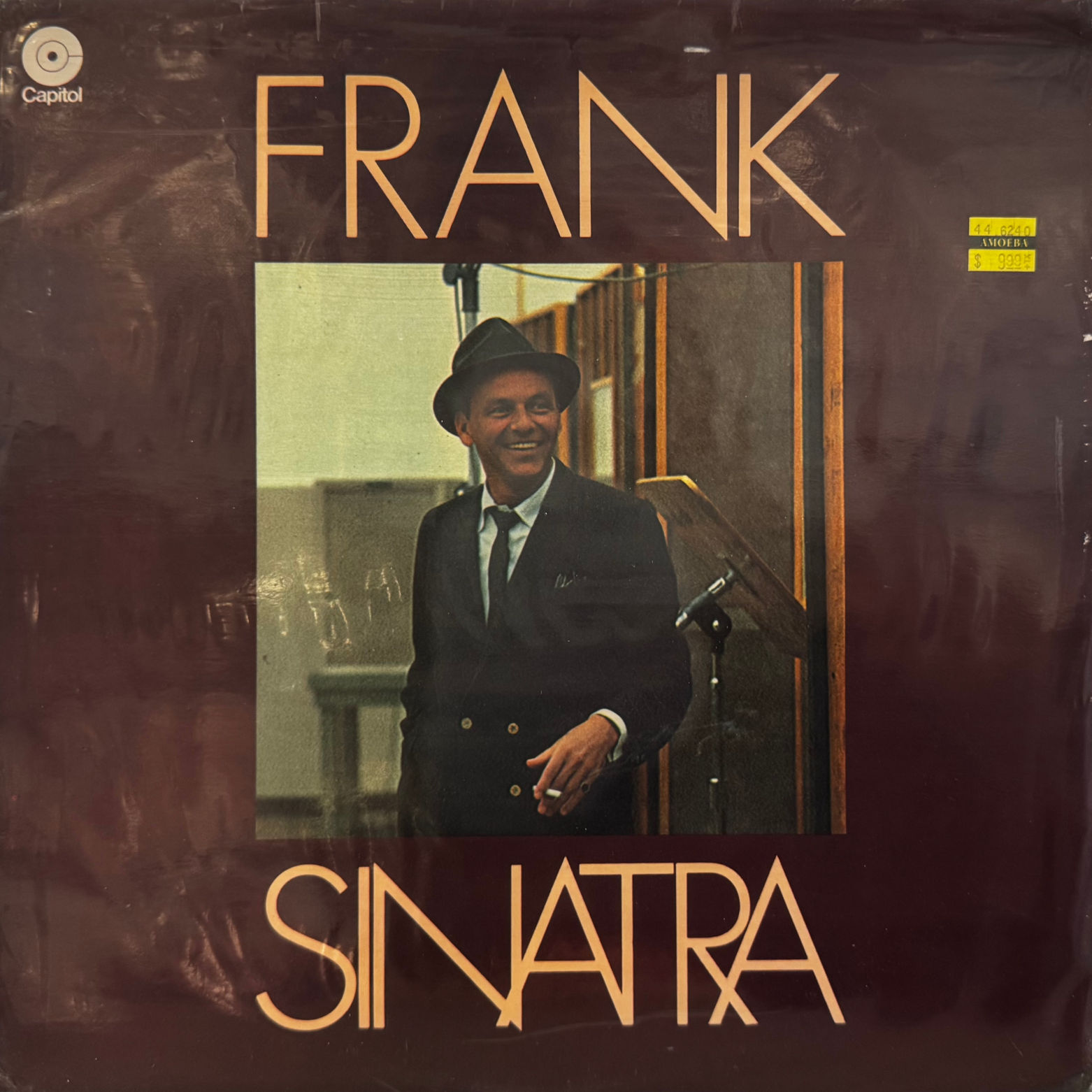
Frank Sinatra
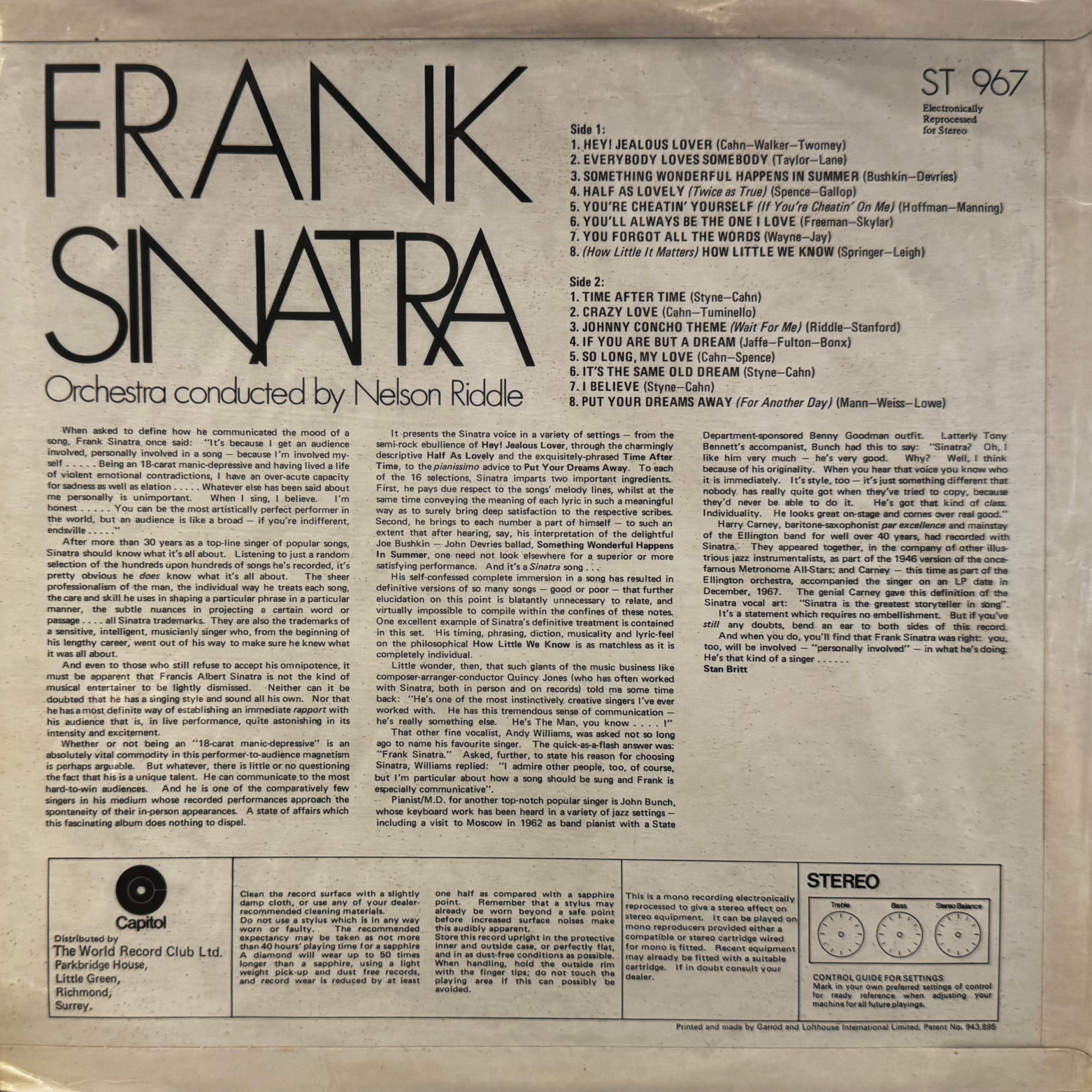
When asked to define how he communicated the mood of a song, Frank Sinatra once said: "It's because I get an audience involved, personally involved in a song - because I'm involved myself.....Being an 18-carat manic-depressive and having lived a life of violent emotional contradictions, I have an over-acute capacity for sadness as well as elation.... Whatever else has been said about me personally is unimportant. When I sing, believe. I'm honest. You can be the most artistically perfect performer in the world, but an audience is like a broad - if you're indifferent, endsville.....
After more than 30 years as a top-line singer of popular songs, Sinatra should know what it's all about. Listening to just a random selection of the hundreds upon hundreds of songs he's recorded, it's pretty obvious he does know what it's all about. The sheer professionalism of the man, the individual way he treats each song, the care and skill. he uses in shaping a particular phrase in a particular manner, the subtle nuances in projecting a certain word or passage.... all Sinatra trademarks. They are also the trademarks of a sensitive, intelligent, musicianly singer who, from the beginning of his lengthy career, went out of his way to make sure he knew what it was all about.
And even to those who still refuse to accept his omnipotence, it must be apparent that Francis Albert Sinatra is not the kind of musical entertainer to be lightly dismissed. Neither can it be doubted that he has a singing style and sound all his own. Nor that he has a most definite way of establishing an immediate rapport with his audience that is, in live performance, quite astonishing in its intensity and excitement.
Whether or not being an "18-carat manic-depressive" is an absolutely vital commodity in this performer-to-audience magnetism is perhaps arguable. But whatever, there is little or no questioning the fact that his is a unique talent. He can communicate to the most hard-to-win audiences. And he is one of the comparatively few singers in his medium whose recorded performances approach the spontaneity of their in-person appearances. A state of affairs which this fascinating album does nothing to dispel.
It presents the Sinatra voice in a variety of settings - from the semi-rock ebullience of Hey! Jealous Lover, through the charmingly descriptive Half As Lovely and the exquisitely-phrased Time After Time, to the pianissimo advice to Put Your Dreams Away. To each of the 16 selections, Sinatra imparts two important ingredients. First, he pays due respect to the songs' melody lines, whilst at the same time conveying the meaning of each lyric in such a meaningful way as to surely bring deep satisfaction to the respective scribes. Second, he brings to each number a part of himself - to such an extent that after hearing, say, his interpretation of the delightful Joe Bushkin - John Devries ballad, Something Wonderful Happens In Summer, one need not look elsewhere for a superior or more satisfying performance. And it's a Sinatra song...
His self-confessed complete immersion in a song has resulted in definitive versions of so many songs - good or poor - that further elucidation on this point is blatantly unnecessary to relate, and virtually impossible to compile within the confines of these notes. One excellent example of Sinatra's definitive treatment is contained in this set. His timing, phrasing, diction, musicality and lyric-feel on the philosophical How Little We Know is as matchless as it is completely individual.
Little wonder, then, that such giants of the music business like composer-arranger-conductor Quincy Jones (who has often worked with Sinatra, both in person and on records) told me some time back: He's one of the most instinctively creative singers I've ever worked with. He has this tremendous sense of communication - he's really something else. He's The Man, you know.... I"
That other fine vocalist, Andy Williams, was asked not so long ago to name his favourite singer. The quick-as-a-flash answer was: "Frank Sinatra." Asked, further, to state his reason for choosing Sinatra; Williams replied: "I admire other people, too, of course, but I'm particular about how a song should be sung and Frank is especially communicative".
Pianist/M.D. for another top-notch popular singer is John Bunch, whose keyboard work has been heard in a variety of jazz settings - including a visit to Moscow in 1962 as band pianist with a State Department - sponsored Benny Goodman outfit. Latterly Tony Bennett's accompanist, Bunch had this to say: "Sinatra? Oh, I like him very much - he's very good. Why? Well, I think because of his originality. When you hear that voice you know who it is immediately. It's style, too - it's just something different that nobody. has really quite got when they've tried to copy, because they'd never be able to do it. He's got that kind of class. Individuality. He looks great on-stage and comes over real good."
Harry Carney, baritone-saxophonist par excellence and mainstay of the Ellington band for well over 40 years, had recorded with Sinatra. They appeared together, in the company of other illustrious jazz instrumentalists, as part of the 1946 version of the once-famous Metronome All-Stars; and Carney - this time as part of the Ellington orchestra, accompanied the singer on an LP date in December, 1967. The genial Carney gave this definition of the Sinatra vocal art: "Sinatra is the greatest storyteller in song".
It's a statement which requires no embellishment. But if you've still any doubts, bend an ear to both sides of this record.
And when you do, you'll find that Frank Sinatra was right: you, too, will be involved - "personally involved" - in what he's doing. He's that kind of a singer.
Stan Britt
Side 1
- Hey! Jealous Lover
- Everybody Loves Somebody
- Something Wonderful Happens in Summer
- Half As Lovely
- Your Cheatin' Yourself
- You'll Always Be The One I Love
- You Forgot All The Words
- (How Little It Matters) How Little We Know
Side 2
- Time After Time
- Crazy Love
- Johnny Concho Theme
- If You are But a Dream
- So Long, My Love
- It's The Same Old Dream
- I Believe
- Put Your Dreams Away
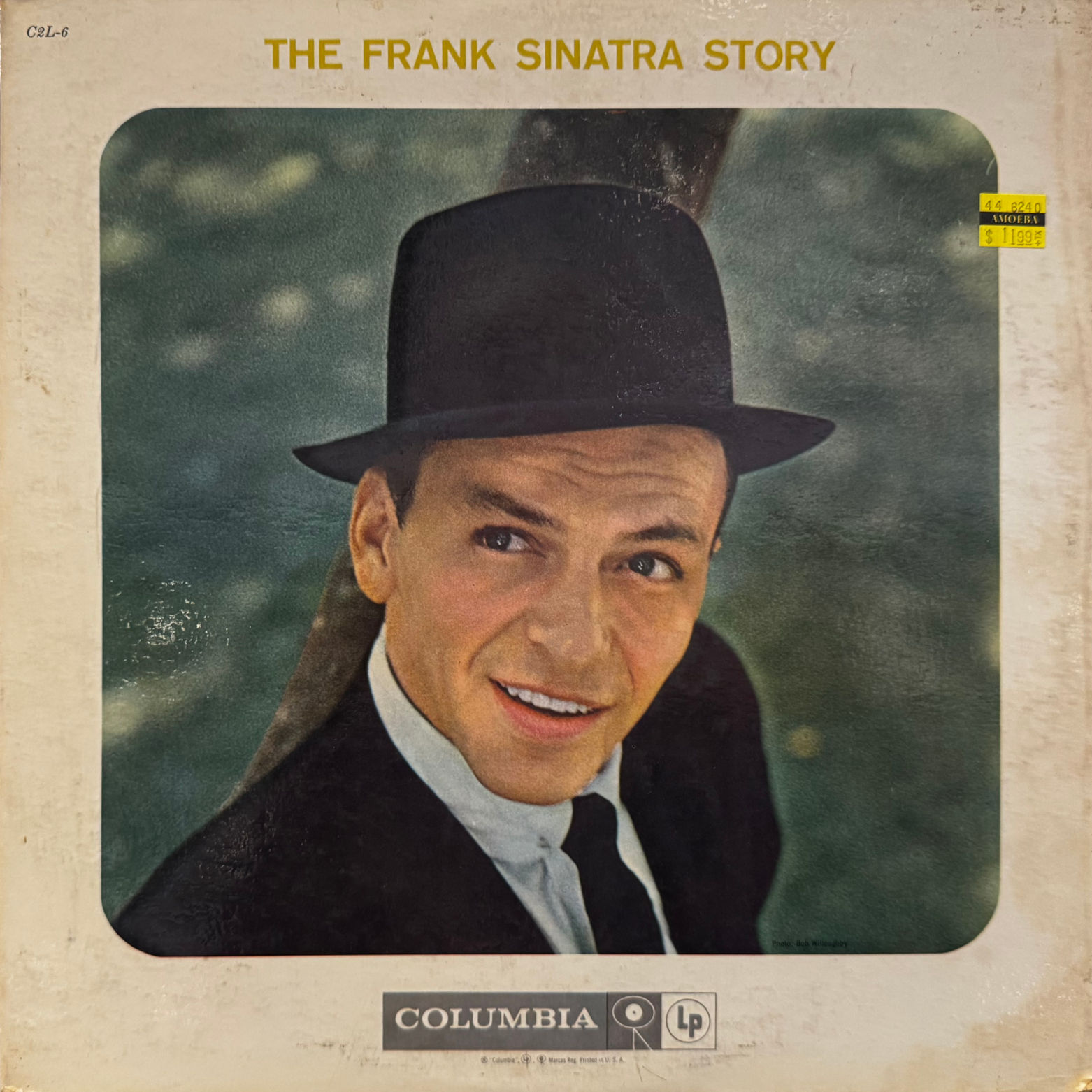
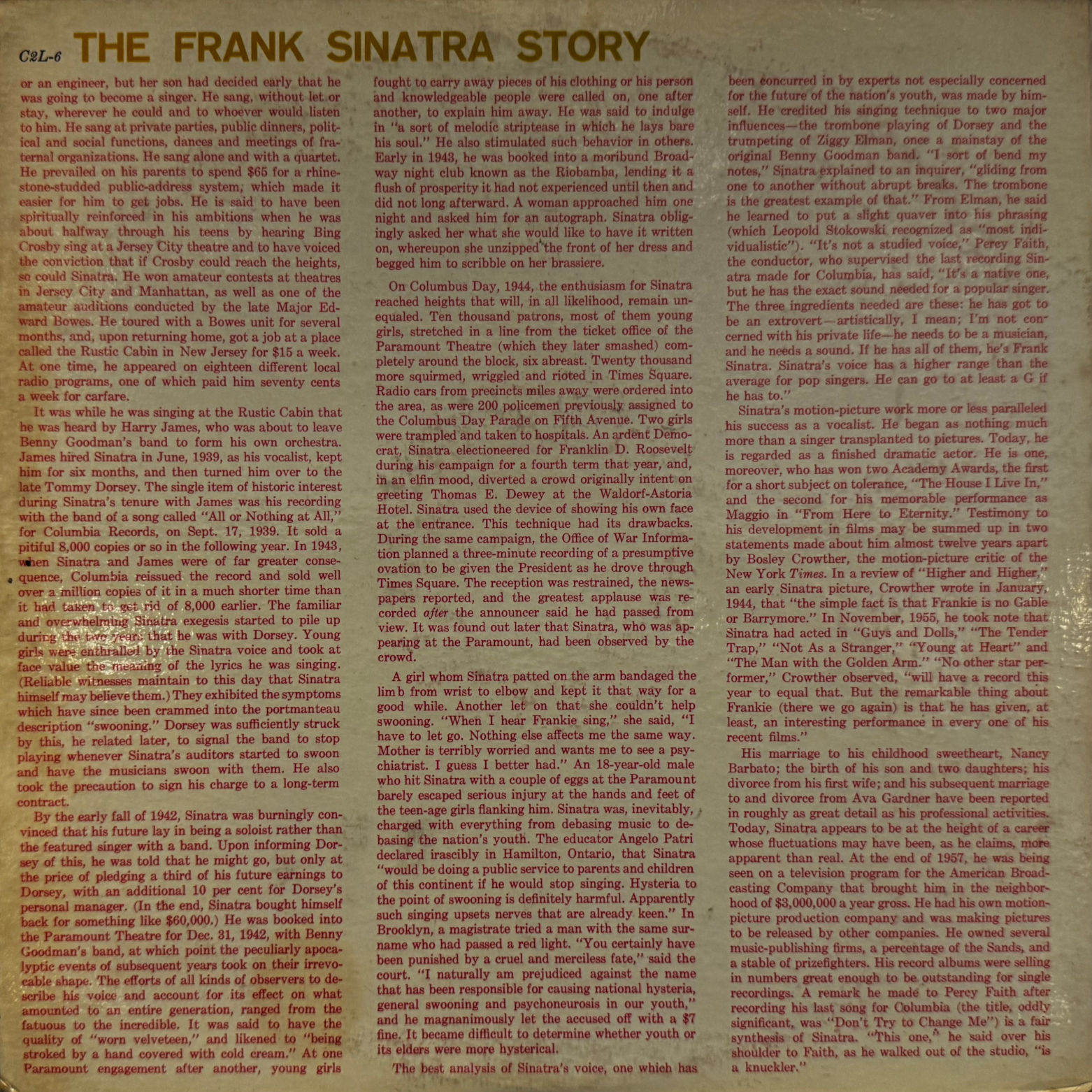
The Frank Sinatra Story
by Gilbert Millstein
In an era epitomized by the conscientious and convulsive, although largely ephemeral, inflation of minor tics into mass movements, Frank Sinatra, the singer and actor, is quite likely the most authentic and enduring manifestation in America of kitsch, a German concept meaning popular culture. As is the grave tribal custom with all such phenomena, he was first rewarded with enormous sums of money and invested with a status only sporadically accorded kings, presidents or visionaries, after which his psyche was picked up, poked at, peeled, peered into, turned around, held up to the light, shaken like a piggy bank, dropped to the floor to see whether it would break, and finally returned to him, scratched here and there, but on the whole intact, if not readily susceptible to easy cataloguing. The fact is that in the fifteen years or so of his career in which he has been a clearly identifiable totem, standing spindling but erect, lop-eared, strikingly tailored and splendidly alone amidst importunate multitudes (often as not, inexplicably angry and forlornly appealing all at once), there has been something for everybody in Sinatra, most of it contradicting most of the rest. While this has prevented him from taking on the aura of the folk hero (since the folk hero, through a process of omission, emerges without blemish), it has done something much more valuable for Sinatra: it has kept him alive, artistically and financially; the public has a morbid habit of laying a wreath once a year on the tombs of folk heroes and then going on about its business. It is a tribute to Sinatra's viability, inverse but none the less heartfelt, that the most widely circulated newspaper in the United States, the tabloid New York Daily News, once stated editorially that it was utterly bored with news of him.
Ordinarily, the task of making any public figure conform to one or two, or even a series, of easily grasped stereotypes presents his advisers, to say nothing of reporters, press agents, critics, commentators and cocktail-party psychoanalysts, with no insuperable problem: the personality is wrenched around arbitrarily; a number of bright primary colors are applied slapdash to him; and the subject can generally be counted on to live up to, with more or less alacrity, the myths created about him. Sometimes, he actually is a good deal like what he is said to be. None of this applies to Sinatra, the circumstances of whose very birth have been rendered in conflicting versions. It has been written of him, with an equally authoritative air in both instances, that when he was delivered, the attending physician believed him to be still-born, whereupon his grandmother thrust him under a cold-water faucet, icily propelling him into life, Contrarily, it has been said that his grandmother was not even present at the time and that he displayed no reluctance whatever to live. Both writers were agreed only that he came into the world in Hoboken, New Jersey, on December 12, 1915, that he weighed 18 pounds, and that he still carries on his face the scars of the doctor's forceps. Still others have placed the date two years later, but they were palpably the victims of press agents whose business it is to see that the bloom is kept on their peach, even if it has to be pasted on.
The elusive nature of the quarry has led any number of observers into comparisons of Sinatra with others so unlike that a simple recounting invariably produces a comic effect. Thus, a Presbyterian minister from Paterson, New Jersey, at a ceremony on the Mall in New York City's Central Park, pictured the poet Robert Burns as the Frank Sinatra of a century and a half before, in that reports of Burns' frailties were "too greatly exaggerated." The sculptor Jo Davidson, having been commissioned by a motion-picture fan magazine to do a bust of Sinatra, examined the bone structure of his sitter's face and then delivered himself of the pronouncement that "He's like a younger Lincoln." A recording-company executive on intimate terms with Sinatra has declared him to be "the only Italian I know who might have been a Dostoevski." The Russian theme was also favored by John Foster Dulles, when he was the United States representative to the United Nations in 1950. Dulles made a speech rebuking the Soviet Union's Andrei Y. Vishinsky for something Vishinsky had said. "Really," Dulles asked, "are we bobby-soxers who swoon when our modern Frank Sinatra croons?"
A vast kitchen midden of material about Sinatra has accumulated over the years, by far the greater part of it pretending to an intimacy with him that does not exist in reality. Sinatra is by no means a reticent man, but he evinces an inclination, often strenuous, to decline the opportunity to lay bare whatever it is he believes his soul to be. The result has been an outpouring, perhaps unmatched in the twentieth century, of weighty interpretation confidently built on nothing more solid than speculation; on utterances, either chance or suggested to Sinatra at some point in a carefully calculated publicity campaign; or on veritable incidents, the meaning of which may not have been apparent to him, much less to anyone else. He has been described as "tender," "belligerent," "independent" and "dependent"; "cocky," "scared," "gay" and "brooding"; "down-right terrifying" and "terrified"; "delightful," "generous," and "violent" while simultaneously "fighting for the underdog," all of which constitutes an impressive congeries of self-canceling opinions. In the December, 1957, issue of Metronome, a music-trade publication, a critic named Bill Coss wrote of Sinatra that he was "the most complete, the most fantastic symbol of American maleness yet discovered, for both good and bad reasons..." This piece of intelligence was foreshadowed in the divinings of a Hollywood astrologer, who, a few months earlier, said of Sinatra that he "should not be married, for he has the Moon in Scorpio, which gives him a very strong love nature. Women will always enjoy his love, for he was born to give them happiness, however brief."
On the other side of the fence, Judy Garland has found him "like a little boy. Women seem to think of him as their child," and a lady reporter from Cleveland discovered him to be "just a slender boy with an unruly head of black curls and a frightened smile... a simple kid with no grandiose ideas." A psychologist joined hands with the ladies in saying that in Sinatra's person might be detected one of the elemental instincts of womankind - the urge to feed the hungry." A British critic, Harold Hobson, of the London Times, in reporting Sinatra's debut at the Palladium in July, 1950, said, "It is not 'The Voice' but 'The Smile' that does such enormous, such legendary execution - the shy, deprecating smile, with the quiver at the corner of the mouth, that makes the young ladies in the gallery swoon in ecstasy, and the maturer matrons in the dress circle gurgle with protective delight.... Here is an artist who, hailing from the most amiably rowdy and self-confident community the world has ever known, has elected to express the timidity that can never be wholly driven out of the boastfullest heart. To a people whose ideal of manhood is husky, full-blooded and self-reliant, he has chosen to suggest that, under the ... crashing self-assertion, man is still only a child, frightened and whimpering in the dark." In what may be construed either as an access of professional desperation or the realization that Sinatra is complicated, one writer fell back on the old, comfortable Jekyll-Hyde delineation, characterizing him as "Siamese twins." This plainly failed to satisfy Bill Davidson, a biographer from Look Magazine. To Davidson, Sinatra was nothing less than "a chameleon. He can change a dozen times in twenty-four hours."
Some years ago, in the preface to his short, skillful book on Sinatra, E. J. Kahn Jr., a writer for The New Yorker, admitted that it was "impossible to write objectively about Sinatra and at the same time provide a universally acceptable answer to the question so often asked about him by his fellow men - 'What's he got that I ain't got?' " If the rootstock of Sinatra's personality lies buried too deep for excavation, its flowering has been marvelously abundant. The chances are that no popular entertainer, not excluding the late John Barrymore or Rudolph Valentino, Greta Garbo, Clark Gable, or Bing Crosby, has combined in himself so many elements of ready identification - both positive and negative - to which millions could respond. Barrymore was a great actor and a tragic man; Valentino was a myth rather than a man. Garbo is both actress and myth; Gable is an ideal symbol of virility; and Crosby is an outstandingly talented performer, but an avuncular man whose ways meet with unanimous approval. To the mass mind, all are some of these things; none is all of them; none is hero and villain; wayward child and potent adult; romantic figure and rake; and none has, like Sinatra, stirred in the public such loudly ambivalent expressions of affection and distaste. None, certainly, has run a course comparable to his: the awesome rise, the fierce adulation; the decline (real or seeming); and the resurgence.
Not a single ingredient of the American dream is lacking in Sinatra; not even the affable impudence with which he has accounted for himself. "I'm going to do as I please," he once told an interviewer. "I don't need anybody in the world. I did it all myself." To another, he said he had never had to make a comeback. "I never went any place," he insisted. "I never stopped working. Never went any place. The whole point is I never stopped entertaining, even though I didn't make a picture for a year and a half, but I kept doing tremendous business in night clubs and personal appearances. It would be more accurate to call what happened to my career the rise and fall and rise again." He also tossed a bone to the sizable group that is vaguely unhappy if the object of its attention has not availed himself of psychiatry. To a third interviewer, he disclosed, "I was under analysis for six months once. The reason was that I had a couple of specific problems I had to work out." He sturdily refused to credit the discipline with more than that. "I know a lot of people who use psychiatry as a crutch," he said. "They can hardly wait to get on that couch and tell something new that has occurred to them. I used it more as a way to talk out my problems." Having rounded third, he came home standing up, as they say. "It's the same thing you could do with a close friend," he told his questioner. "But in show business, it's hard to have close friends, and I don't feel I should burden them with my problems." He had demonstrated that at the pinnacle of success, he, too, could know loneliness.
This is an attractive proposition and looks well in print, but extensive testimony exists that Sinatra has got close friends and that he has, from time to time, discussed his problems with some of them. In fairness to him, he has also laden them with gifts, Cadillacs among them, gold cigarette lighters and cuff links by the gross, and an indeterminate quantity of precious kickshaws of one kind or another. He has chartered airplanes to take them on junkets. He pre-empted a Hollywood restaurant one night simply to entertain them and thoughtfully paid for and had installed an air-conditioning unit the place had lacked up to then. It cost him $4,000. The owner was a friend, too. A few years ago, Charles Morrison, owner of the Mocambo, a Hollywood night club, who was still another good friend, died, and the operation of the club was taken over by his widow. Sinatra, in a characteristic gesture, canceled a forthcoming engagement at the Sands Hotel in Las Vegas, of which he is a 2 per cent owner, and booked himself into the Mocambo at the minimum wage stipulated by union contract, or a good many thousands of dollars a week less than he would have earned at the Sands as part owner and performer. It was a vastly sentimental thing to do, and, as it turned out, an extremely profitable one for the Mocambo. It also provided Hollywood with the nightly spectacle, during Sinatra's engagement, of the star attraction weeping unrestrainedly as he sang, and of his audience, packed in like details of the Laocoon group, joining him in tears. "You never in your life saw anything like it," a man who was present on several of these nights recalled recently. "He cried; they cried; everybody cried; the joint made a million bucks - I'm exaggerating - and you would have sworn Sinatra had invented crying."
A man whose character traits are both strongly marked and exasperatingly diffuse at the same time, which Sinatra's are, is apt to create confusion between what it is he is, what it is he looks like, and what it is he does, all three sometimes being conveniently cemented into a critical estimate of him. To take only a very few of the hundreds of thousands of impassioned appraisals made of Sinatra, he has been termed a "lyric skeleton," "a second Boyer, understandably better for ruthless dieting," "a new Dumbo," "a musical bag of bones," and "the captain and quarterback of crooners." The first amalgam says nothing more than that he is a thin singer; the second variant makes him a thin singer with romantic attributes; the third takes note of his large ears; the fourth is an adaptation of the first; and the last is a purely irritated admission that he happened to be the most successful of his breed. On a higher level, the confusion was similarly compounded by the critic Paul Bowles, writing in the New York Herald Tribune on the occasion of Sinatra's appearance in August, 1943, with the New York Philharmonic at Lewisohn Stadium. "The hysteria which accompanies his presence in public," said Bowles, "is in no way part of an artistic manifestation. It is a slightly disturbing spectacle to witness the almost synchronized screams that come from the audience as he closes his eyes or moves his body slightly sideways, because the spontaneous reaction corresponds to no common understanding relating to tradition or technique of performance, nor yet to the meaning of the sung text." As a triumphantly irrefutable proof that Sinatra was no artist, Bowles appended this insight: "In thanking the audience for its enthusiasm, he referred to the members of the Philharmonic as 'the boys in the band.'"
There is no doubt that some of the mixup attending any detailing of Sinatra's life has been abetted by (a) himself; (b) a succession of press agents, the most imaginative of whom was the late George Evans, who piloted his speedy but erratic vessel through the shoals and reefs of the glittering early years; and (e) Sinatra's followers, who, at one period, were estimated by several sober sources to total roughly 40,000,000 throbbing souls, most of them under 21. By now, for example, the tasty but inaccurate accounts of Francis Albert Sinatra's initial poverty and miraculous rescue, through the agency of music, from incipient criminality, have been pretty well disproved. He was the only child of Martin and Natalie Sinatra, both of whom were born in Italy and were of distinctly middle-class habits and outlook. Martin Sinatra was once a minor prizefighter who later became a captain in the Hoboken Fire Department. Natalie Sinatra, who is known as Dolly, was a practical nurse and an important figure in local Democratic politics. Young Frank was raised more by his grandmother than by his parents; by an aunt and by an elderly Jewish woman, a neighbor, who seems to have taken the place of his grandmother when she died in 1927. He lacked neither for clothes nor for money and seems to have acquired friends as much by reason of the generosity he displayed from the outset as by his ways, which could be, then as they are now, quite ingratiating when he chose to make them so.
At one time, Sinatra was obligingly prone to go along with the belief, encouraged by his appearance, that he was a frail, sickly type, barely able to keep his feet by grasping the microphone through which he was trying to sing. Once, in 1945, while addressing the student body of a Manhattan high school in which there had been an outbreak of racial disturbances, Sinatra first observed that there were no discernible biological differences among the races and then added that "Every race produces men with big strong muscles and guys like me." A year later, in a guest column for Leonard Lyons, he said, "Ham can make a scrawny kid, who has to leave the hanger in his coat to have any shoulders, into a movie star." Statements of this kind are incontestable, it is true, but not as descriptions of Sinatra. His father taught him to box and he was a wiry boy. His physical courage has never been in dispute. He once hit a waiter who had refused to serve a Negro, and he has attacked men much bigger than himself - with marked success - for various reasons, including such burning issues as antisemitism, on the one hand, and, on the other, a remark addressed to a woman Sinatra regarded as a lady.
Upon his graduation from grammar school in Hoboken, Sinatra attended that city's Demarest High School briefly and went to work, first as a helper on a news-paper-delivery truck, and then as an office boy for the paper, the Jersey Observer, which has since gone out of business. His mother wanted him to be either a doctor or an engineer, but her son had decided early that he was going to become a singer. He sang, without let or stay, wherever he could and to whoever would listen to him. He sang at private parties, public dinners, political and social functions, dances and meetings of fraternal organizations. He sang alone and with a quartet. He prevailed on his parents to spend $65 for a rhinestone-studded public-address system, which made it easier for him to get jobs. He is said to have been spiritually reinforced in his ambitions when he was about halfway through his teens by hearing Bing Crosby sing at a Jersey City theatre and to have voiced the conviction that if Crosby could reach the heights, so could Sinatra. He won amateur contests at theatres in Jersey City and Manhattan, as well as one of the amateur auditions conducted by the late Major Edward Bowes. He toured with a Bowes unit for several months, and, upon returning home, got a job at a place called the Rustic Cabin in New Jersey for $15 a week. At one time, he appeared on eighteen different local radio programs, one of which paid him seventy cents a week for carfare.
It was while he was singing at the Rustic Cabin that he was heard by Harry James, who was about to leave Benny Goodman's band to form his own orchestra. James hired Sinatra in June, 1939, as his vocalist, kept him for six months, and then turned him over to the late Tommy Dorsey. The single item of historic interest during Sinatra's tenure with James was his recording with the band of a song called "All or Nothing at All," for Columbia Records, on Sept. 17, 1939. It sold a pitiful 8,000 copies or so in the following year. In 1943, when Sinatra and James were of far greater consequence, Columbia reissued the record and sold well over a million copies of it in a much shorter time than it had taken to get rid of 8,000 earlier. The familiar and overwhelming Sinatra exegesis started to pile up during the two years that he was with Dorsey. Young girls were enthralled by the Sinatra voice and took at face value the meaning of the lyrics he was singing. (Reliable witnesses maintain to this day that Sinatra himself may believe them.) They exhibited the symptoms which have since been crammed into the portmanteau description "swooning." Dorsey was sufficiently struck by this, he related later, to signal the band to stop playing whenever Sinatra's auditors started to swoon and have the musicians swoon with them. He also took the precaution to sign his charge to a long-term contract.
By the early fall of 1942, Sinatra was burningly convinced that his future lay in being a soloist rather than the featured singer with a band. Upon informing Dorsey of this, he was told that he might go, but only at the price of pledging a third of his future earnings to Dorsey, with an additional 10 per cent for Dorsey's personal manager. (In the end, Sinatra bought himself back for something like $60,000.) He was booked into the Paramount Theatre for Dec. 31, 1942, with Benny Goodman's band, at which point the peculiarly apocalyptic events of subsequent years took on their irrevocable shape. The efforts of all kinds of observers to describe his voice and account for its effect on what amounted to an entire generation, ranged from the fatuous to the incredible. It was said to have the quality of "worn velveteen," and likened to "being stroked by a hand covered with cold cream." At one Paramount engagement after another, young girls fought to carry away pieces of his clothing or his person and knowledgeable people were called on, one after another, to explain him away. He was said to indulge in "a sort of melodic striptease in which he lays bare his soul." He also stimulated such behavior in others. Early in 1943, he was booked into a moribund Broadway night club known as the Riobamba, lending it a flush of prosperity it had not experienced until then and did not long afterward. A woman approached him one night and asked him for an autograph. Sinatra obligingly asked her what she would like to have it written on, whereupon she unzipped the front of her dress and begged him to scribble on her brassiere.
On Columbus Day, 1944, the enthusiasm for Sinatra reached heights that will, in all likelihood, remain unequaled. Ten thousand patrons, most of them young girls, stretched in a line from the ticket office of the Paramount Theatre (which they later smashed) completely around the block, six abreast. Twenty thousand more squirmed, wriggled and rioted in Times Square. Radio cars from precincts miles away were ordered into the area, as were 200 policemen previously assigned to the Columbus Day Parade on Fifth Avenue. Two girls were trampled and taken to hospitals. An ardent Democrat, Sinatra electioneered for Franklin D. Roosevelt during his campaign for a fourth term that year, and, in an elfin mood, diverted a crowd originally intent on greeting Thomas E. Dewey at the Waldorf-Astoria Hotel. Sinatra used the device of showing his own face at the entrance. This technique had its drawbacks. During the same campaign, the Office of War Information planned a three-minute recording of a presumptive ovation to be given the President as he drove through Times Square. The reception was restrained, the newspapers reported, and the greatest applause was recorded after the announcer said he had passed from view. It was found out later that Sinatra, who was appearing at the Paramount, had been observed by the crowd.
A girl whom Sinatra patted on the arm bandaged the limb from wrist to elbow and kept it that way for a good while. Another let on that she couldn't help swooning. "When I hear Frankie sing," she said, "I have to let go. Nothing else affects me the same way. Mother is terribly worried and wants me to see a psychiatrist. I guess I better had." An 18-year-old male who hit Sinatra with a couple of eggs at the Paramount barely escaped serious injury at the hands and feet of the teenage girls flanking him. Sinatra was, inevitably, charged with everything from debasing music to debasing the nation's youth. The educator Angelo Patri declared irascibly in Hamilton, Ontario, that Sinatra "would be doing a public service to parents and children of this continent if he would stop singing. Hysteria to the point of swooning is definitely harmful. Apparently such singing upsets nerves that are already keen." In Brooklyn, a magistrate tried a man with the same surname who had passed a red light. "You certainly have been punished by a cruel and merciless fate," said the court. "I naturally am prejudiced against the name that has been responsible for causing national hysteria, general swooning and psychoneurosis in our youth, and he magnanimously let the accused off with a $7 fine. It became difficult to determine whether youth or its elders were more hysterical.
The best analysis of Sinatra's voice, one which has been concurred in by experts not especially concerned for the future of the nation's youth, was made by him-self. He credited his singing technique to two major influences - the trombone playing of Dorsey and the trumpeting of Ziggy Elman, once a mainstay of the original Benny Goodman band. "I sort of bend my notes," Sinatra explained to an inquirer, "gliding from one to another without abrupt breaks. The trombone is the greatest example of that." From Elman, he said he learned to put a slight quaver into his phrasing (which Leopold Stokowski recognized as "most individualistic"). "It's not a studied voice," Percy Faith, the conductor, who supervised the last recording Sinatra made for Columbia, has said, "It's a native one, but he has the exact sound needed for a popular singer. The three ingredients needed are these: he has got to be an extrovert - artistically, I mean; I'm not concerned with his private life he needs to be a musician, and he needs a sound. If he has all of them, he's Frank Sinatra. Sinatra's voice has a higher range than the average for pop singers. He can go to at least a G if he has to."
Sinatra's motion-picture work more or less paralleled his success as a vocalist. He began as nothing much more than a singer transplanted to pictures. Today, he is regarded as a finished dramatic actor. He is one, moreover, who has won two Academy Awards, the first for a short subject on tolerance, "The House I Live In," and the second for his memorable performance as Maggio in "From Here to Eternity." Testimony to his development in films may be summed up in two statements made about him almost twelve years apart by Bosley Crowther, the motion-picture critic of the New York Times. In a review of "Higher and Higher," an early Sinatra picture, Crowther wrote in January, 1944, that "the simple fact is that Frankie is no Gable or Barrymore." In November, 1955, he took note that Sinatra had acted in "Guys and Dolls," "The Tender Trap," "Not As a Stranger," "Young at Heart" and "The Man with the Golden Arm." "No other star performer," Crowther observed, "will have a record this year to equal that. But the remarkable thing about Frankie (there we go again) is that he has given, at least, an interesting performance in every one of his recent films."
His marriage to his childhood sweetheart, Nancy Barbato; the birth of his son and two daughters; his divorce from his first wife; and his subsequent marriage to and divorce from Ava Gardner have been reported in roughly as great detail as his professional activities. Today, Sinatra appears to be at the height of a career whose fluctuations may have been, as he claims, more apparent than real. At the end of 1957, he was being seen on a television program for the American Broadcasting Company that brought him in the neighborhood of $3,000,000 a year gross. He had his own motion-picture production company and was making pictures to be released by other companies. He owned several music-publishing firms, a percentage of the Sands, and a stable of prizefighters. His record albums were selling in numbers great enough to be outstanding for single recordings. A remark he made to Percy Faith after recording his last song for Columbia (the title, oddly significant, was "Don't Try to Change Me") is a fair synthesis of Sinatra. "This one, he said over his shoulder to Faith, as he walked out of the studio, "is a knuckler."
- Ciribiribin
- All Or Nothing At All
- You'll Never Know
- If You are But a Dream
- Nancy
- You Go to My Head
- Stormy Weather
- The House I Live In
- If I Loved You
- Soliloquy
- How Deep Is The Ocean
- Ol' Man River
- You'll Never Walk Alone
- I Concentrate on You
- Castle Rock
- Why Was I Born
- I've Got a Crush on You
- Begin The Beguine
- The Birth of The Blues
- April in Paris
- I'm Glad There Is You
- Laura
- One For My Baby
- Put Your Dreams Away
As an Amazon Associate we earn from qualifying purchases
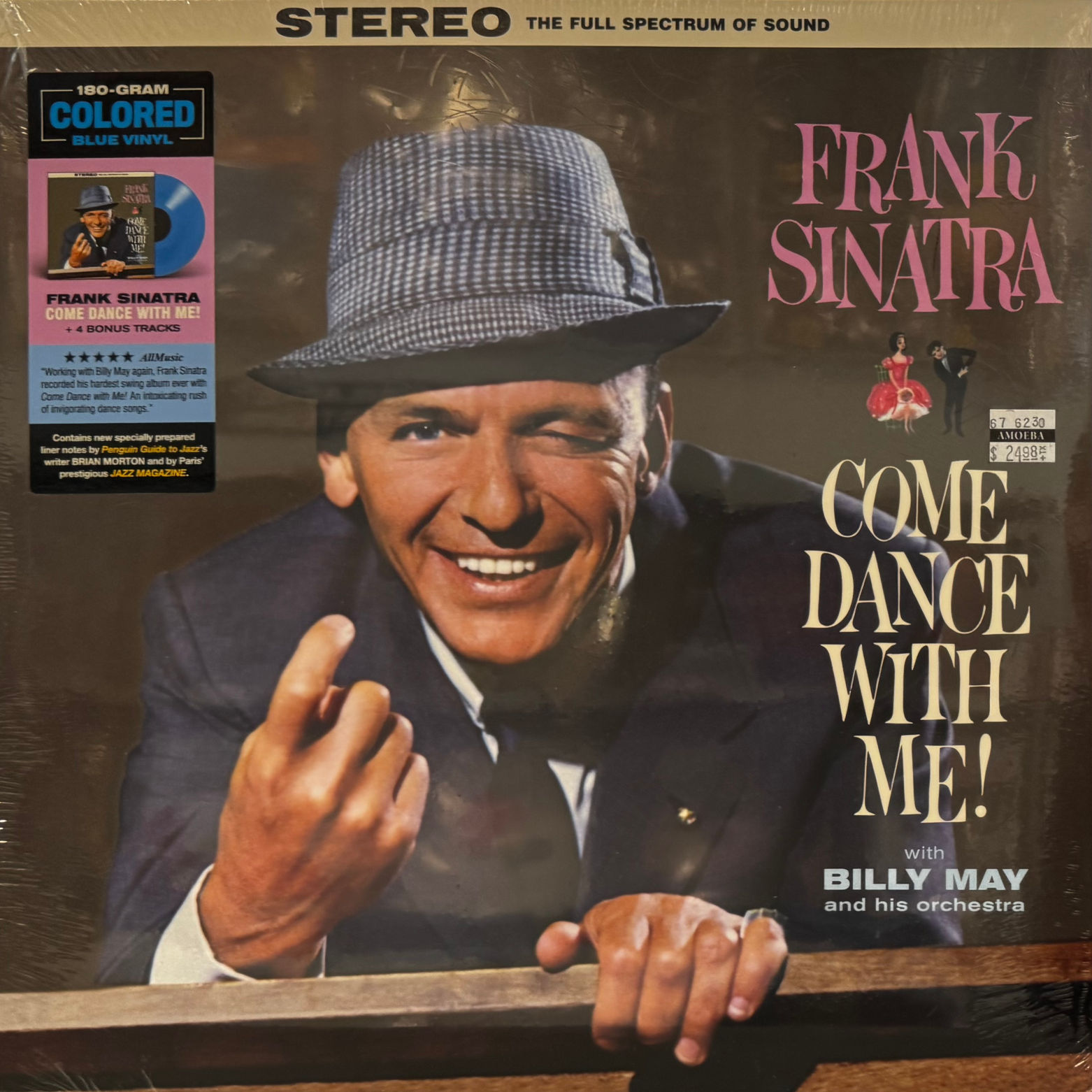
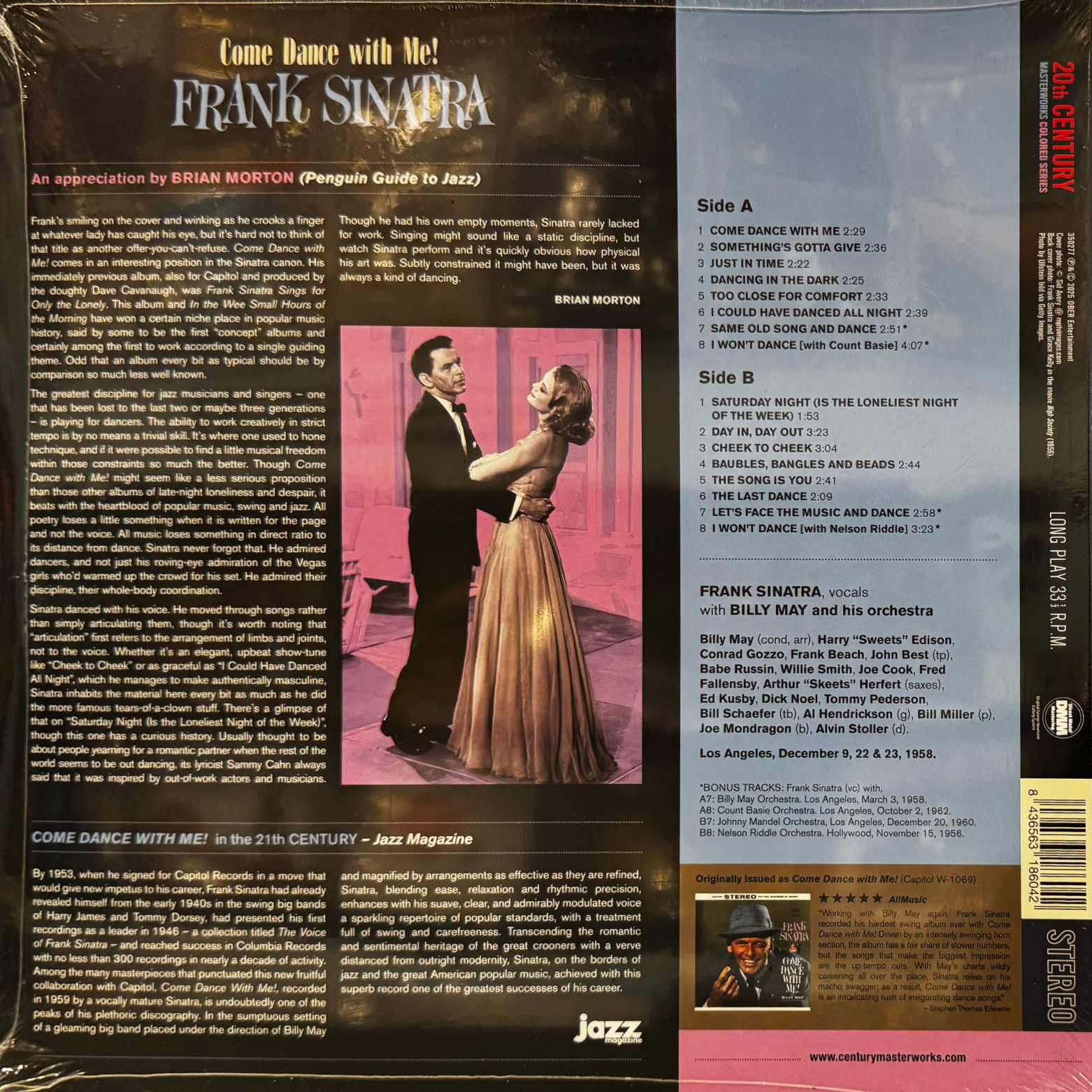
Come Dance with Me
With Billy May and his Orchestra
An appreciation by Brian Morton (Penguin Guide to Jazz)
- The Penguin Guide to Jazz
[https://www.amazon.com/dp/0140153640]
Frank's smiling on the cover and winking as he crooks a finger at whatever lady has caught his eye, but it's hard not to think of that title as another offer-you-can't-refuse. Come Dance with Me! comes in an interesting position in the Sinatra canon. His immediately previous album, also for Capitol and produced by the doughty Dave Cavanaugh, was Frank Sinatra Sings for Only the Lonely. This album and In the Wee Small Hours of the Morning have won a certain niche place in popular music history, said by some to be the first "concept" albums and certainly among the first to work according to a single guiding theme. Odd that an album every bit as typical should be by comparison so much less well known.
The greatest discipline for jazz musicians and singers - one that has been lost to the last two or maybe three generations - is playing for dancers. The ability to work creatively in strict tempo is by no means a trivial skill. It's where one used to hone technique, and if it were possible to find a little musical freedom within those constraints so much the better. Though Come Dance with Me! might seem like a less serious proposition than those other albums of late-night loneliness and despair, it beats with the heartblood of popular music, swing and jazz. All poetry loses a little something when it is written for the page and not the voice. All music loses something in direct ratio to its distance from dance. Sinatra never forgot that. He admired dancers, and not just his roving-eye admiration of the Vegas girls who'd warmed up the crowd for his set. He admired their discipline, their whole-body coordination.
Sinatra danced with his voice. He moved through songs rather than simply articulating them, though it's worth noting that "articulation" first refers to the arrangement of limbs and joints, not to the voice. Whether it's an elegant, upbeat show-tune like "Cheek to Cheek" or as graceful as "I Could Have Danced All Night", which he manages to make authentically masculine, Sinatra inhabits the material here every bit as much as he did the more famous tears-of-a-clown stuff. There's a glimpse of that on "Saturday Night (Is the Loneliest Night of the Week)", though this one has a curious history. Usually thought to be about people yearning for a romantic partner when the rest of the world seems to be out dancing, its lyricist Sammy Can always said that it was inspired by out-of-work actors and musicians.
Though he had his own empty moments, Sinatra rarely lacked for work. Singing might sound like a static discipline, but watch Sinatra perform and it's quickly obvious how physical his art was. Subtly constrained it might have been, but it was always a kind of dancing,
Brian Morton
Jazz Magazine
By 1953, when he signed for Capitol Records in a move that would give new impetus to his career, Frank Sinatra had already revealed himself from the early 1940s in the swing big bands of Harry James and Tommy Dorsey, had presented his first recordings as a leader in 1946 - a collection titled The Voice of Frank Sinatra - and reached success in Columbia Records with no less than 300 recordings in nearly a decade of activity. Among the many masterpieces that punctuated this new fruitful collaboration with Capitol, Come Dance With Me!, recorded in 1959 by a vocally mature Sinatra, is undoubtedly one of the peaks of his plethoric discography. In the sumptuous setting of a gleaming big band placed under the direction of Billy May and magnified by arrangements as effective as they are refined, Sinatra, blending ease, relaxation and rhythmic precision, enhances with his suave, clear, and admirably modulated voice a sparkling repertoire of popular standards, with a treatment full of swing and carefreeness. Transcending the romantic and sentimental heritage of the great crooners with a verve distanced from outright modernity Sinatra, on the borders of jazz and the great American popular music, achieved with this superb record one of the greatest successes of his career.
Jazz Magazine
Side A
- Come Dance with Me
- Something's Gotta Give
- Just in Time
- Dancing in The Dark
- Too Close For Comfort
- I Could Have Danced All Night
- Same Old Song and Dance
- I Won't Dance (with Count Basie)
Side B
- Saturday Night (Is The Loneliest Night of The Week)
- Day In
- Day Out
- Cheek to Cheek
- Baubles, Bangles and Beads
- The Song Is You
- The Last Dance
- Let's Face The Music and Dance
- I Won't Dance (With Nelson Riddle)
As an Amazon Associate we earn from qualifying purchases
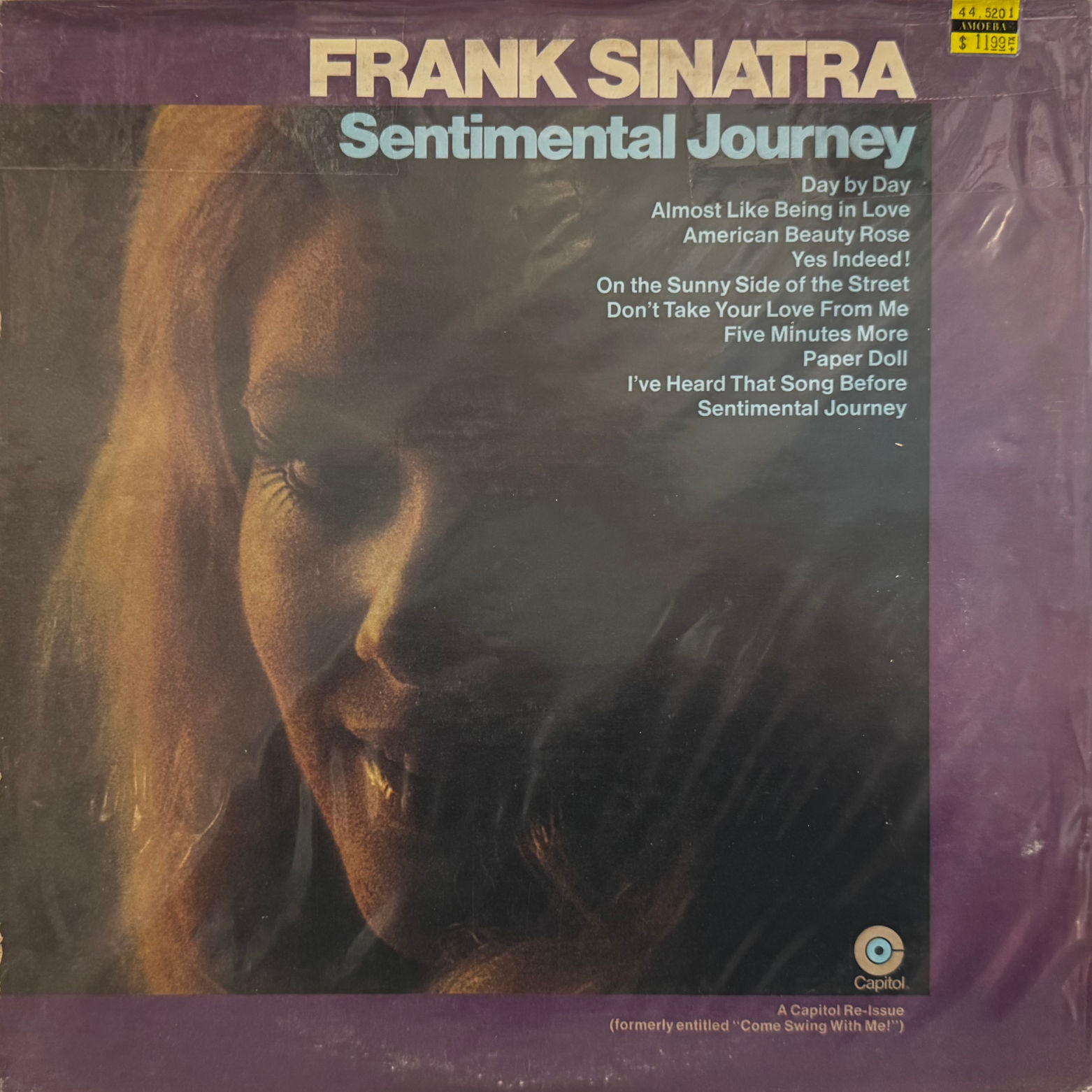
Sentimental Journey
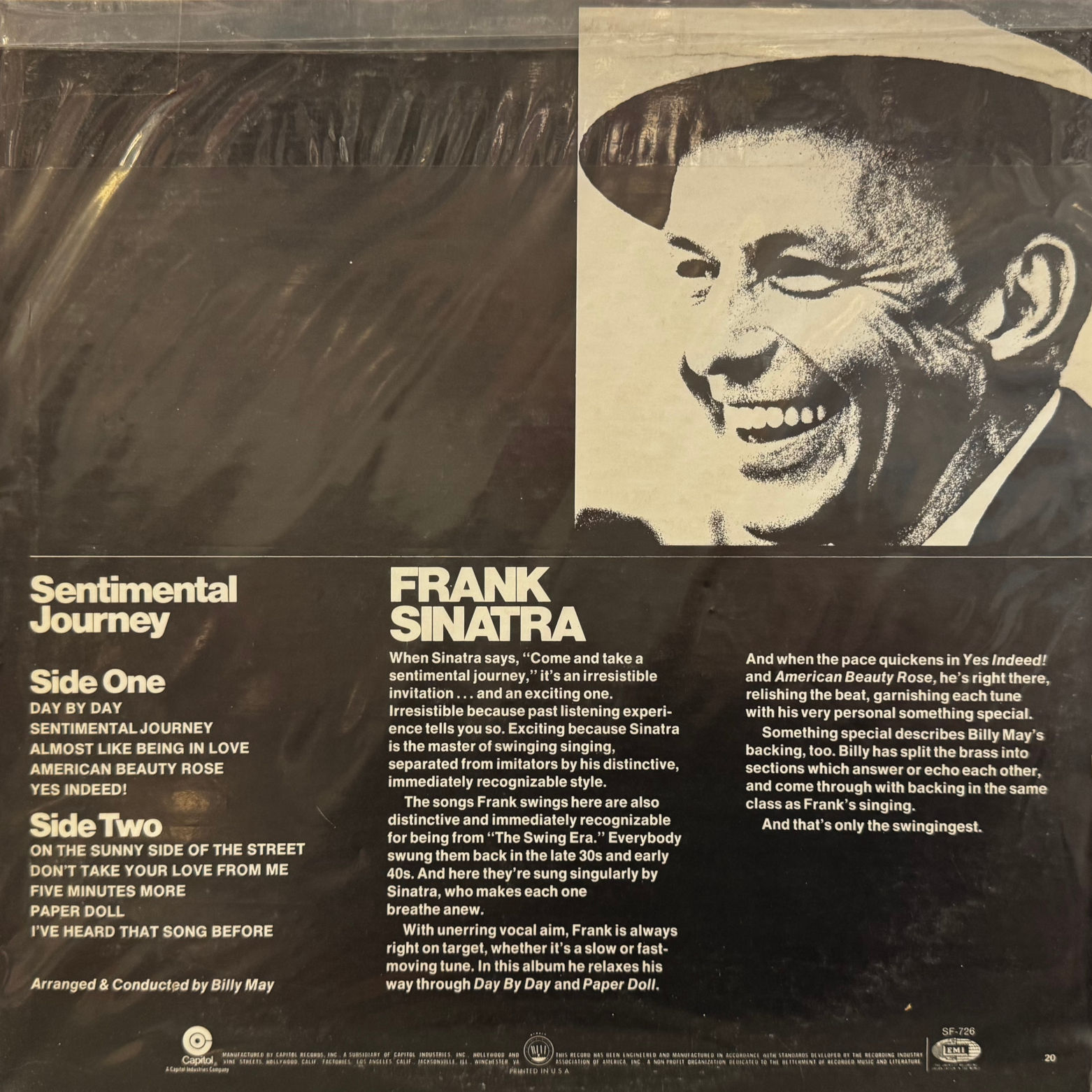
Arranged & Conducted by Billy May
When Sinatra says, "Come and take a sentimental journey," it's an irresistible invitation... and an exciting one. Irresistible because past listening experience tells you so. Exciting because Sinatra is the master of swinging singing, separated from imitators by his distinctive, immediately recognizable style.
The songs Frank swings here are also distinctive and immediately recognizable for being from "The Swing Era." Everybody swung them back in the late 30s and early 40s. And here they're sung singularly by Sinatra, who makes each one breathe anew.
With unerring vocal aim, Frank is always right on target, whether it's a slow or fast-moving tune. In this album he relaxes his way through Day By Day and Paper Doll.
And when the pace quickens in Yes Indeed! and American Beauty Rose, he's right there, relishing the beat, garnishing each tune with his very personal something special.
Something special describes Billy May's backing, too. Billy has split the brass into sections which answer or echo each other, and come through with backing in the same class as Frank's singing.
And that's only the swingingest.
Side One
- Day By Day
- Sentimental Journey
- Almost Like Being in Love
- American Beauty Rose
- Yes Indeed!
Side Two
- On The Sunny Side of The Street
- Don't Take Your Love from Me
- Five Minutes More
- Paper Doll
- I've Heard That Song Before
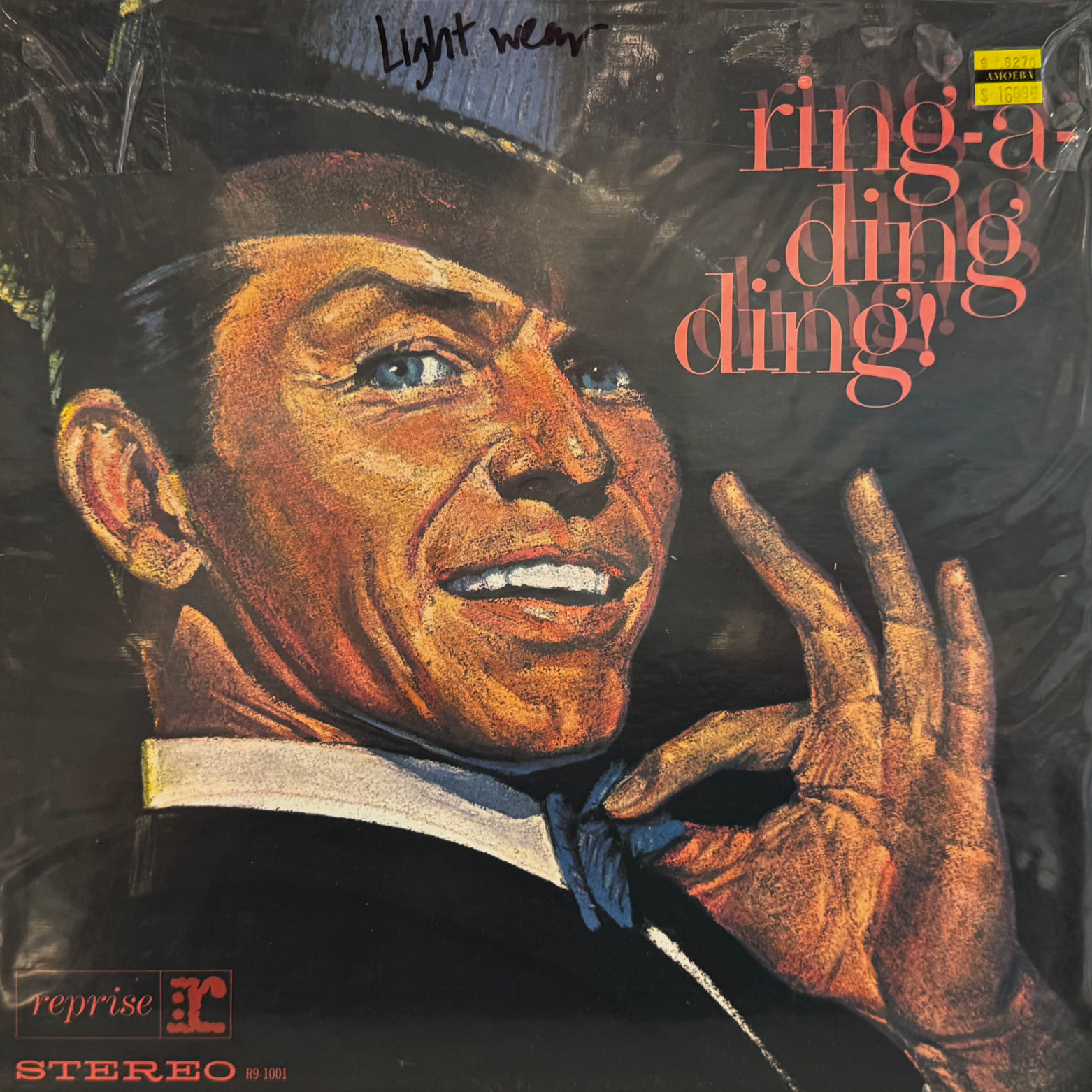
Ring a Ding Ding
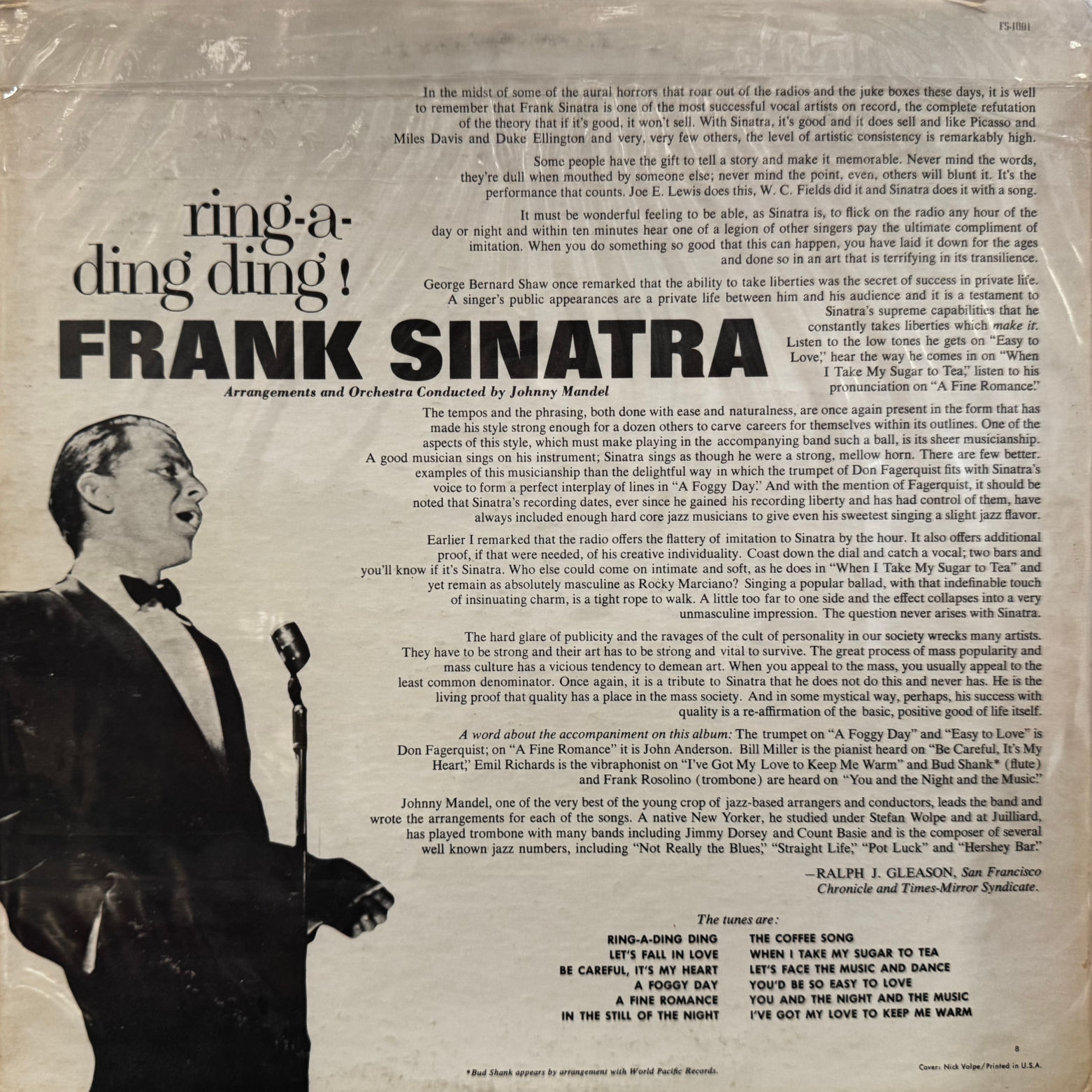
Arrangements and Orchestra Conducted by Johnny Mandel
In the midst of some of the aural horrors that roar out of the radios and the juke boxes these days, it is well to remember that Frank Sinatra is one of the most successful vocal artists on record, the complete refutation of the theory that if it's good, it won't sell. With Sinatra, it's good and it does sell and like Picasso and Miles Davis and Duke Ellington and very, very few others, the level of artistic consistency is remarkably high.
Some people have the gift to tell a story and make it memorable. Never mind the words, they're dull when mouthed by someone else; never mind the point, even, others will blunt it. It's the performance that counts. Joe E. Lewis does this, W. C. Fields did it and Sinatra does it with a song.
It must be wonderful feeling to be able, as Sinatra is, to flick on the radio any hour of the day or night and within ten minutes hear one of a legion of other singers pay the ultimate compliment of imitation. When you do something so good that this can happen, you have laid it down for the ages and done so in an art that is terrifying in its transilience.
George Bernard Shaw once remarked that the ability to take liberties was the secret of success in private life. A singer's public appearances are a private life between him and his audience and it is a testament to Sinatra's supreme capabilities that he constantly takes liberties which make it. Listen to the low tones he gets on "Easy to Love," hear the way he comes in on "When I Take My Sugar to Tea," listen to his pronunciation on "A Fine Romance."
The tempos and the phrasing, both done with ease and naturalness, are once again present in the form that has made his style strong enough for a dozen others to carve careers for themselves within its outlines. One of the aspects of this style, which must make playing in the accompanying band such a ball, is its sheer musicianship. A good musician sings on his instrument; Sinatra sings as though he were a strong, mellow horn. There are few better. examples of this musicianship than the delightful way in which the trumpet of Don Fagerquist fits with Sinatra's voice to form a perfect interplay of lines in "A Foggy Day." And with the mention of Fagerquist, it should be noted that Sinatra's recording dates, ever since he gained his recording liberty and has had control of them, have always included enough hard core jazz musicians to give even his sweetest singing a slight jazz flavor.
Earlier I remarked that the radio offers the flattery of imitation to Sinatra by the hour. It also offers additional proof, if that were needed, of his creative individuality. Coast down the dial and catch a vocal; two bars and you'll know if it's Sinatra. Who else could come on intimate and soft, as he does in "When I Take My Sugar to Tea" and yet remain as absolutely masculine as Rocky Marciano? Singing a popular ballad, with that indefinable touch of insinuating charm, is a tight rope to walk. A little too far to one side and the effect collapses into a very unmasculine impression. The question never arises with Sinatra.
The hard glare of publicity and the ravages of the cult of personality in our society wrecks many artists. They have to be strong and their art has to be strong and vital to survive. The great process of mass popularity and mass culture has a vicious tendency to demean art. When you appeal to the mass, you usually appeal to the least common denominator. Once again, it is a tribute to Sinatra that he does not do this and never has. He is the living proof that quality has a place in the mass society. And in some mystical way, perhaps, his success with quality is a re-affirmation of the basic, positive good of life itself.
A word about the accompaniment on this album: The trumpet on "A Foggy Day" and "Easy to Love" is Don Fagerquist; on "A Fine Romance" it is John Anderson, Bill Miller is the pianist heard on "Be Careful, It's My Heart? Emil Richards is the vibraphonist on "I've Got My Love to Keep Me Warm" and Bud Shank* (flute) and Frank Rosolino (trombone) are heard on "You and the Night and the Music."
Johnny Mandel, one of the very best of the young crop of jazz-based arrangers and conductors, leads the band and wrote the arrangements for each of the songs, A native New Yorker, he studied under Stefan Wolpe and at Juilliard, has played trombone with many bands including Jimmy Dorsey and Count Basie and is the composer of several well known jazz numbers, including "Not Really the Blues, "Straight Life,' "Pot Luck" and "Hershey Bar"
- Ralph J. Gleason, San Francisco Chronicle and Times-Mirror Syndicate.
The Tunes Are:
- Ring-A-Ding Ding
- Let's Fall in Love
- Be Careful, It's My Heart
- A Foggy Day
- A Fine Romance
- In the Still of the Night
- The Coffee Song
- When I Take My Sugar to Tea
- Let's Face The Music and Dance
- You'd Be So Easy to Love
- You and The Night and The Music
- I've Got My Love to Keep Me Warm
As an Amazon Associate we earn from qualifying purchases
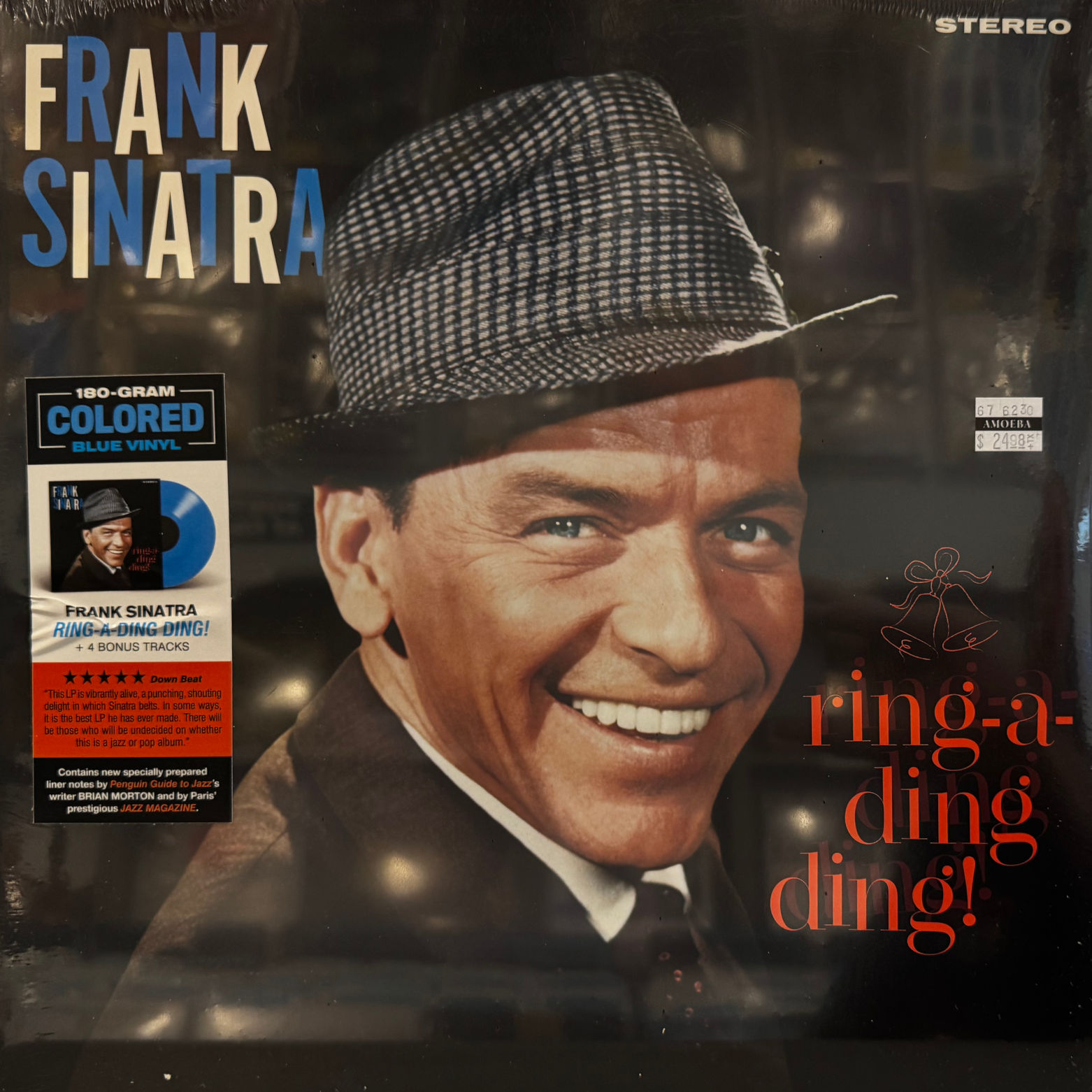
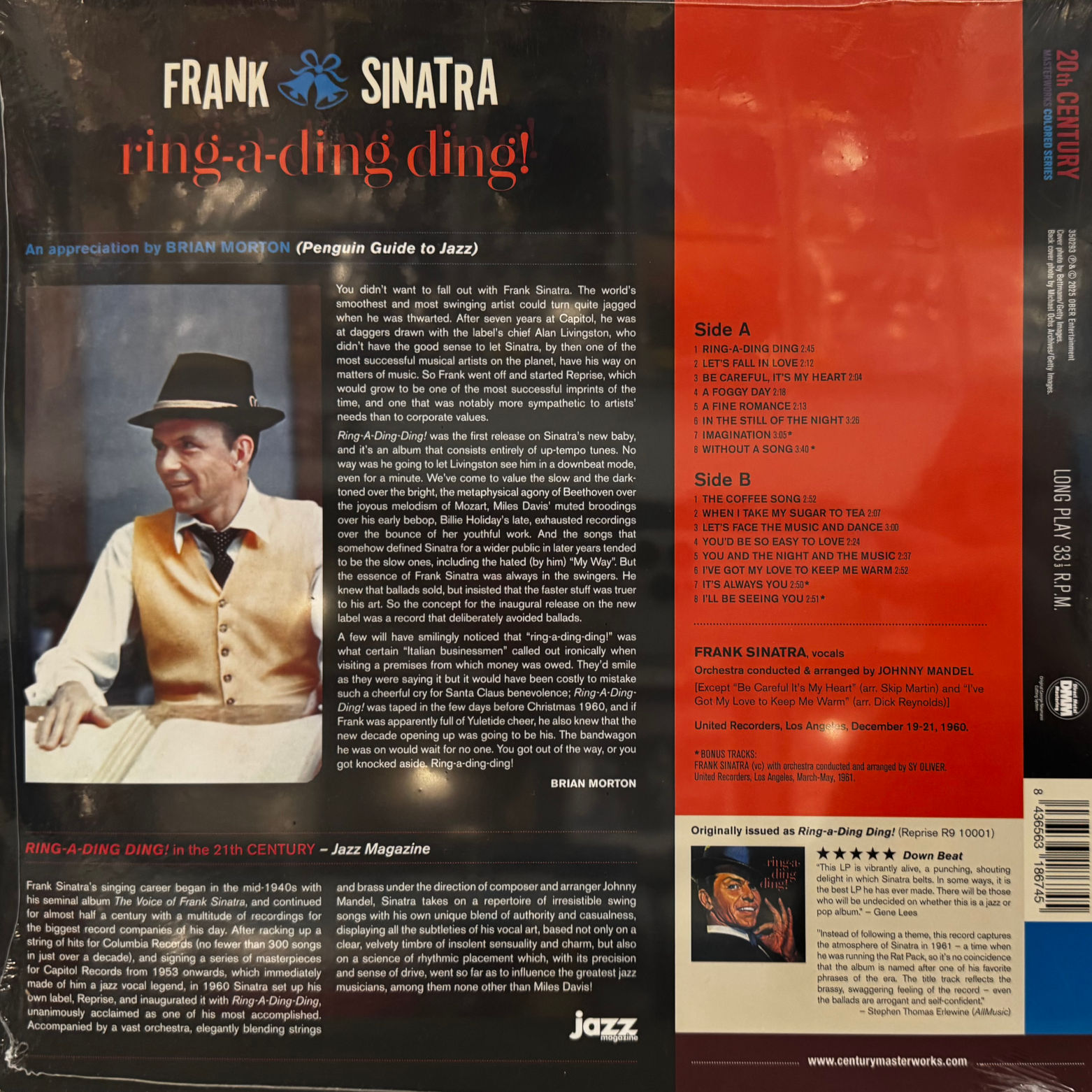
Ring a Ding Ding
Orchestra Conducted and Arranged by Johnny Mandel
An appreciation by Brian Morton (Penguin Guide to Jazz)
- The Penguin Guide to Jazz
[https://www.amazon.com/dp/0140153640]
You didn't want to fall out with Frank Sinatra. The world's smoothest and most swinging artist could turn quite jagged when he was thwarted. After seven years at Capitol, he was at daggers drawn with the label's chief Alan Livingston, who didn't have the good sense to let Sinatra, by then one of the most successful musical artists on the planet, have his way on matters of music. So Frank went off and started Reprise, which would grow to be one of the most successful imprints of the time, and one that was notably more sympathetic to artists needs than to corporate values.
Ring-A-Ding-Ding! was the first release on Sinatra's new baby, and it's an album that consists entirely of up-tempo tunes. No way was he going to let Livingston see him in a downbeat mode, even for a minute. We've come to value the slow and the dark-toned over the bright, the metaphysical agony of Beethoven over the joyous melodism of Mozart, Miles Davis' muted broodings over his early bebop, Billie Holiday's late, exhausted recordings over the bounce of her youthful work. And the songs that somehow defined Sinatra for a wider public in later years tended to be the slow ones, including the hated (by him) "My Way". But the essence of Frank Sinatra was always in the swingers. He knew that ballads sold, but insisted that the faster stuff was truer to his art. So the concept for the inaugural release on the new label was a record that deliberately avoided ballads.
A few will have smilingly noticed that "ring-a-ding-ding!" was what certain "Italian businessmen" called out ironically when visiting a premises from which money was owed. They'd smile as they were saying it but it would have been costly to mistake such a cheerful cry for Santa Claus benevolence; Ring-A-Ding-Ding! was taped in the few days before Christmas 1960, and if Frank was apparently full of Yuletide cheer, he also knew that the new decade opening up was going to be his. The bandwagon he was on would wait for no one. You got out of the way, or you got knocked aside. Ring-a-ding-ding!
Brian Morton
RING-A-DING DING! in the 21th CENTURY - Jazz Magazine
Frank Sinatra's singing career began in the mid-1940s with his seminal album The Voice of Frank Sinatra, and continued for almost half a century with a multitude of recordings for the biggest record companies of his day. After racking up a string of hits for Columbia Records (no fewer than 300 songs in just over a decade), and signing a series of masterpieces for Capitol Records from 1953 onwards, which immediately made of him a jazz vocal legend, in 1960 Sinatra set up his own label, Reprise, and inaugurated it with Ring-A-Ding-Ding, unanimously acclaimed as one of his most accomplished. Accompanied by a vast orchestra, elegantly blending strings and brass under the direction of composer and arranger Johnny Mandel, Sinatra takes on a repertoire of irresistible swing songs with his own unique blend of authority and casualness, displaying all the subtleties of his vocal art, based not only on a clear, velvety timbre of insolent sensuality and charm, but also on a science of rhythmic placement which, with its precision and sense of drive, went so far as to influence the greatest jazz musicians, among them none other than Miles Davis!
Jazz Magazine
Side A
- Ring-A-Ding Ding
- Let's Fall in Love
- Be Careful, It's My Heart
- A Foggy Day
- A Fine Romance
- In the Still of the Night
- Imagination
- Without a Song
Side B
- The Coffee Song
- When I Take My Sugar to Tea
- Let's Face The Music and Dance
- You'd Be So Easy to Love
- You and The Night and The Music
- I've Got My Love to Keep Me Warm
- It's Always You
- I'll Be Seeing You
As an Amazon Associate we earn from qualifying purchases
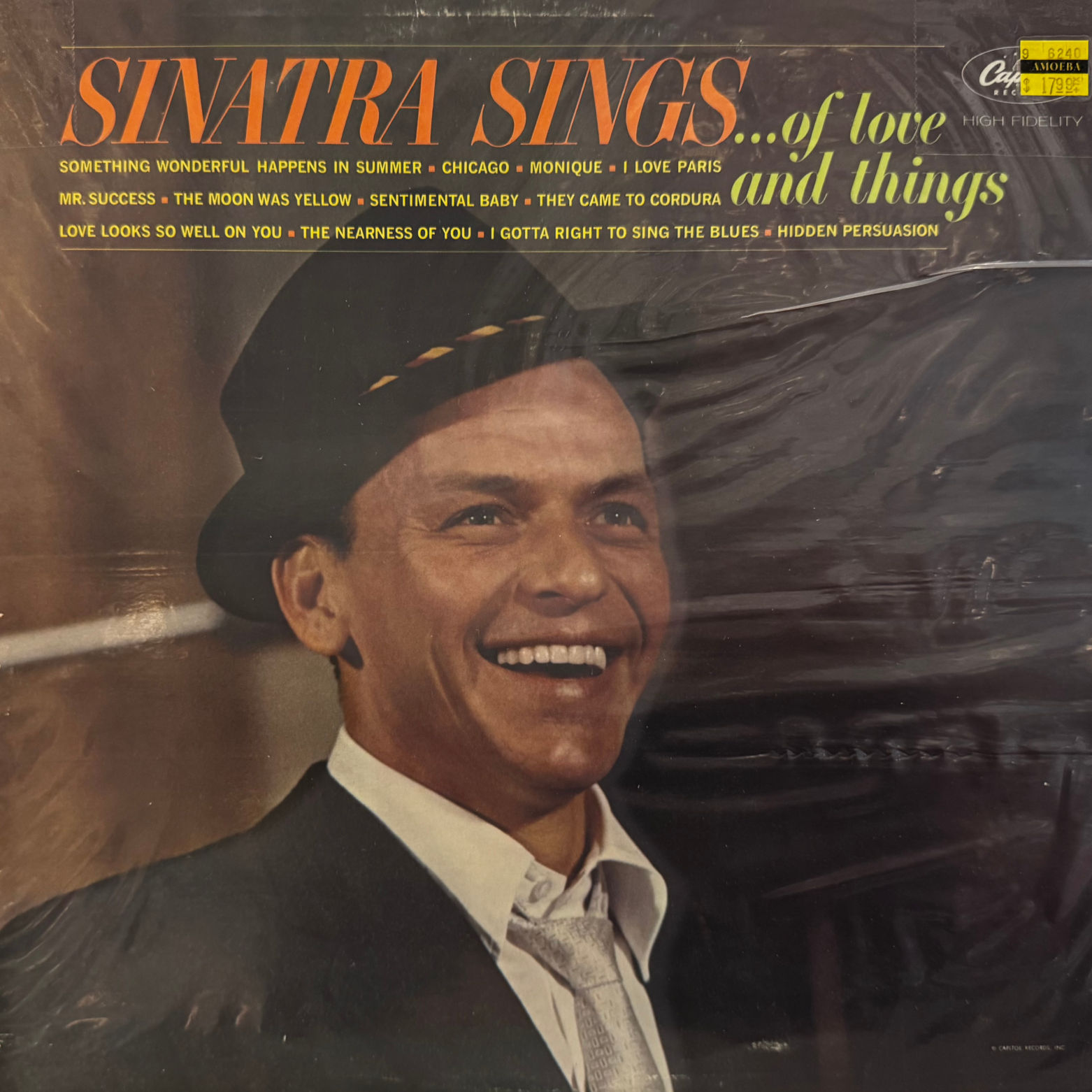
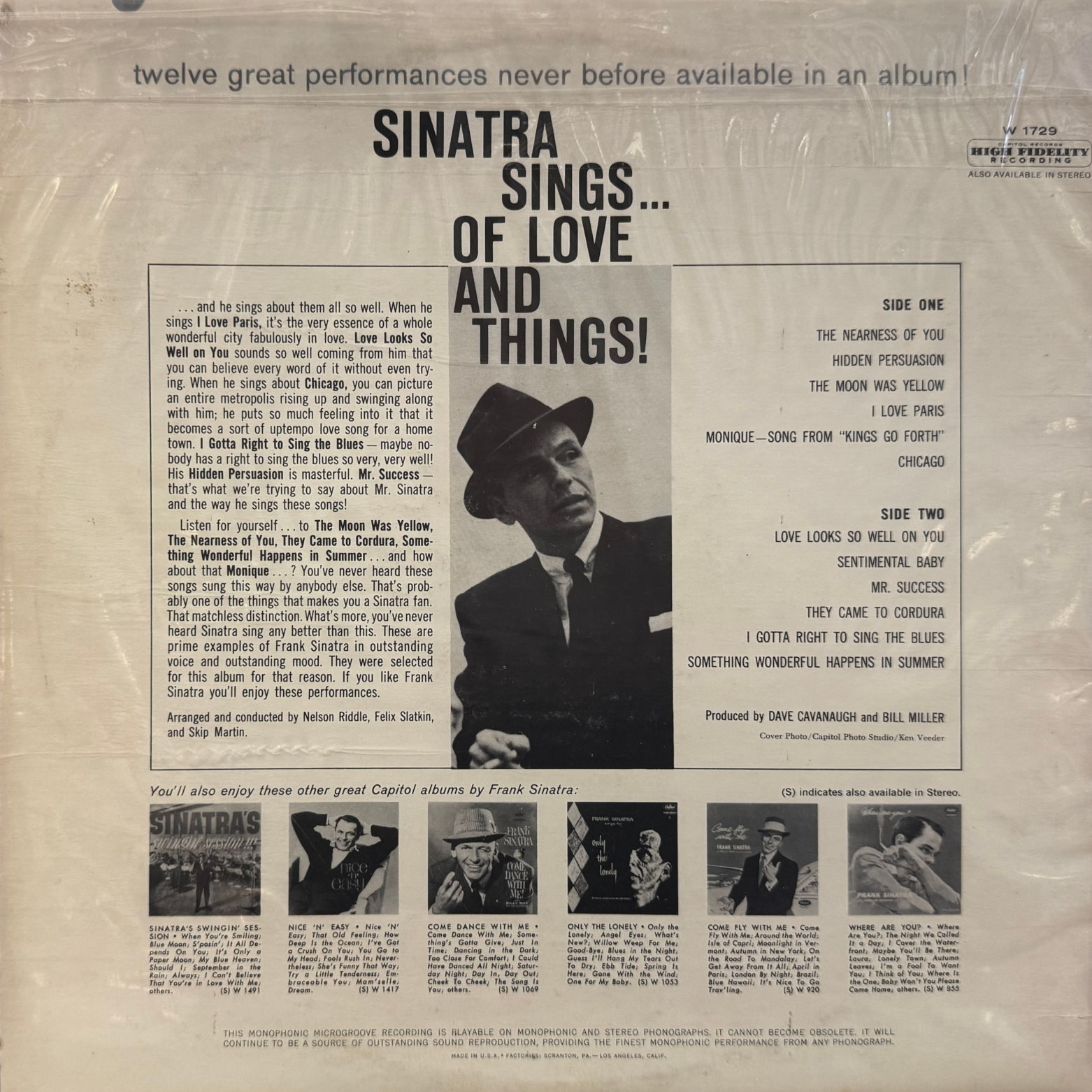
Sinatra Sings
Of Love and Things
... and he sings about them all so well. When he sings I Love Paris, it's the very essence of a whole wonderful city fabulously in love. Love Looks So Well on You sounds so well coming from him that you can believe every word of it without even trying. When he sings about Chicago, you can picture an entire metropolis rising up and swinging along with him; he puts so much feeling into it that it becomes a sort of uptempo love song for a home town. I Gotta Right to Sing the Blues - maybe nobody has a right to sing the blues so very, very well! His Hidden Persuasion is masterful. Mr. Success - that's what we're trying to say about Mr. Sinatra and the way he sings these songs!
Listen for yourself... to The Moon Was Yellow, The Nearness of You, They Came to Cordura, Something Wonderful Happens in Summer... and how about that Monique...? You've never heard these songs sung this way by anybody else. That's probably one of the things that makes you a Sinatra fan. That matchless distinction. What's more, you've never heard Sinatra sing any better than this. These are prime examples of Frank Sinatra in outstanding voice and outstanding mood. They were selected for this album for that reason. If you like Frank Sinatra you'll enjoy these performances.
Arranged and conducted by Nelson Riddle, Felix Slatkin, and Skip Martin.
Side One
- The Nearness of You
- Hidden Persuasion
- The Moon Was Yellow
- I Love Paris
- Monique - Song from "Kings Go Forth"
- Chicago
Side Two
- Love Looks So Well on You
- Sentimental Baby
- Mr. Success
- They Came to Cordura
- I Gotta Right to Sing The Blues
- Something Wonderful Happens in Summer
As an Amazon Associate we earn from qualifying purchases
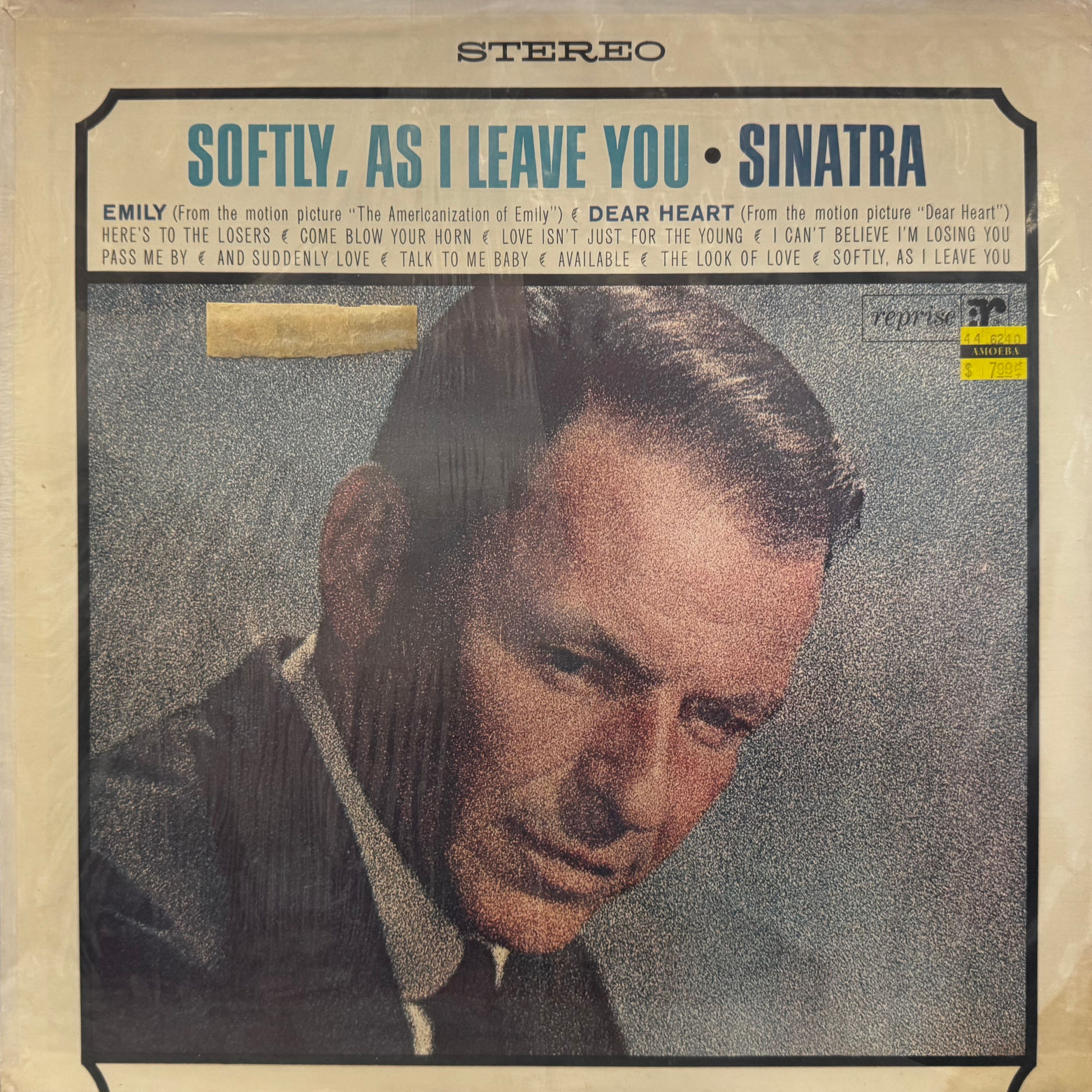
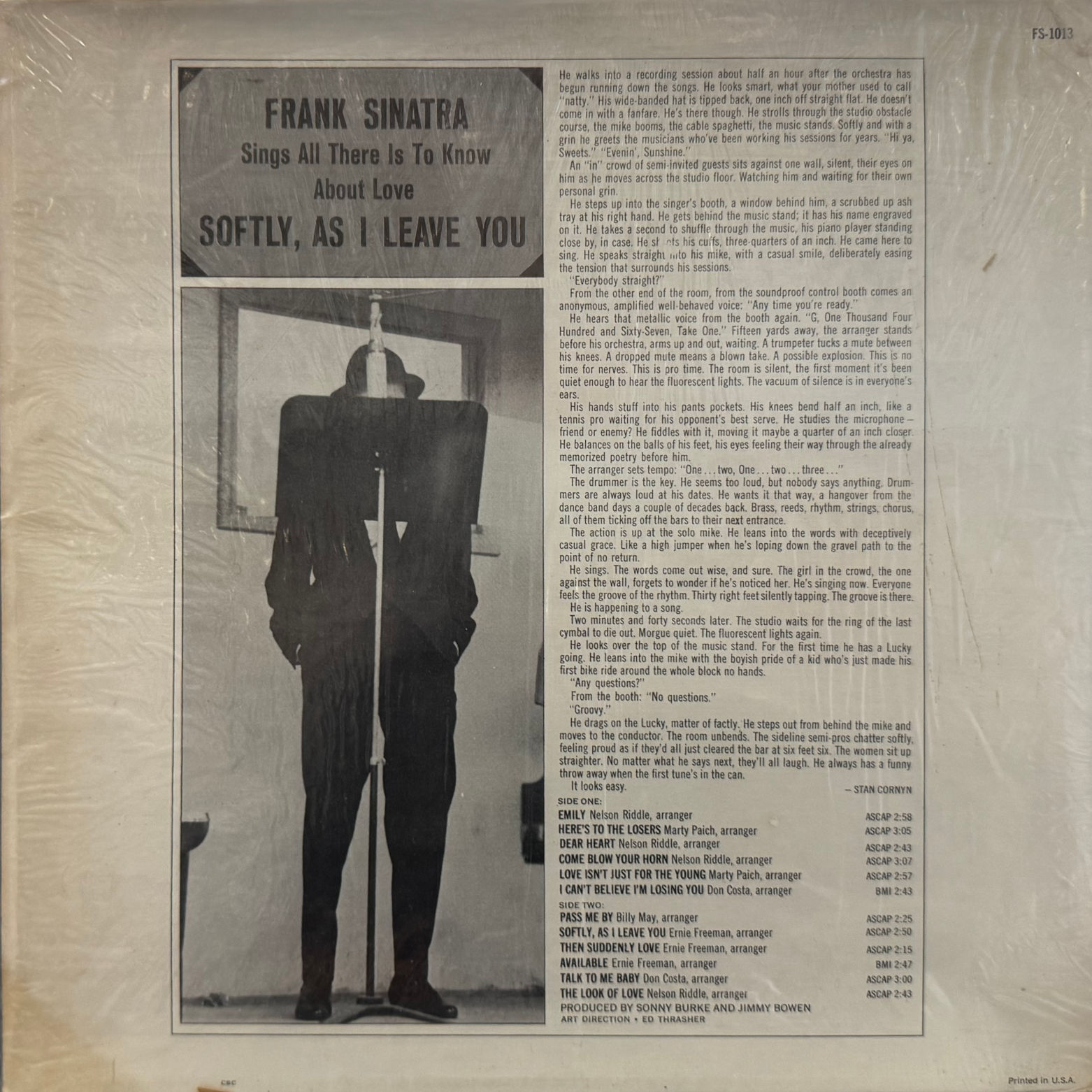
Softly As I Leave You
Frank Sinatra Sings all there is to know about love
He walks into a recording session about half an hour after the orchestra has begun running down the songs. He looks smart, what your mother used to call "natty." His wide-banded hat is tipped back, one inch off straight flat. He doesn't come in with a fanfare. He's there though. He strolls through the studio obstacle course, the mike booms, the cable spaghetti, the music stands. Softly and with a grin he greets the musicians who've been working his sessions for years. "Hi ya Sweets." "Evenin', Sunshine."
An "in" crowd of semi-invited guests sits against one wall, silent, their eyes on him as he moves across the studio floor. Watching him and waiting for their own personal grin.
He steps up into the singer's booth, a window behind him, a scrubbed up ash tray at his right hand. He gets behind the music stand; it has his name engraved on it. He takes a second to shuffle through the music, his piano player standing close by, in case. He shoots his cuffs, three-quarters of an inch. He came here to sing. He speaks straight to his mike, with a casual smile, deliberately easing the tension that surrounds his sessions.
"Everybody straight?"
From the other end of the room, from the soundproof control booth comes an anonymous, amplified well-behaved voice: "Any time you're ready."
He hears that metallic voice from the booth again. "G, One Thousand Four Hundred and Sixty-Seven, Take One." Fifteen yards away, the arranger stands before his orchestra, arms up and out, waiting. A trumpeter tucks a mute between his knees. A dropped mute means a blown take. A possible explosion. This is no time for nerves. This is pro time. The room is silent, the first moment it's been quiet enough to hear the fluorescent lights. The vacuum of silence is in everyone's ears.
His hands stuff into his pants pockets. His knees bend half an inch, like a tennis pro waiting for his opponent's best serve. He studies the microphone - friend or enemy? He fiddles with it, moving it maybe a quarter of an inch closer. He balances on the balls of his feet, his eyes feeling their way through the already memorized poetry before him.
The arranger sets tempo: "One... two, One... two... three...
The drummer is the key. He seems too loud, but nobody says anything. Drummers are always loud at his dates. He wants it that way, a hangover from the dance band days a couple of decades back. Brass, reeds, rhythm, strings, chorus, all of them ticking off the bars to their next entrance.
The action is up at the solo mike. He leans into the words with deceptively casual grace. Like a high jumper when he's loping down the gravel path to the point of no return.
He sings. The words come out wise, and sure. The girl in the crowd, the one against the wall, forgets to wonder if he's noticed her. He's singing now. Everyone feels the groove of the rhythm. Thirty right feet silently tapping. The groove is there.
He is happening to a song.
Two minutes and forty seconds later. The studio waits for the ring of the last cymbal to die out. Morgue quiet. The fluorescent lights again.
He looks over the top of the music stand. For the first time he has a Lucky going. He leans into the mike with the boyish pride of a kid who's just made his first bike ride around the whole block no hands.
"Any questions?"
From the booth: "No questions."
He drags on the Lucky, matter of factly. He steps out from behind the mike and moves to the conductor. The room unbends. The sideline semi-pros chatter softly, feeling proud as if they'd all just cleared the bar at six feet six. The women sit up straighter. No matter what he says next, they'll all laugh. He always has a funny throw away when the first tune's in the can.
It looks easy.
Stan Cornyn
Side One
- Emily
- Here's to The Losers
- Dear Heart
- Come Blow Your Horn
- Love Isn't Just For The Young
- I Can't Believe I'm Losing You
Side Two
- Pass Me By
- Softly
- As I Leave You
- Then Suddenly Love
- Available
- Talk to Me Baby
- The Look of Love
As an Amazon Associate we earn from qualifying purchases
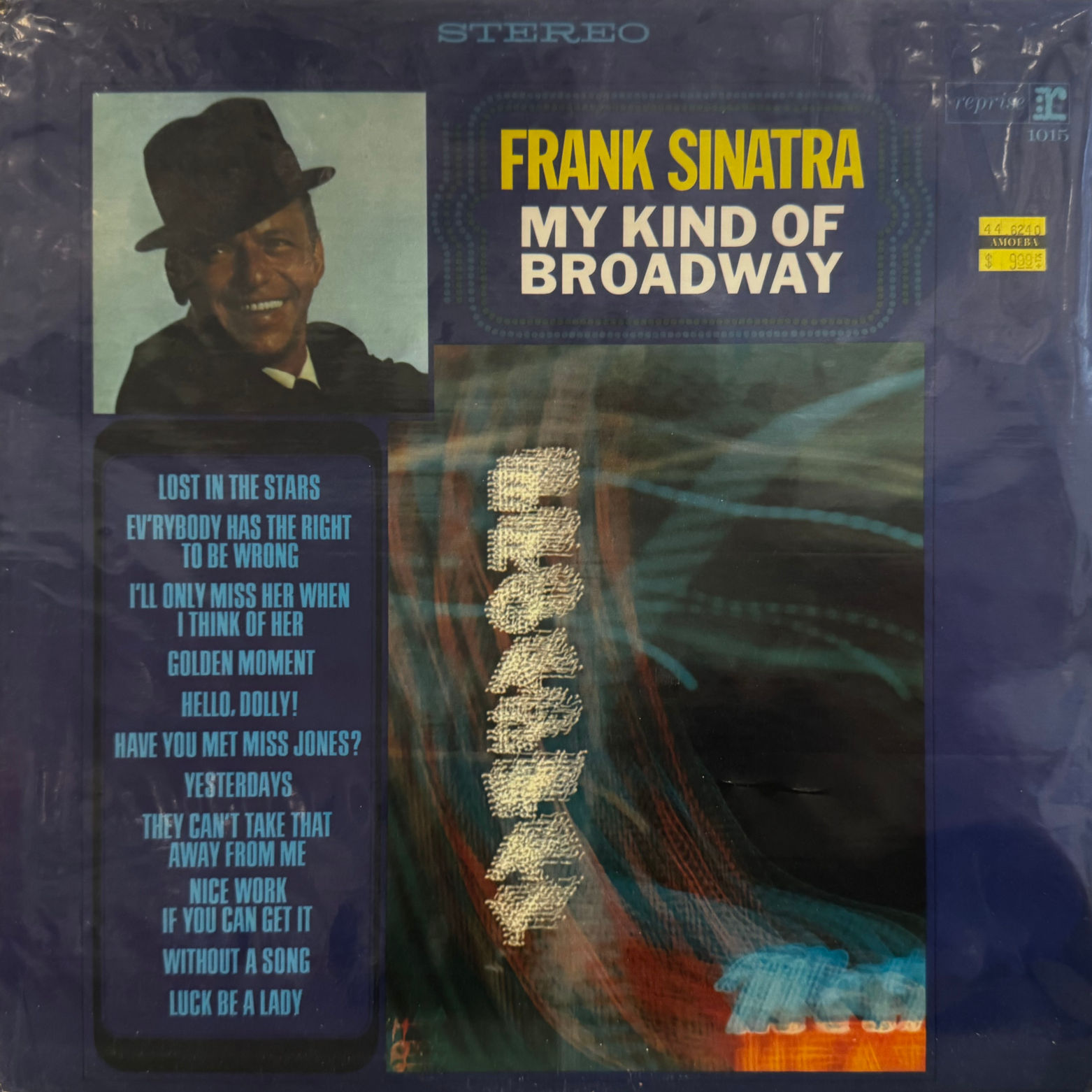
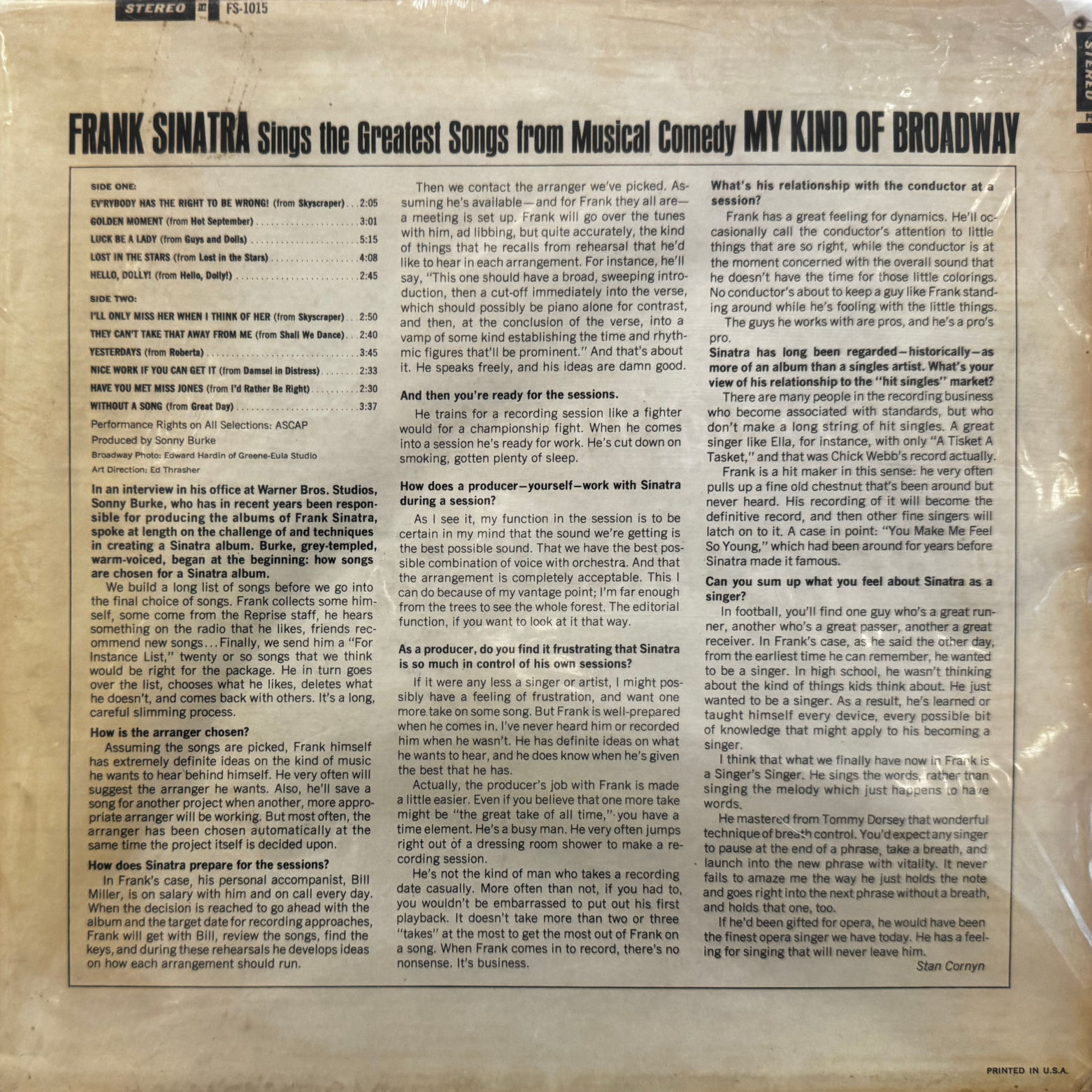
My Kind of Broadway
Frank Sinatra sings the Greatest Songs from the Musical Comedy
In an interview in his office at Warner Bros. Studios, Sonny Burke, who has in recent years been responsible for producing the albums of Frank Sinatra, spoke at length on the challenge of and techniques in creating a Sinatra album. Burke, grey-templed, warm-voiced, began at the beginning: how songs are chosen for a Sinatra album.
We build a long list of songs before we go into the final choice of songs. Frank collects some himself, some come from the Reprise staff, he hears something on the radio that he likes, friends recommend new songs...Finally, we send him a "For Instance List," twenty or so songs that we think would be right for the package. He in turn goes over the list, chooses what he likes, deletes what he doesn't, and comes back with others. It's a long, careful slimming process.
How is the arranger chosen?
Assuming the songs are picked, Frank himself has extremely definite ideas on the kind of music he wants to hear behind himself. He very often will suggest the arranger he wants. Also, he'll save a song for another project when another, more appropriate arranger will be working. But most often, the arranger has been chosen automatically at the same time the project itself is decided upon.
How does Sinatra prepare for the sessions?
In Frank's case, his personal accompanist, Bill Miller, is on salary with him and on call every day. When the decision is reached to go ahead with the album and the target date for recording approaches, Frank will get with Bill, review the songs, find the keys, and during these rehearsals he develops ideas on how each arrangement should run.
Then we contact the arranger we've picked. Assuming he's available and for Frank they all are - a meeting is set up. Frank will go over the tunes with him, ad libbing, but quite accurately, the kind of things that he recalls from rehearsal that he'd like to hear in each arrangement. For instance, he'll say, "This one should have a broad, sweeping introduction, then a cut-off immediately into the verse, which should possibly be piano alone for contrast, and then, at the conclusion of the verse, into a vamp of some kind establishing the time and rhythmic figures that'll be prominent." And that's about it. He speaks freely, and his ideas are damn good.
And then you're ready for the sessions.
He trains for a recording session like a fighter would for a championship fight. When he comes into a session he's ready for work. He's cut down on smoking, gotten plenty of sleep.
How does a producer - yourself - work with Sinatra during a session?
As I see it, my function in the session is to be certain in my mind that the sound we're getting is the best possible sound. That we have the best possible combination of voice with orchestra. And that the arrangement is completely acceptable. This I can do because of my vantage point; I'm far enough from the trees to see the whole forest. The editorial. function, if you want to look at it that way.
As a producer, do you find it frustrating that Sinatra is so much in control of his own sessions?
If it were any less a singer or artist, I might possibly have a feeling of frustration, and want one more take on some song. But Frank is well-prepared when he comes in. I've never heard him or recorded him when he wasn't. He has definite ideas on what he wants to hear, and he does know when he's given the best that he has.
Actually, the producer's job with Frank is made a little easier. Even if you believe that one more take might be "the great take of all time," you have a time element. He's a busy man. He very often jumps right out of a dressing room shower to make a recording session.
He's not the kind of man who takes a recording date casually. More often than not, if you had to, you wouldn't be embarrassed to put out his first playback. It doesn't take more than two or three "takes" at the most to get the most out of Frank on a song. When Frank comes in to record, there's no nonsense. It's business.
What's his relationship with the conductor at a session?
Frank has a great feeling for dynamics. He'll occasionally call the conductor's attention to little things that are so right, while the conductor is at the moment concerned with the overall sound that he doesn't have the time for those little colorings. No conductor's about to keep a guy like Frank standing around while he's fooling with the little things. The guys he works with are pros, and he's a pro's pro.
Sinatra has long been regarded - historically - as more of an album than a singles artist. What's your view of his relationship to the "hit singles" market?
There are many people in the recording business who become associated with standards, but who don't make a long string of hit singles. A great singer like Ella, for instance, with only "A Tisket A Tasket," and that was Chick Webb's record actually.
Frank is a hit maker in this sense: he very often pulls up a fine old chestnut that's been around but never heard. His recording of it will become the definitive record, and then other fine singers will latch on to it. A case in point: "You Make Me Feel So Young," which had been around for years before Sinatra made it famous.
Can you sum up what you feel about Sinatra as a singer?
In football, you'll find one guy who's a great runner, another who's a great passer, another a great receiver. In Frank's case, as he said the other day, from the earliest time he can remember, he wanted to be a singer. In high school, he wasn't thinking about the kind of things kids think about. He just wanted to be a singer. As a result, he's learned or taught himself every device, every possible bit of knowledge that might apply to his becoming a singer.
I think that what we finally have now in Frank is a Singer's Singer. He sings the words, rather than singing the melody which just happens to have words.
He mastered from Tommy Dorsey that wonderful technique of breath control. You'd expect any singer to pause at the end of a phrase, take a breath, and launch into the new phrase with vitality. It never fails to amaze me the way he just holds the note and goes right into the next phrase without a breath, and holds that one, too.
If he'd been gifted for opera, he would have been the finest opera singer we have today. He has a feeling for singing that will never leave him.
Stan Cornyn
Side A
- Ev'rybody Has The Right to Be Wrong!
- Golden Moment
- Luck Be a Lady
- Lost in The Stars
- Hello
- Dolly!
Side B
- I'll Only Miss Her When I Think of Her
- They Can't Take That Away from Me
- Yesterdays
- Nice Work If You Can Get It
- Have You Met Miss Jones?
- Without a Song
- YOUTUBE:
[https://www.youtube.com/playlist?list=OLAK5uy] - SPOTIFY:
[https://open.spotify.com/album/4pA0MHfxB10F9Q8HhoItIh] - APPLE MUSIC:
[https://music.apple.com/us/album/1443402534] - AMAZON:
[https://www.amazon.com/dp/B000006L3R]
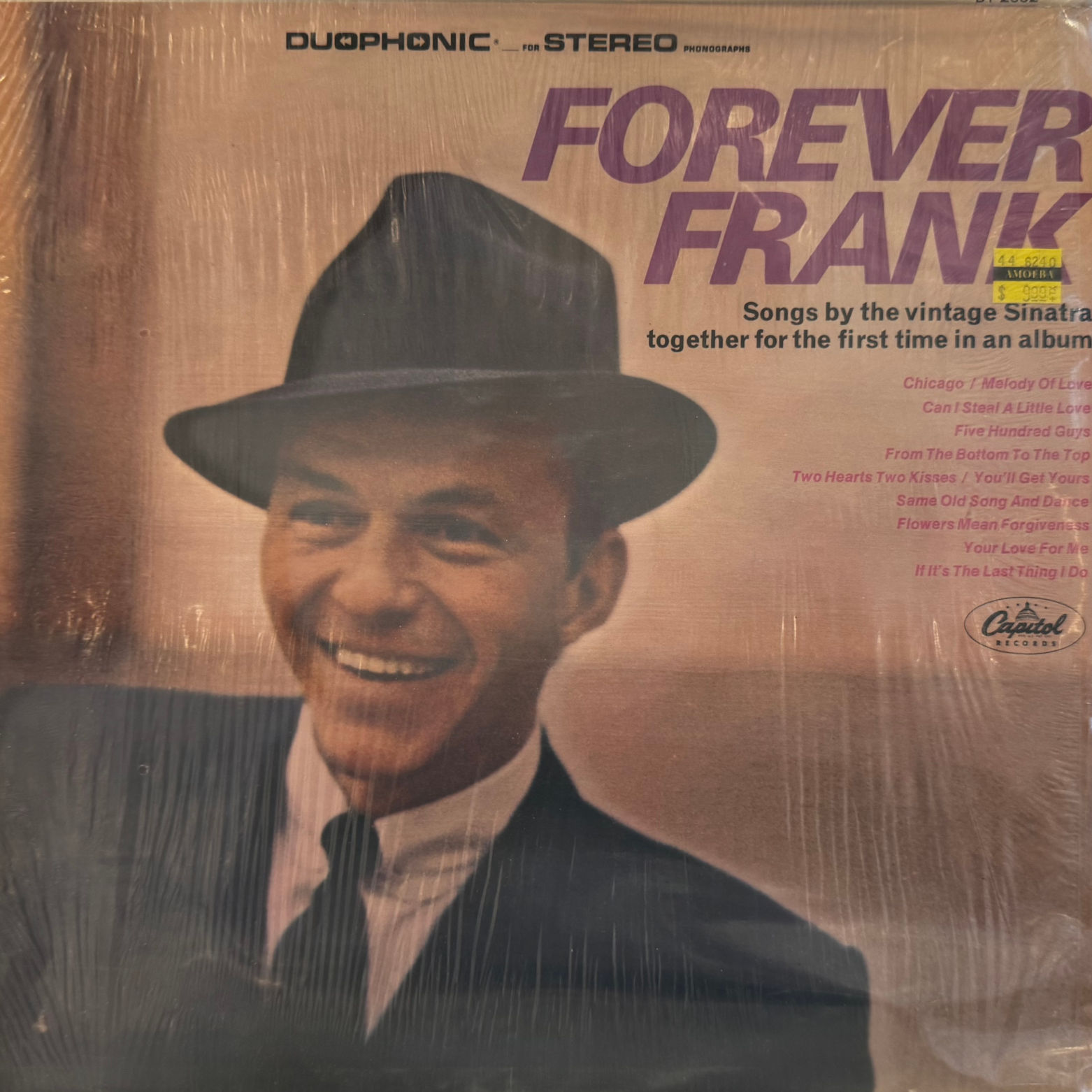
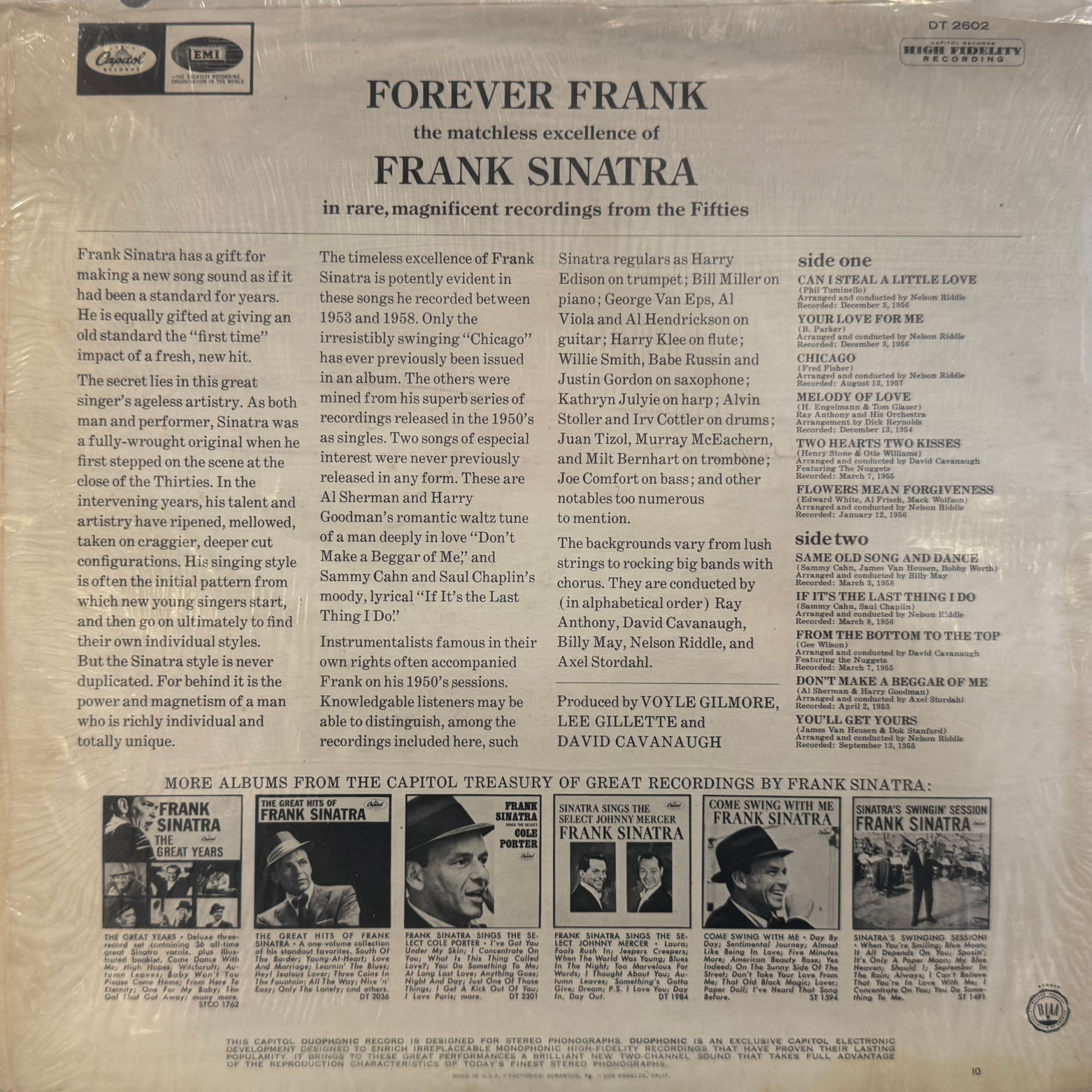
Forever Frank
Songs by the vintage Sinatra together for the first time in an album
Frank Sinatra has a gift for making a new song sound as if it had been a standard for years. He is equally gifted at giving an old standard the "first time" impact of a fresh, new hit.
The secret lies in this great singer's ageless artistry. As both man and performer, Sinatra was a fully-wrought original when he first stepped on the scene at the close of the Thirties. In the intervening years, his talent and artistry have ripened, mellowed, taken on craggier, deeper cut configurations. His singing style is often the initial pattern from which new young singers start, and then go on ultimately to find their own individual styles. But the Sinatra style is never duplicated. For behind it is the power and magnetism of a man who is richly individual and totally unique.
The timeless excellence of Frank Sinatra is potently evident in these song's he recorded between 1953 and 1958. Only the irresistibly swinging "Chicago" has ever previously been issued in an album. The others were mined from his superb series of recordings released in the 1950's as singles. Two songs of especial interest were never previously released in any form. These are Al Sherman and Harry Goodman's romantic waltz tune of a man deeply in love "Don't Make a Beggar of Me" and Sammy Cahn and Saul Chaplin's moody, lyrical "If It's the Last Thing I Do."
Instrumentalists famous in their own rights often accompanied Frank on his 1950's sessions.
Knowledgeable listeners may be able to distinguish, among the recordings included here, such Sinatra regulars as Harry Edison on trumpet; Bill Miller on piano; George Van Eps, Al Viola and Al Hendrickson on guitar; Harry Klee on flute; Willie Smith, Babe Russin and Justin Gordon on saxophone; Kathryn Julyie on harp; Alvin Stoller and Irv Cottler on drums; Juan Tizol, Murray MeEachern, and Milt Bernhart on trombone; Joe Comfort on bass; and other notables too numerous to mention.
The backgrounds vary from lush strings to rocking big bands with chorus. They are conducted by (in alphabetical order) Ray Anthony, David Cavanaugh, Billy May, Nelson Riddle, and Axel Stordahl.
Side One
- Can I Steal a Little Love
- Your Love For Me
- Chicago
- Melody of Love
- Two Hearts Two Kisses
- Flowers Mean Forgiveness
Side Two
- Same Old Song and Dance
- If It's The Last Thing I Do
- From The Bottom to The Top
- Don't Make a Beggar of Me
- You'll Get Yours
As an Amazon Associate we earn from qualifying purchases
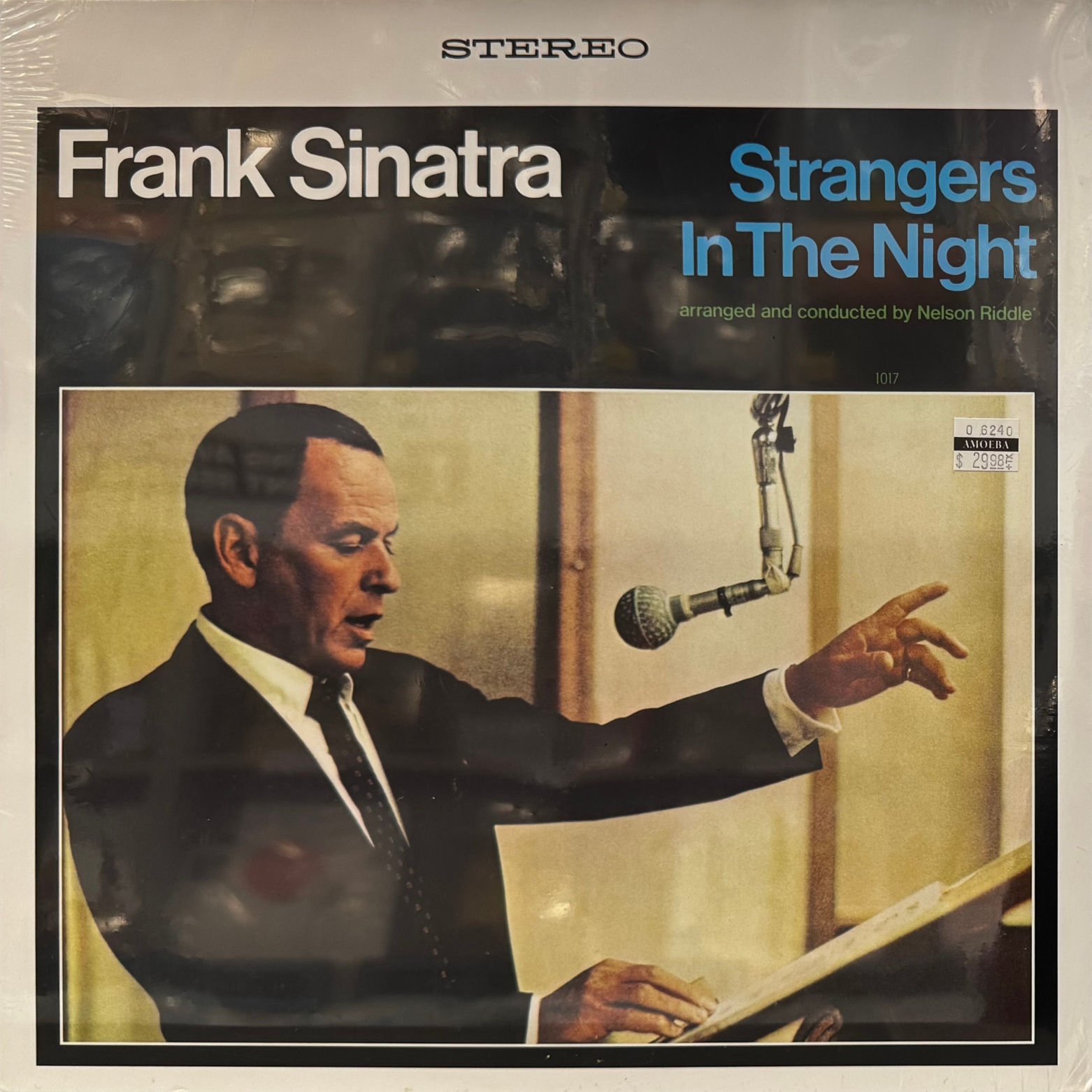
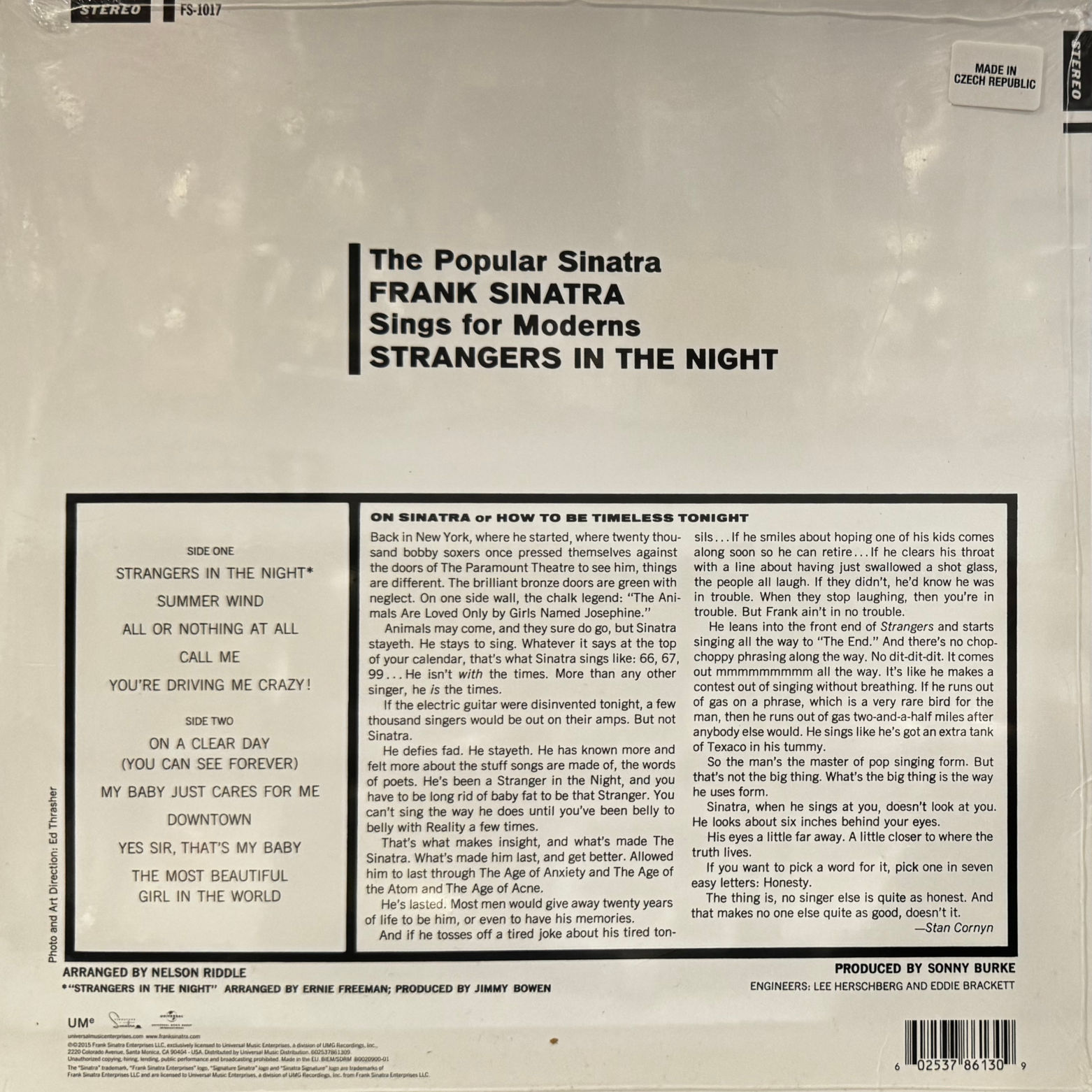
Strangers in the Night
Arranged and Conducted by Nelson Riddle
On Sinatra or How to be Timeless Tonight
Back in New York, where he started, where twenty thousand bobby soxers once pressed themselves against the doors of The Paramount Theatre to see him, things are different. The brilliant bronze doors are green with neglect. On one side wall, the chalk legend: "The Animals Are Loved Only by Girls Named Josephine."
Animals may come, and they sure do go, but Sinatra stayeth. He stays to sing. Whatever it says at the top of your calendar, that's what Sinatra sings like: 66, 67, 99... He isn't with the times. More than any other singer, he is the times.
If the electric guitar were disinvented tonight, a few thousand singers would be out on their amps. But not Sinatra.
He defies fad. He stayeth. He has known more and felt more about the stuff songs are made of, the words of poets. He's been a Stranger in the Night, and you have to be long rid of baby fat to be that Stranger. You can't sing the way he does until you've been belly to belly with Reality a few times.
That's what makes insight, and what's made The Sinatra. What's made him last, and get better. Allowed him to last through The Age of Anxiety and The Age of the Atom and The Age of Acne.
He's lasted. Most men would give away twenty years of life to be him, or even to have his memories.
And if he tosses off a tired joke about his tired tonsils... If he smiles about hoping one of his kids comes along soon so he can retire...If he clears his throat with a line about having just swallowed a shot glass, the people all laugh. If they didn't, he'd know he was in trouble. When they stop laughing, then you're in trouble. But Frank ain't in no trouble.
He leans into the front end of Strangers and starts singing all the way to "The End." And there's no chop-choppy phrasing along the way. No dit-dit-dit. It comes out mmmmmmmmm all the way. It's like he makes a contest out of singing without breathing. If he runs out of gas on a phrase, which is a very rare bird for the man, then he runs out of gas two-and-a-half miles after anybody else would. He sings like he's got an extra tank of Texaco in his tummy.
So the man's the master of pop singing form. But that's not the big thing. What's the big thing is the way he uses form.
Sinatra, when he sings at you, doesn't look at you.
He looks about six inches behind your eyes.
His eyes a little far away. A little closer to where the truth lives.
If you want to pick a word for it, pick one in seven easy letters: Honesty.
The thing is, no singer else is quite as honest. And that makes no one else quite as good, doesn't it.
-Stan Cornyn
Side One
- Strangers in The Night
- Summer Wind
- All or Nothing at All
- Call Me
- You're Driving Me Crazy!
Side Two
- On a Clear Day (You Can See Forever)
- My Baby Just Cares For Me
- Downtown
- Yes Sir, That's My Baby
- The Most Beautiful Girl in The World
As an Amazon Associate we earn from qualifying purchases
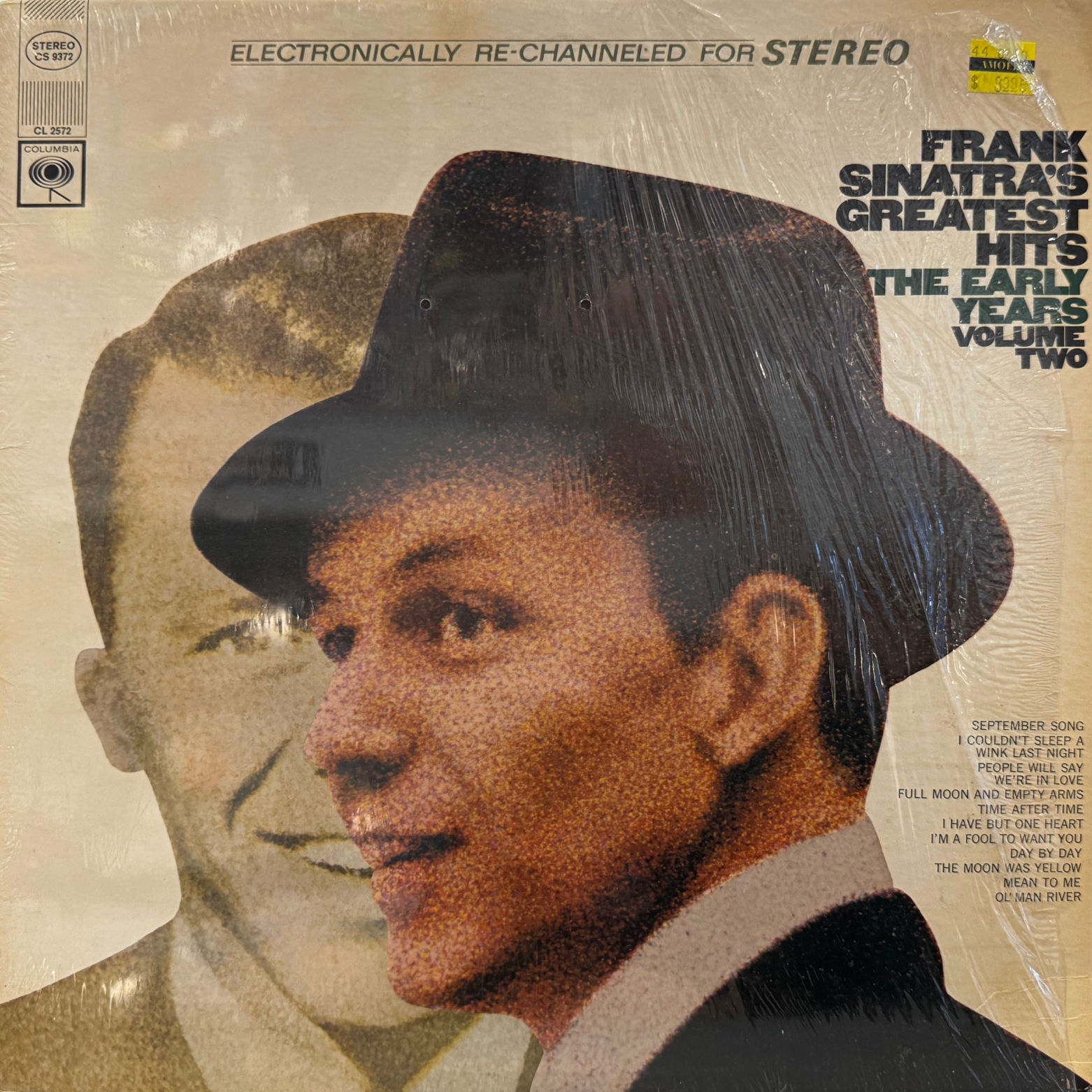
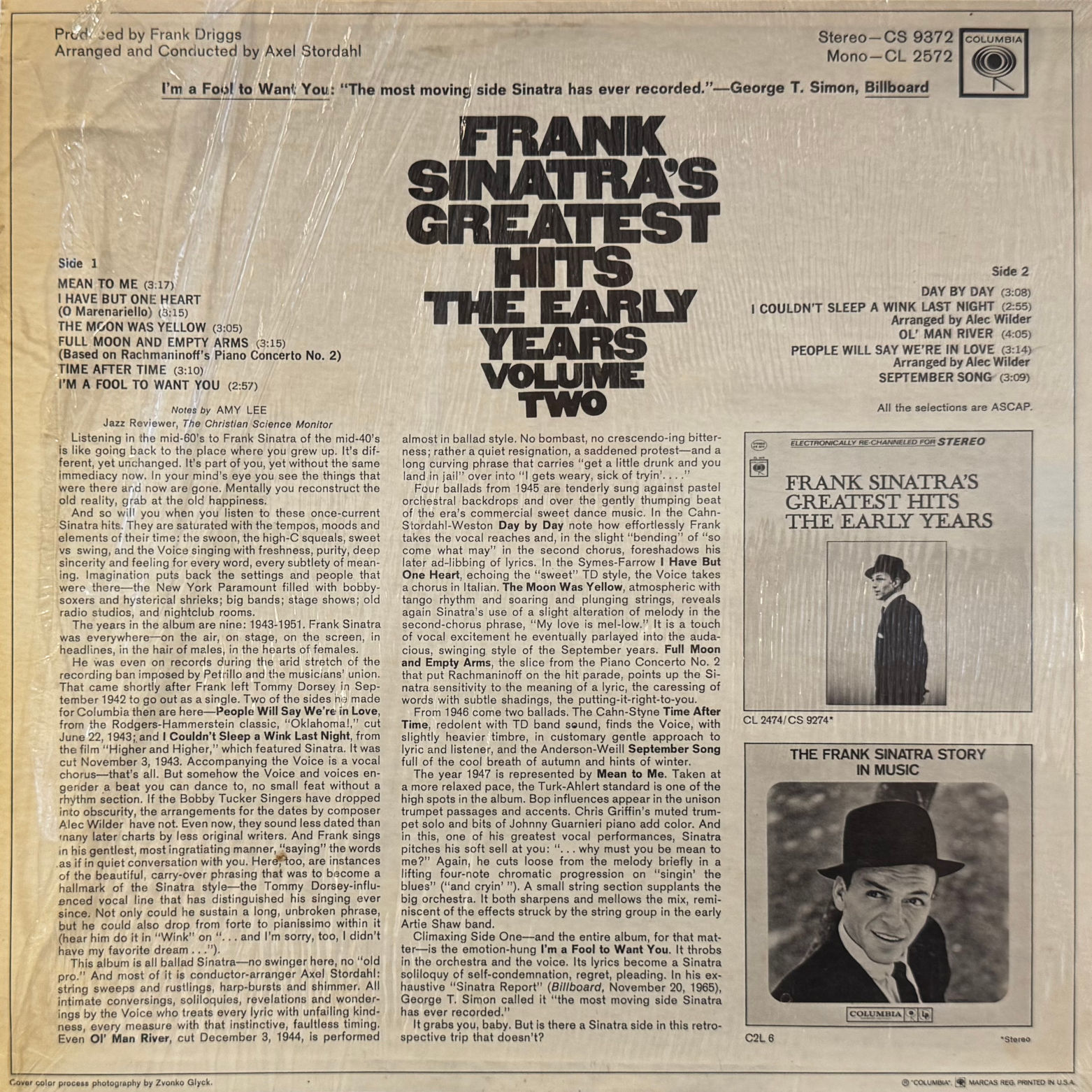
Greatest Hits the Early Years
Volume Two
Notes by Amy Lee
Jazz Reviewer, The Christian Science Monitor
Listening in the mid-60's to Frank Sinatra of the mid-40's is like going back to the place where you grew up. It's different, yet unchanged. It's part of you, yet without the same immediacy now. In your mind's eye you see the things that were there and now are gone. Mentally you reconstruct the old reality, grab at the old happiness.
And so will you when you listen to these once - current Sinatra hits. They are saturated with the tempos, moods and elements of their time: the swoon, the high-C squeals, sweet vs swing, and the Voice singing with freshness, purity, deep sincerity and feeling for every word, every subtlety of meaning. Imagination puts back the settings and people that were there the New York Paramount filled with bobby-soxers and hysterical shrieks; big bands; stage shows; old radio studios, and nightclub rooms.
The years in the album are nine: 1943-1951. Frank Sinatra was everywhere - on the air, on stage, on the screen, in headlines, in the hair of males, in the hearts of females.
He was even on records during the arid stretch of the recording ban imposed by Petrillo and the musicians' union. That came shortly after Frank left Tommy Dorsey in September 1942 to go out as a single. Two of the sides he made for Columbia then are here-People Will Say We're in Love, from the Rodgers-Hammerstein classic, "Oklahoma!" cut June 22, 1943; and I Couldn't Sleep a Wink Last Night, from the film "Higher and Higher," which featured Sinatra. It was cut November 3, 1943. Accompanying the Voice is a vocal chorus that's all. But somehow the Voice and voices engender a beat you can dance to, no small feat without a rhythm section. If the Bobby Tucker Singers have dropped into obscurity, the arrangements for the dates by composer Alec Wilder have not. Even now, they sound less dated than many later charts by less original writers. And Frank sings in his gentlest, most ingratiating manner, "saying" the words as if in quiet conversation with you. Here, too, are instances of the beautiful, carry-over phrasing that was to become a hallmark of the Sinatra style-the Tommy Dorsey - influenced vocal line that has distinguished his singing ever since. Not only could he sustain a long, unbroken phrase, but he could also drop from forte to pianissimo within it (hear him do it in "Wink" on ". ...and I'm sorry, too, I didn't have my favorite dream...).
This album is all ballad Sinatra no swinger here, no "old pro." And most of it is conductor-arranger Axel Stordahl: string sweeps and rustlings, harp-bursts and shimmer. All intimate conversings, soliloquies, revelations and wonderings by the Voice who treats every lyric with unfailing kind-ness, every measure with that instinctive, faultless timing. Even Ol Man River, cut December 3, 1944, is performed almost in ballad style. No bombast, no crescendo-ing bitterness; rather a quiet resignation, a saddened protest - and a long curving phrase that carries "get a little drunk and you land in jail" over into "I gets weary, sick of tryin'..."
Four ballads from 1945 are tenderly sung against pastel orchestral backdrops and over the gently thumping beat of the era's commercial sweet dance music. In the Cahn-Stordahl-Weston Day by Day note how effortlessly Frank takes the vocal reaches and, in the slight "bending" of "so come what may" in the second chorus, foreshadows his later ad-libbing of lyrics. In the Symes-Farrow I Have But One Heart, echoing the "sweet" TD style, the Voice takes a chorus in Italian. The Moon Was Yellow, atmospheric with tango rhythm and soaring and plunging strings, reveals again Sinatra's use of a slight alteration of melody in the second-chorus phrase, "My love is mellow." It is a touch of vocal excitement he eventually parlayed into the audacious, swinging style of the September years. Full Moon and Empty Arms, the slice from the Piano Concerto No. 2 that put Rachmaninoff on the hit parade, points up the Sinatra sensitivity to the meaning of a lyric, the caressing of words with subtle shadings, the putting-it-right-to-you.
From 1946 come two ballads. The Cahn-Styne Time After Time, redolent with TD band sound, finds the Voice, with slightly heavier timbre, in customary gentle approach to lyric and listener, and the Anderson-Weill September Song full of the cool breath of autumn and hints of winter.
he year 1947 is represented by Mean to Me. Taken at a more relaxed pace, the Turk-Ahlert standard is one of the high spots in the album. Bop influences appear in the unison trumpet passages and accents. Chris Griffin's muted trumpet solo and bits of Johnny Guarnieri piano add color. And in this, one of his greatest vocal performances, Sinatra pitches his soft sell at you: "... why must you be mean to me?" Again, he cuts loose from the melody briefly in a lifting four-note chromatic progression on "singin' blues" ("and cryin' "). A small string section supplants the big orchestra. It both sharpens and mellows the mix, reminiscent of the effects struck by the string group in the early Artie Shaw band.
Climaxing Side One-and the entire album, for that matter - is the emotion - hung I'm a Fool to Want You. It throbs in the orchestra and the voice. Its lyrics become a Sinatra soliloquy of self-condemnation, regret, pleading, In his exhaustive "Sinatra Report" (Billboard, November 20, 1965), George T. Simon called it "the most moving side Sinatra has ever recorded."
It grabs you, baby. But is there a Sinatra side in this retrospective trip that doesn't?
Side A
- Mean to Me
- I Have But One Heart (O Marenariello)
- The Moon Was Yellow
- Full Moon and Empty Arms
- Time Ater Time
- I'm a Fool to Want You
Side B
- Day By Day
- I Couldn't Sleep a Wink Last Night
- Ol' Man River
- People Will Say We're in Love
- September Song
As an Amazon Associate we earn from qualifying purchases
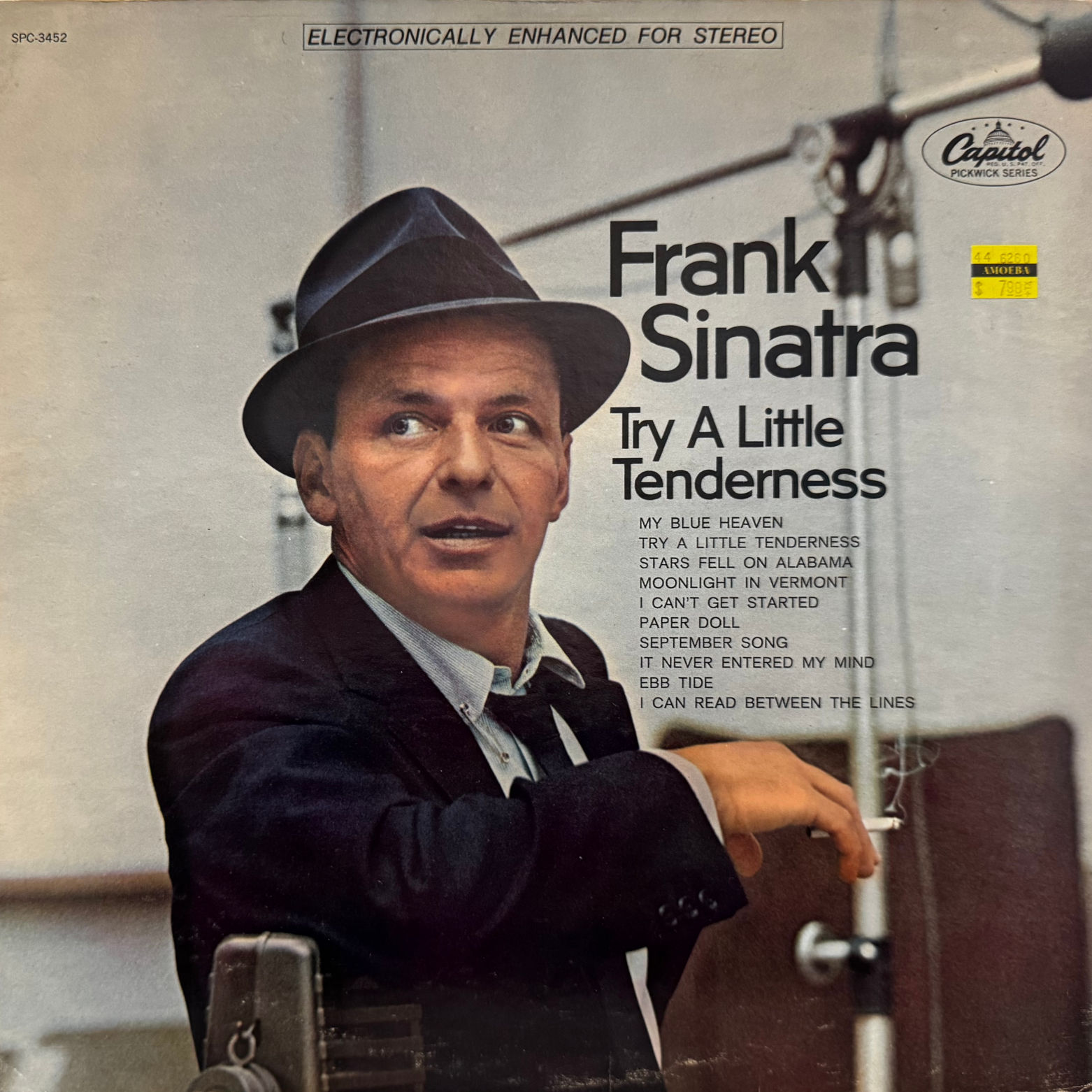
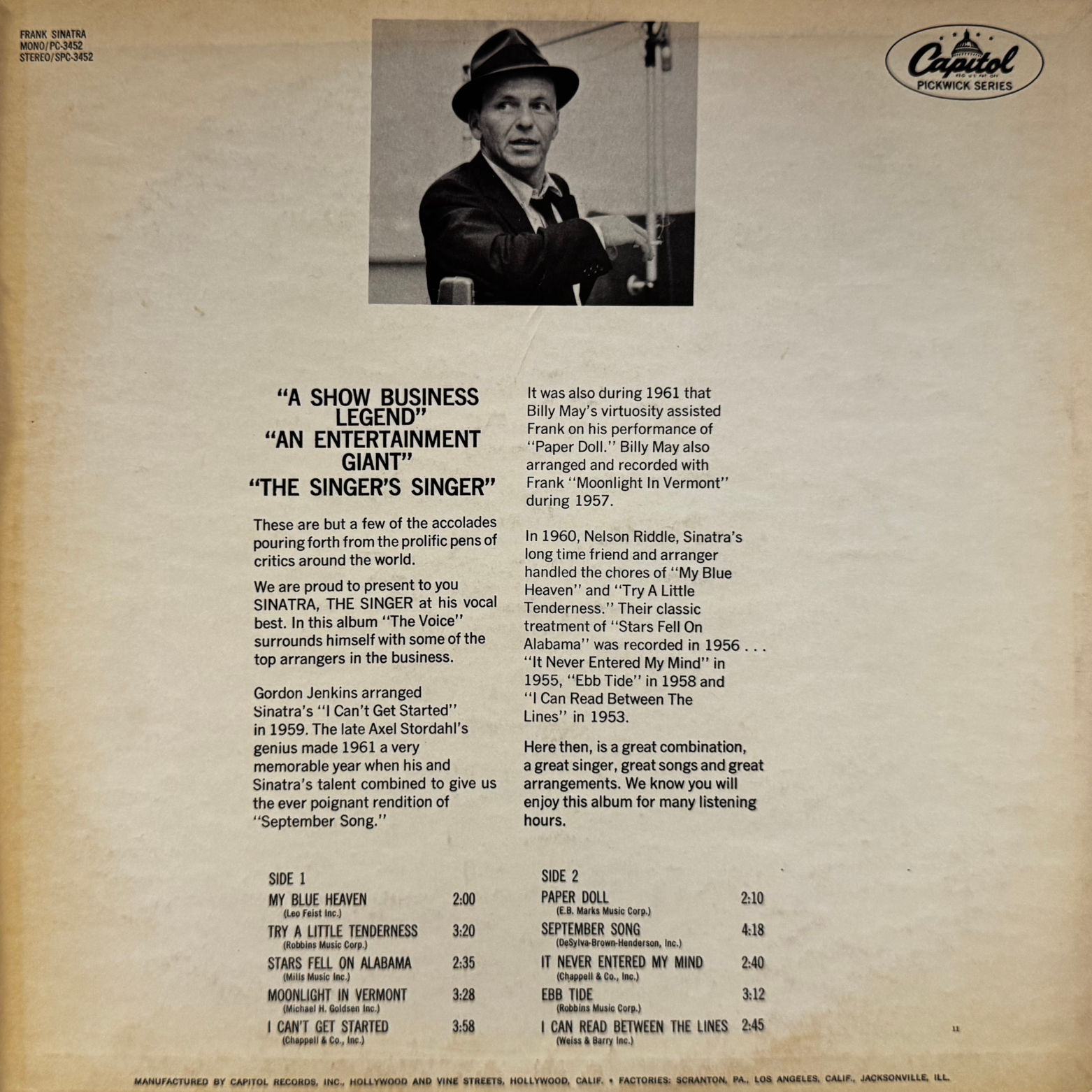
Try a Little Tenderness
"A SHOW BUSINESS LEGEND"
"AN ENTERTAINMENT GIANT"
"THE SINGER'S SINGER"
These are but a few of the accolades pouring forth from the prolific pens of critics around the world.
We are proud to present to you SINATRA, THE SINGER at his vocal best. In this album "The Voice" surrounds himself with some of the top arrangers in the business.
Gordon Jenkins arranged Sinatra's "I Can't Get Started" in 1959. The late Axel Stordahl's genius made 1961 a very memorable year when his and Sinatra's talent combined to give us the ever poignant rendition of "September Song."
It was also during 1961 that Billy May's virtuosity assisted Frank on his performance of "Paper Doll." Billy May also arranged and recorded with Frank "Moonlight In Vermont" during 1957.
In 1960, Nelson Riddle, Sinatra's long time friend and arranger handled the chores of "My Blue Heaven" and "Try A Little Tenderness." Their classic treatment of "Stars Fell On Alabama" was recorded in 1956 ... "It Never Entered My Mind" in 1955, "Ebb Tide" in 1958 and "I Can Read Between The Lines" in 1953.
Here then, is a great combination, a great singer, great songs and great arrangements. We know you will enjoy this album for many listening hours.
Side 1
- My Blue Heaven
- Try a Little Tenderness
- Stars Fell on Alabama
- Moonlight in Vermont
- I Can't Get Started
Side 2
- Paper Doll
- September Song
- It Never Entered My Mind
- Ebb Tide
- I Can Read Between The Lines
As an Amazon Associate we earn from qualifying purchases
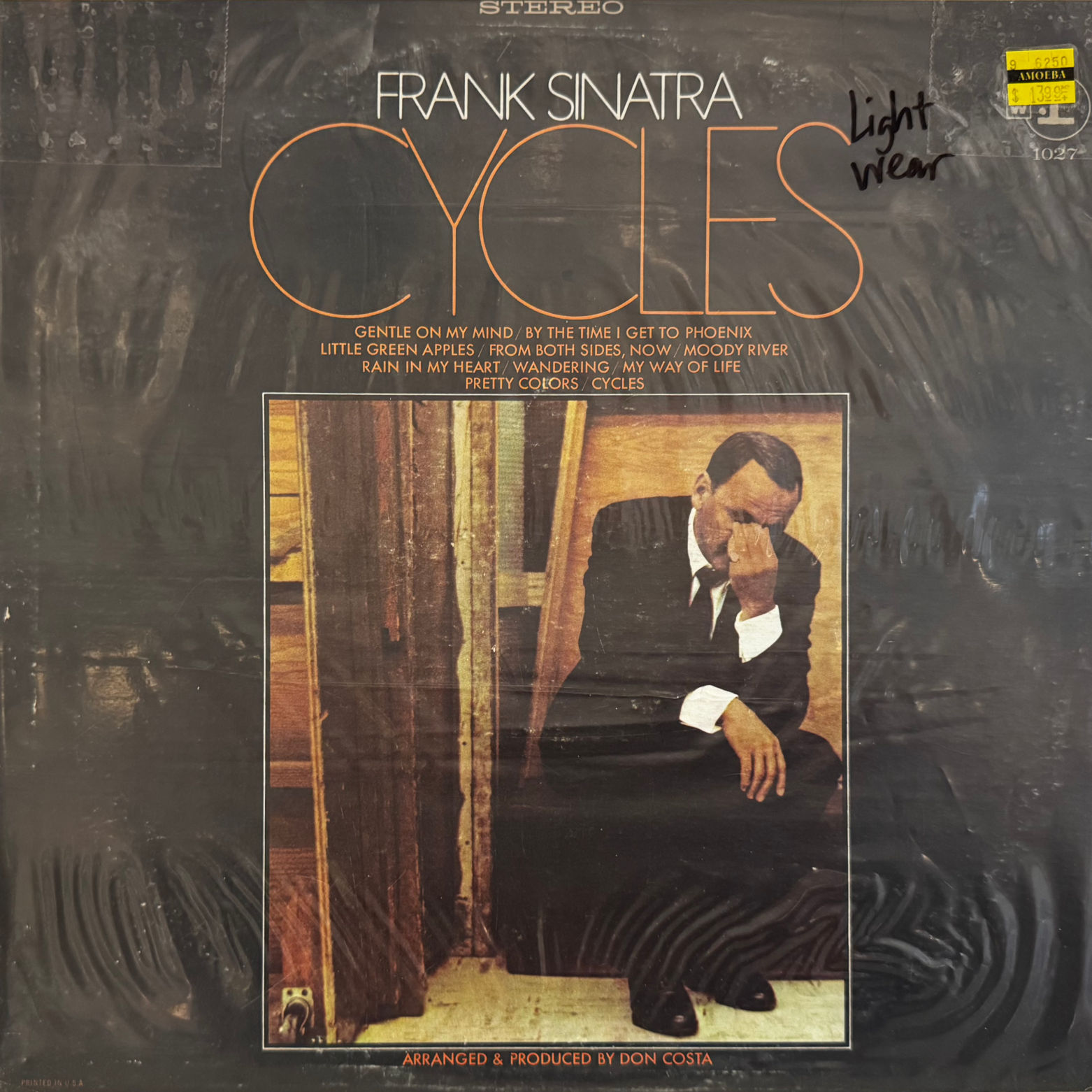
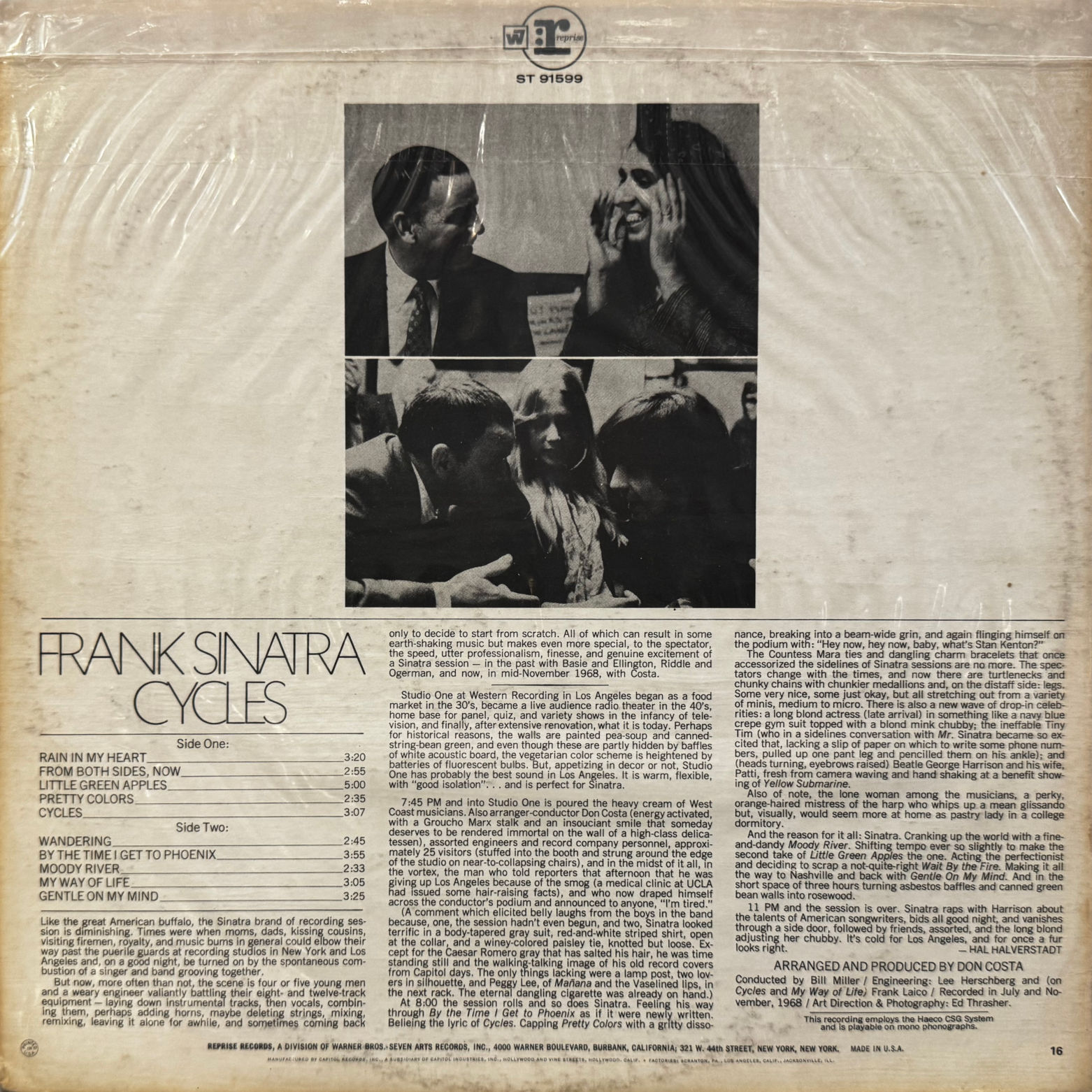
Cycles
Like the great American buffalo, the Sinatra brand of recording session is diminishing. Times were when moms, dads, kissing cousins, visiting firemen, royalty, and music bums in general could elbow their way past the puerile guards at recording studios in New York and Los Angeles and, on a good night, be turned on by the spontaneous combustion of a singer and band grooving together.
But now, more often than not, the scene is four or five young men and a weary engineer valiantly battling their eight - and twelve - track equipment - laying down instrumental tracks, then vocals, combining them, perhaps adding horns, maybe deleting strings, mixing, remixing, leaving it alone for awhile, and sometimes coming back only to decide to start from scratch. All of which can result in some earth-shaking music but makes even more special, to the spectator, the speed, utter professionalism, finesse, and genuine excitement of a Sinatra session - in the past with Basie and Ellington, Riddle and Ogerman, and now, in mid-November 1968, with Costa.
Studio One at Western Recording in Los Angeles began as a food market in the 30's, became a live audience radio theater in the 40's, home base for panel, quiz, and variety shows in the infancy of television, and finally, after extensive renovation, what it is today. Perhaps for historical reasons, the walls are painted pea-soup and canned-string-bean green, and even though these are partly hidden by baffles of white acoustic board, the vegetarian color scheme is heightened by batteries of fluorescent bulbs. But, appetizing in decor or not, Studio One has probably the best sound in Los Angeles. It is warm, flexible, with "good isolation" ... and is perfect for Sinatra.
7:45 PM and into Studio One is poured the heavy cream of West Coast musicians. Also arranger-conductor Don Costa (energy activated, with a Groucho Marx stalk and an insouciant smile that someday deserves to be rendered immortal on the wall of a high-class delicatessen), assorted engineers and record company personnel, approximately 25 visitors (stuffed into the booth and strung around the edge of the studio on near-to-collapsing chairs), and in the midst of it all, in the vortex, the man who told reporters that afternoon that he was giving up Los Angeles because of the smog (a medical clinic at UCLA had issued some hair-raising facts), and who now draped himself across the conductor's podium and announced to anyone, "I'm tired."
(A comment which elicited belly laughs from the boys in the band because, one, the session hadn't even begun, and two, Sinatra looked terrific in a body-tapered gray suit, red-and-white striped shirt, open at the collar, and a winey-colored paisley tie, knotted but loose. Except for the Caesar Romero gray that has salted his hair, he was time standing still and the walking-talking image of his old record covers from Capitol days. The only things lacking were a lamp post, two lovers in silhouette, and Peggy Lee, of Manana and the Vaselined lips, in the next rack. The eternal dangling cigarette was already on hand.)
At 8:00 the session rolls and so does Sinatra. Feeling his way through By the Time I Get to Phoenix as if it were newly written. Belying the lyric of Cycles. Capping Pretty Colors with a gritty dissonance, breaking into a beam-wide grin, and again flinging himself on the podium with: "Hey now, hey now, baby, what's Stan Kenton?"
The Countess Mara ties and dangling charm bracelets that once accessorized the sidelines of Sinatra sessions are no more. The spectators change with the times, and now there are turtlenecks and chunky chains with chunkier medallions and, on the distaff side: legs. Some very nice, some just okay, but all stretching out from a variety of minis, medium to micro. There is also a new wave of drop-in celebrities: a long blond actress (late arrival) in something like a navy blue crepe gym suit topped with a blond mink chubby; the ineffable Tiny Tim (who in a sidelines conversation with Mr. Sinatra became so excited that, lacking a slip of paper on which to write some phone numbers, pulled up one pant leg and penciled them on his ankle); and (heads turning, eyebrows raised) Beatle George Harrison and his wife, Patti, fresh from camera waving and hand shaking at a benefit showing of Yellow Submarine.
Also of note, the lone woman among the musicians, a perky, orange-haired mistress of the harp who whips up a mean glissando but, visually, would seem more at home as pastry lady in a college dormitory.
And the reason for it all: Sinatra. Cranking up the world with a fine-and-dandy Moody River. Shifting tempo ever so slightly to make the second take of Little Green Apples the one. Acting the perfectionist and deciding to scrap a not-quite-right Wait By the Fire. Making it all the way to Nashville and back with Gentle On My Mind. And in the short space of three hours turning asbestos baffles and canned green bean walls into rosewood.
11 PM and the session is over. Sinatra raps with Harrison about the talents of American songwriters, bids all good night, and vanishes through a side door, followed by friends, assorted, and the long blond adjusting her chubby. It's cold for Los Angeles, and for once a fur looks right.
- Hal Halverstadt
Side One
- Rain in My Heart
- From Both Sides, Now
- Little Green Apples
- Pretty Colors
- Cycles
Side Two
- Wandering
- By The Time I Get to Phoenix
- Moody River
- My Way of Life
- Gentle on My Mind
- YOUTUBE:
[https://www.youtube.com/playlist?list=OLAK5uy] - SPOTIFY:
[https://open.spotify.com/album/4N6a1fTmJmyPJp9HmrNyVO] - APPLE MUSIC:
[https://music.apple.com/us/album/1443470324] - AMAZON:
[https://www.amazon.com/music/player/albums/B00HWM6WP6]
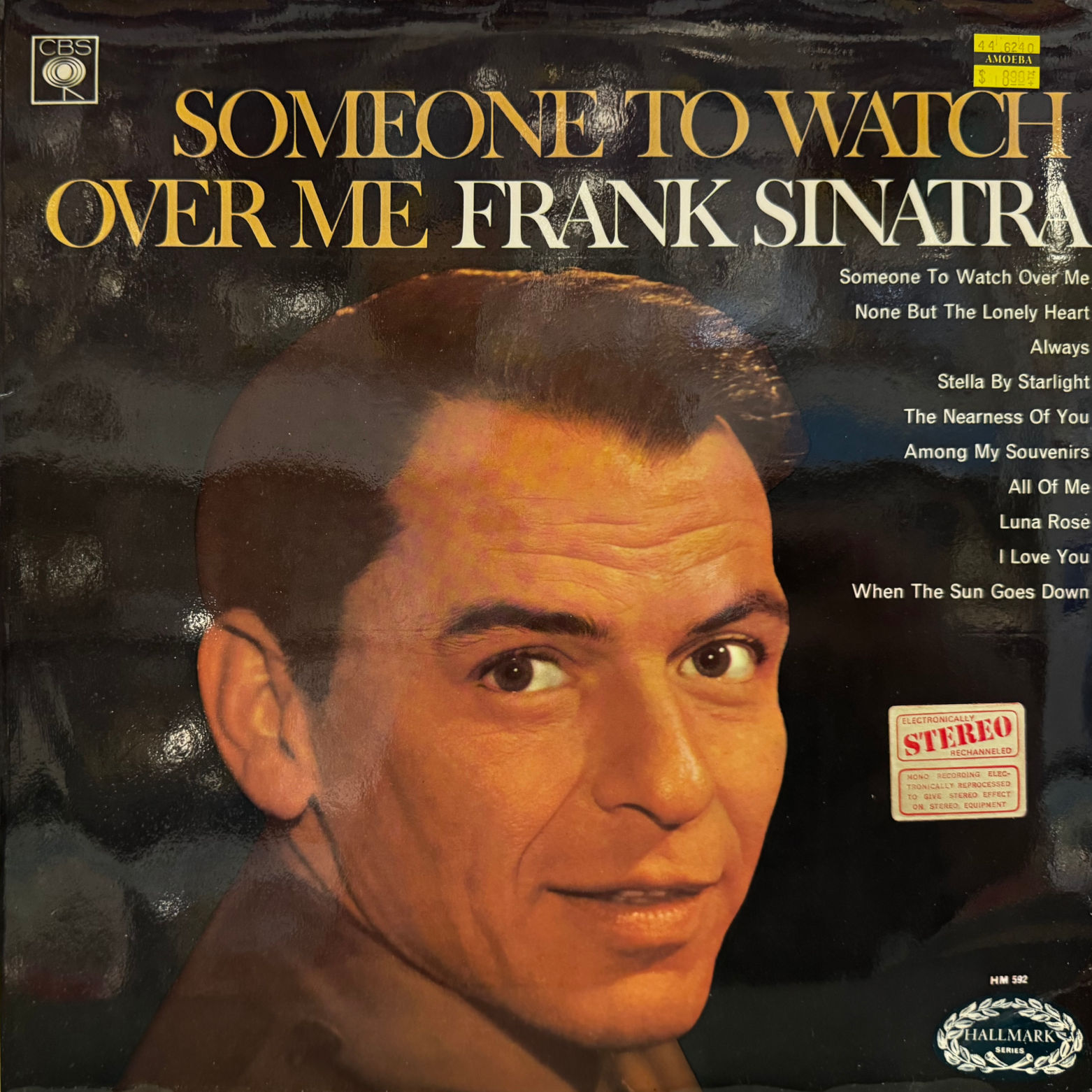
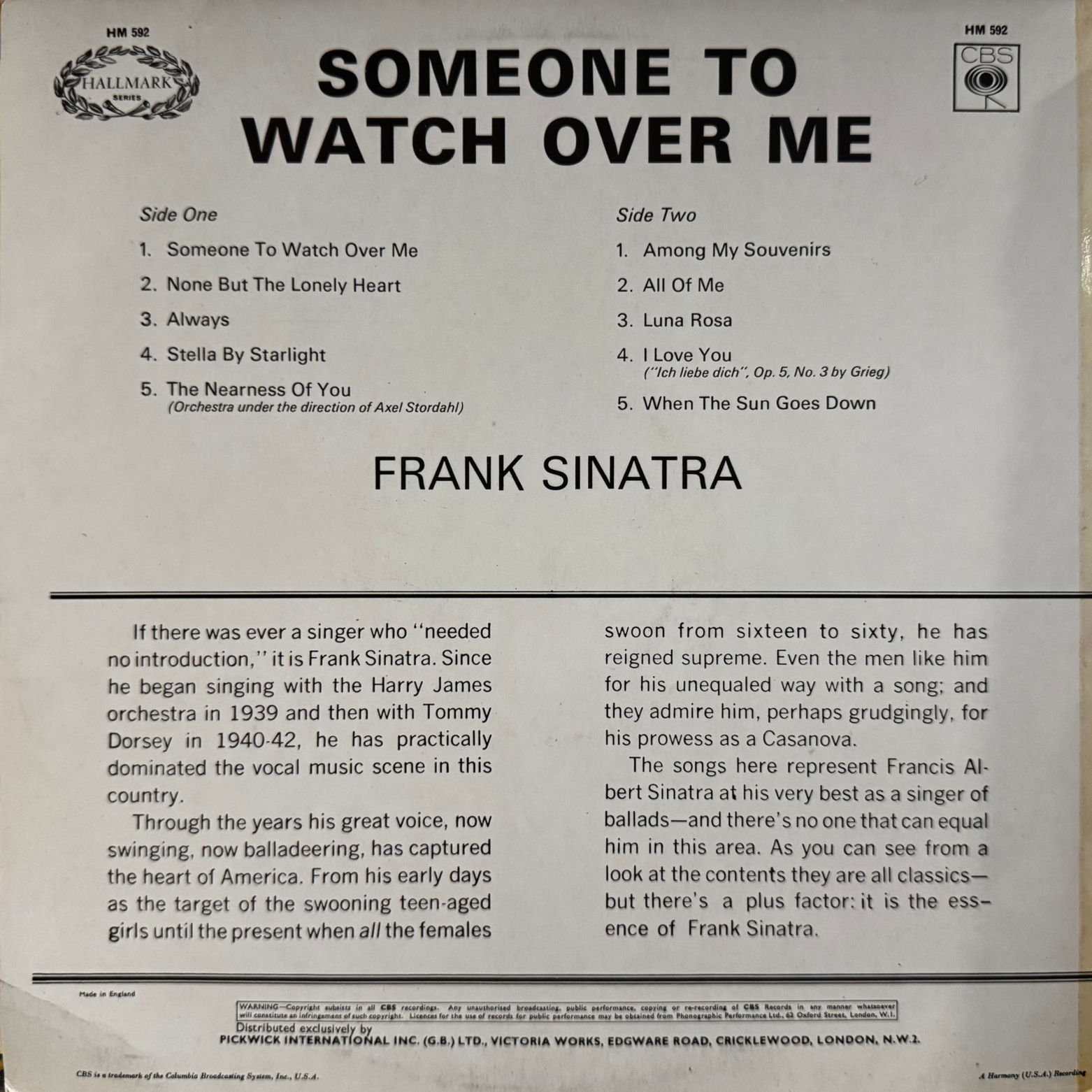
Someone to Watch Over Me
Frank Sinatra sings the Greatest Songs from the Musical Comedy
If there was ever a singer who "needed no introduction, " it is Frank Sinatra. Since he began singing with the Harry James orchestra in 1939 and then with Tommy Dorsey in 1940-42, he has practically dominated the vocal music scene in this country.
Through the years his great voice, now swinging, now balladeering, has captured the heart of America. From his early days as the target of the swooning teenaged girls until the present when all the females swoon from sixteen to sixty, he has reigned supreme. Even the men like him for his unequaled way with a song; and they admire him, perhaps grudgingly, for his prowess as a Casanova.
The songs here represent Francis Albert Sinatra at his very best as a singer of ballads - and there's no one that can equal him in this area. As you can see from a look at the contents they are all classics - but there's a plus factor: it is the essence of Frank Sinatra.
Side One
- Someone to Watch Over Me
- None But The Lonely Heart
- Always
- Stella By Starlight
- The Nearness of You
Side Two
- Among The Souvenirs
- All of Me
- Luna Rosa
- I Love You
- When The Sun Goes Down
As an Amazon Associate we earn from qualifying purchases
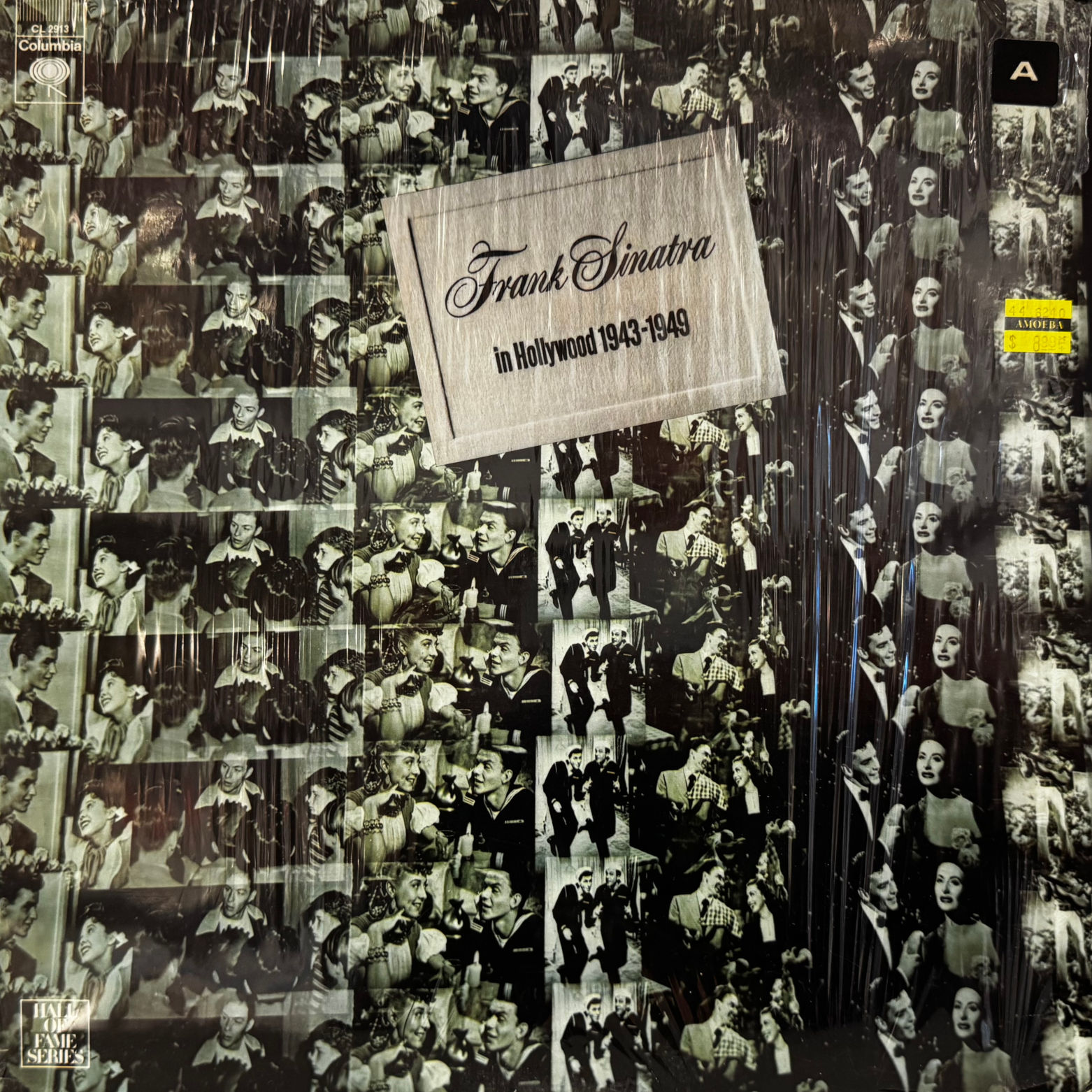
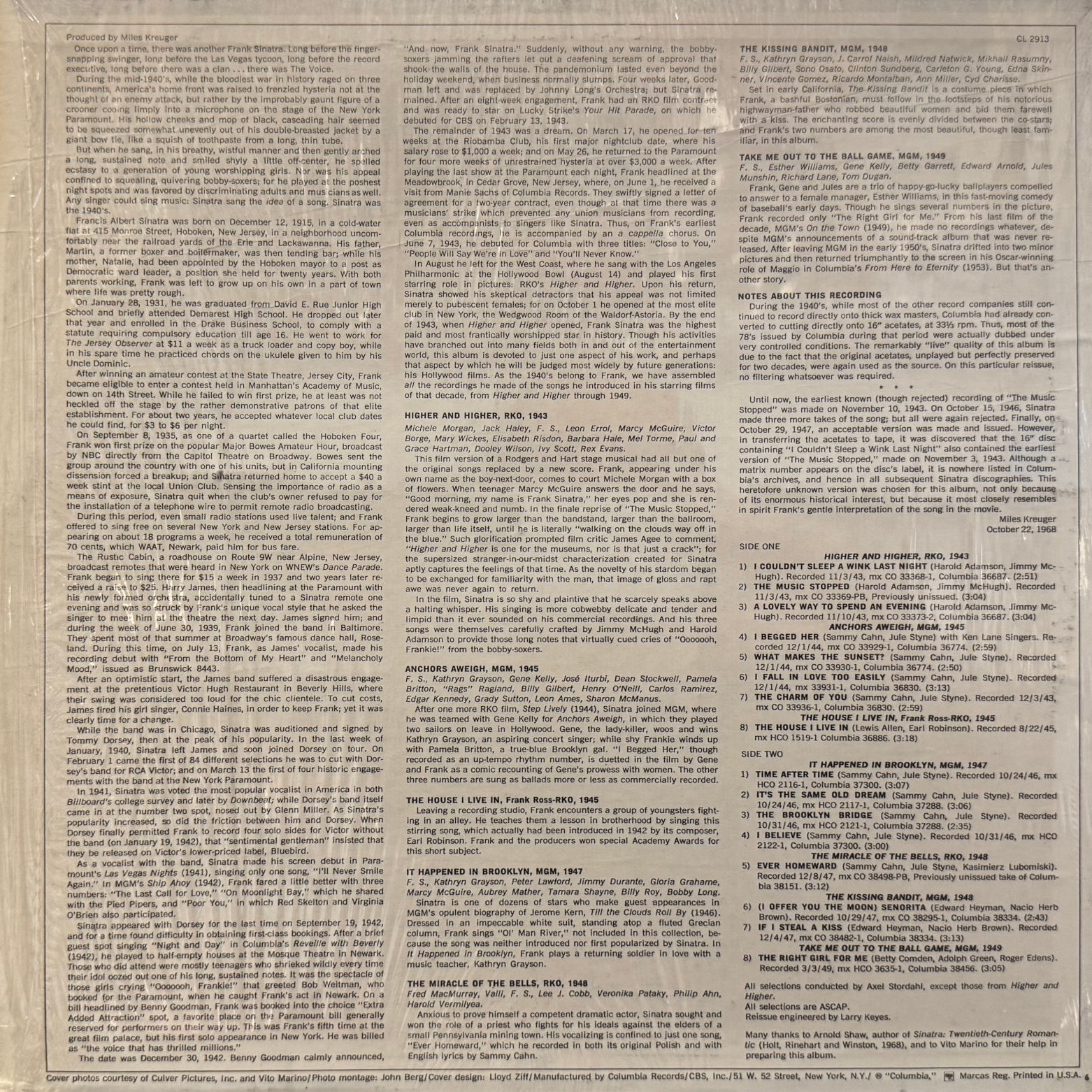
In Hollywood 1943-1949
Produced by Miles Kreuger
Once upon a time, there was another Frank Sinatra. Long before the finger-snapping swinger, long before the Las Vegas tycoon, long before the record executive, long before there was a clan... there was The Voice.
During the mid-1940's, while the bloodiest war in history raged on three continents, America's home front was raised to frenzied hysteria not at the thought of an enemy attack, but rather by the improbably gaunt figure of a crooner cooing limply into a microphone on the stage of the New York Paramount. His hollow cheeks and mop of black, cascading hair seemed to be squeezed somewhat unevenly out of his double-breasted jacket by a giant bow tie, like a squish of toothpaste from a long, thin tube.
But when he sang, in his breathy, wistful manner and then gently arched a long, sustained note and smiled shyly a little off-center, he spelled ecstasy to a generation of young worshiping girls. Nor was his appeal confined to squealing, quivering bobby-soxers; for he played at the poshest night spots and was favored by discriminating adults and musicians as well. Any singer could sing music: Sinatra sang the idea of a song. Sinatra was the 1940's.
Francis Albert Sinatra was born on December 12, 1915, in a cold-water flat at 415 Monroe Street, Hoboken, New Jersey, in a neighborhood uncomfortably near the railroad yards of the Erie and Lackawanna. His father, Martin, a former boxer and boilermaker, was then tending bar; while his mother, Natalie, had been appointed by the Hoboken mayor to a post as Democratic ward leader, a position she held for twenty years. With both parents working, Frank was left to grow up on his own in a part of town where life was pretty rough.
On January 28, 1931, he was graduated from David E. Rue Junior High School and briefly attended Demarest High School. He dropped out later that year and enrolled in the Drake Business School, to comply with a statute requiring compulsory education till age 16. He went to work for The Jersey Observer at $11 a week as a truck loader and copy boy, while in his spare time he practiced chords on the ukulele given to him by his Uncle Dominic.
After winning an amateur contest at the State Theatre, Jersey City, Frank became eligible to enter a contest held in Manhattan's Academy of Music, down on 14th Street. While he failed to win first prize, he at least was not heckled off the stage by the rather demonstrative patrons of that elite establishment. For about two years, he accepted whatever local club dates he could find, for $3 to $6 per night.
On September 8, 1935, as one of a quartet called the Hoboken Four, Frank won first prize on the popular Major Bowes Amateur Hour, broadcast by NBC directly from the Capitol Theatre on Broadway. Bowes sent the group around the country with one of his units, but in California mounting dissension forced a breakup; and Sinatra returned home to accept a $40 a week stint at the local Union Club. Sensing the importance of radio as a means of exposure, Sinatra quit when the club's owner refused to pay for the installation of a telephone wire to permit remote radio broadcasting.
During this period, even small radio stations used live talent; and Frank offered to sing free on several New York and New Jersey stations. For appearing on about 18 programs a week, he received a total remuneration of 70 cents, which WAAT, Newark, paid him for bus fare.
The Rustic Cabin, a roadhouse on Route 9W near Alpine, New Jersey, broadcast remotes that were heard in New York on WNEW's Dance Parade. Frank began to sing there for $15 a week in 1937 and two years later received a raise to $25. Harry James, then headlining at the Paramount with his newly formed orchestra, accidentally tuned to a Sinatra remote one evening and was so struck by Frank's unique vocal style that he asked the singer to meet him at the theatre the next day. James signed him; and during the week of June 30, 1939, Frank joined the band in Baltimore. They spent most of that summer at Broadway's famous dance hall, Roseland. During this time, on July 13, Frank, as James' vocalist, made his recording debut with "From the Bottom of My Heart" and "Melancholy Mood," issued as Brunswick 8443.
After an optimistic start, the James band suffered a disastrous engagement at the pretentious Victor Hugh Restaurant in Beverly Hills, where their swing was considered too loud for the chic clientele. To cut costs, James fired his girl singer, Connie Haines, in order to keep Frank; yet it was clearly time for a change.
While the band was in Chicago, Sinatra was auditioned and signed by Tommy Dorsey, then at the peak of his popularity. In the last week of January, 1940, Sinatra left James and soon joined Dorsey on tour. On February 1 came the first of 84 different selections he was to cut with Dorsey's band for RCA Victor; and on March 13 the first of four historic engagements with the band at the New York Paramount.
In 1941, Sinatra was voted the most popular vocalist in America in both Billboard's college survey and later by Downbeat; while Dorsey's band itself came in at the number two spot, nosed out by Glenn Miller. As Sinatra's popularity increased, so did the friction between him and Dorsey. When Dorsey finally permitted Frank to record four solo sides for Victor without the band (on January 19, 1942), that "sentimental gentleman" insisted that they be released on Victor's lower-priced label, Bluebird.
As a vocalist with the band, Sinatra made his screen debut in Paramount's Las Vegas Nights (1941), singing only one song, "I'II Never Smile Again." In MGM's Ship Ahoy (1942), Frank fared a little better with three numbers: "The Last Call for Love," "On Moonlight Bay," which he shared with the Pied Pipers, and "Poor You," in which Red Skelton and Virginia O'Brien also participated.
Sinatra appeared with Dorsey for the last time on September 19, 1942, and for a time found difficulty in obtaining first-class bookings. After a brief guest spot singing "Night and Day" in Columbia's Reveille with Beverly (1942), he played to half-empty houses at the Mosque Theatre in Newark. Those who did attend were mostly teenagers who shrieked wildly every time their idol oozed out one of his long, sustained notes. It was the spectacle of those girls crying "Ooooooh, Frankie!" that greeted Bob Weitman, who booked for the Paramount, when he caught Frank's act in Newark. On a bill headlined by Benny Goodman, Frank was booked into the choice "Extra Added Attraction" spot, a favorite place on the Paramount bill generally reserved for performers on their way up. This was Frank's fifth time at the great film palace, but his first solo appearance in New York. He was billed as "the voice that has thrilled millions."
The date was December 30, 1942. Benny Goodman calmly announced, "And now, Frank Sinatra." Suddenly, without any warning, the bobby-soxers jamming the rafters let out a deafening scream of approval that shook the walls of the house. The pandemonium lasted even beyond the holiday weekend, when business normally slumps. Four weeks later, Goodman left and was replaced by Johnny Long's Orchestra; but Sinatra remained. After an eight-week engagement, Frank had an RKO film contract and was ready to star on Lucky Strike's Your Hit Parade, on which he debuted for CBS on February 13, 1943.
The remainder of 1943 was a dream. On March 17, he opened for ten weeks at the Riobamba Club, his first major nightclub date, where his salary rose to $1,000 a week; and on May 26, he returned to the Paramount for four more weeks of unrestrained hysteria at over $3,000 a week. After playing the last show at the Paramount each night, Frank headlined at the Meadowbrook, in Cedar Grove, New Jersey, where, on June 1, he received a visit from Manie Sachs of Columbia Records. They swiftly signed a letter of agreement for a two-year contract, even though at that time there was a musicians' strike which prevented any union musicians from recording, even as accompanists to singers like Sinatra. Thus, on Frank's earliest Columbia recordings, he is accompanied by an a cappella chorus. On June 7, 1943, he debuted for Columbia with three titles: "Close to You," "People Will Say We're in Love" and "You'll Never Know."
In August he left for the West Coast, where he sang with the Los Angeles Philharmonic at the Hollywood Bowl (August 14) and played his first starring role in pictures: RKO's Higher and Higher. Upon his return, Sinatra showed his skeptical detractors that his appeal was not limited merely to pubescent females; for on October 1 he opened at the most elite club in New York, the Wedgwood Room of the Waldorf-Astoria. By the end of 1943, when Higher and Higher opened, Frank Sinatra was the highest paid and most frantically worshiped star in history. Though his activities have branched out into many fields both in and out of the entertainment world, this album is devoted to just one aspect of his work, and perhaps that aspect by which he will be judged most widely by future generations: his Hollywood films. As the 1940's belong to Frank, we have assembled all the recordings he made of the songs he introduced in his starring films of that decade, from Higher and Higher through 1949.
Side One
- I Couldn't Sleep a Wink Last Night
- The Music Stopped
- a Lovely Way to Spend An Evening
- I Begged Her
- What Makes The Sunset
- I Fall in Love Too Easily
- The Charm of You
- The House I Live In
Side Two
- Time After Time
- It's The Same Old Dream
- The Brooklyn Bridge
- I Believe
- Ever Homeward
- (I Offer You The Moon) Senorita
- If I Steal a Kiss
- The Right Girl For Me
As an Amazon Associate we earn from qualifying purchases
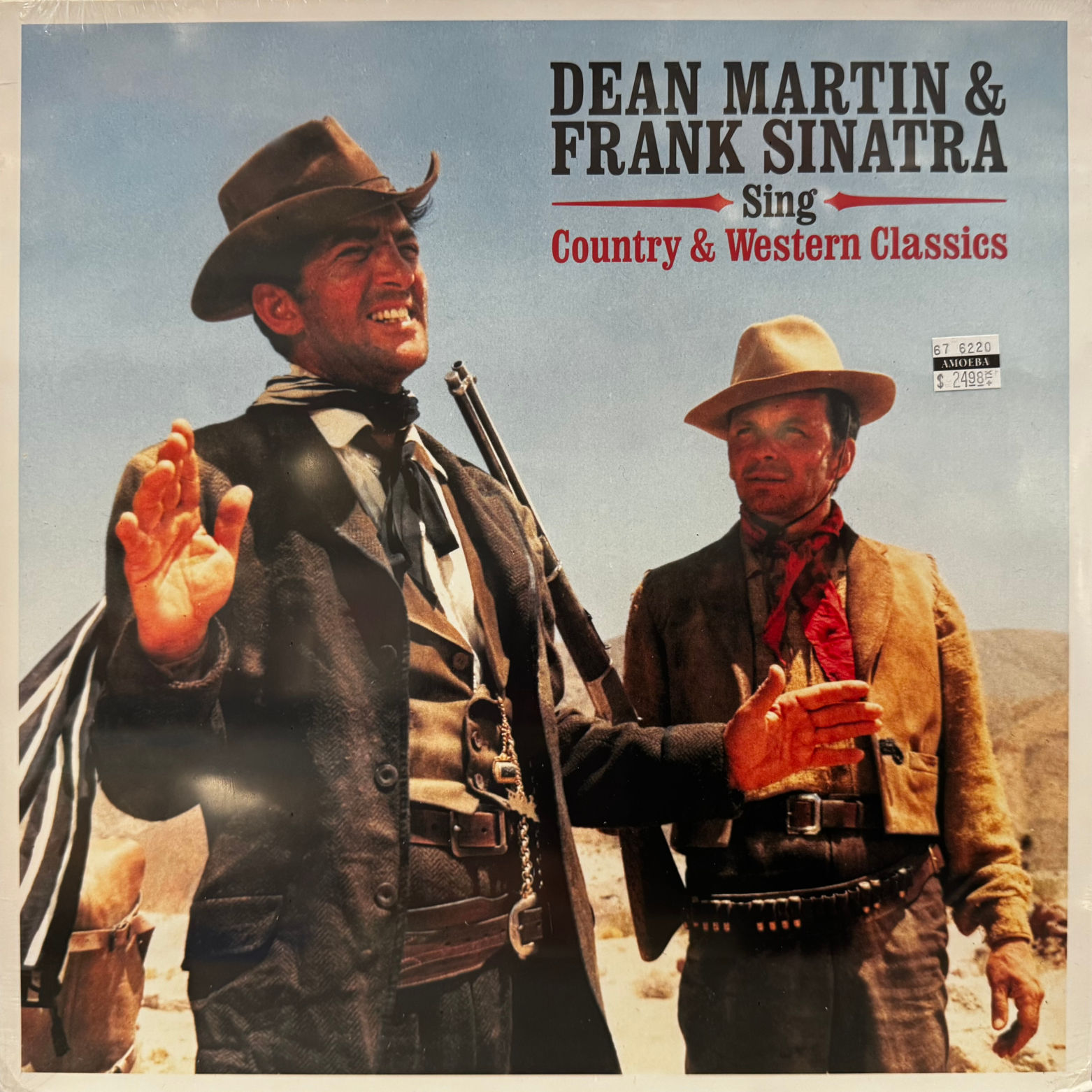
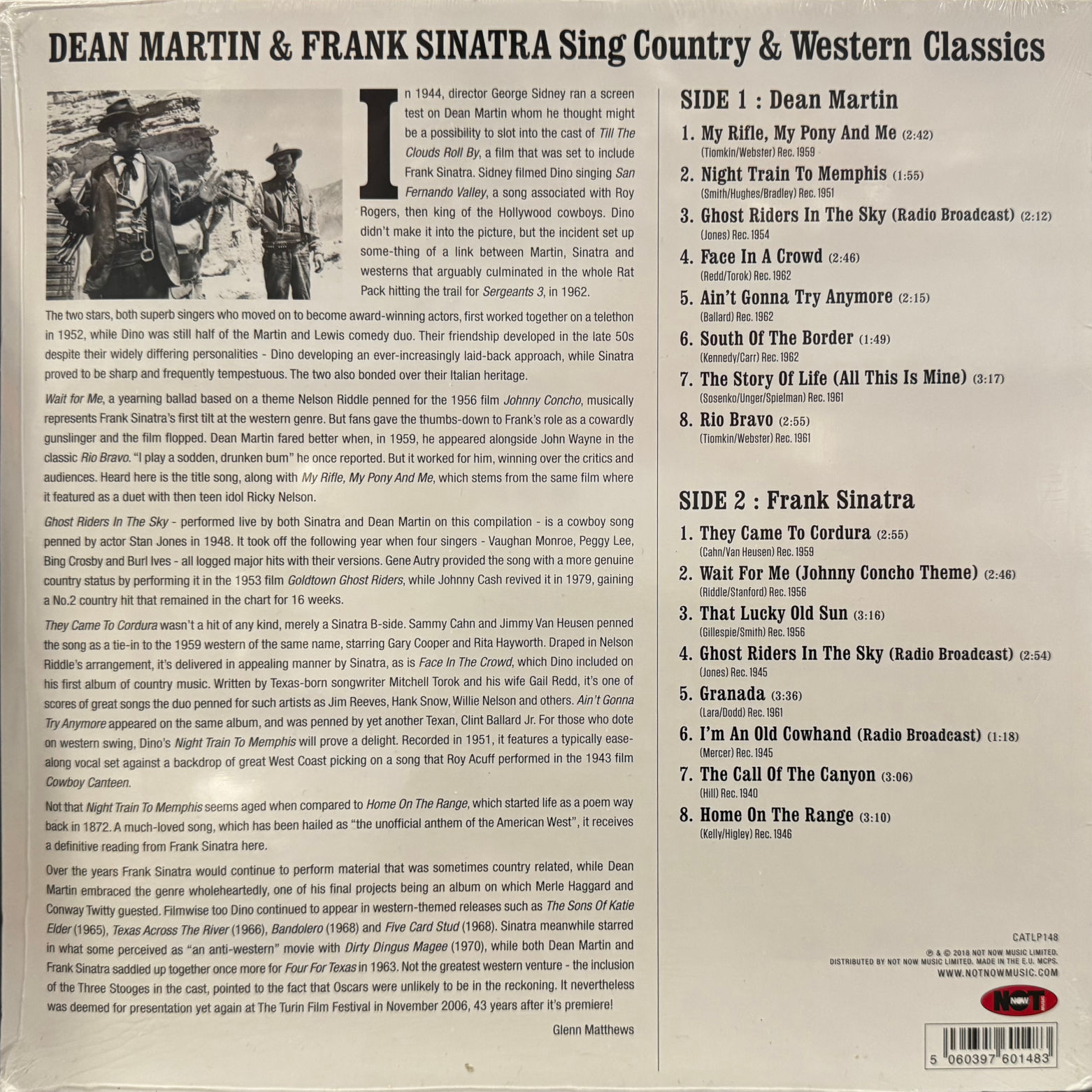
Dean Martin & Frank Sinatra
Sing Country & Western Classics
In 1944, director George Sidney ran a screen test on Dean Martin whom he thought might be a possibility to slot into the cast of Till The Clouds Roll By, a film that was set to include Frank Sinatra. Sidney filmed Dino singing San Fernando Valley, a song associated with Roy Rogers, then king of the Hollywood cowboys. Dino didn't make it into the picture, but the incident set up something of a link between Martin, Sinatra and westerns that arguably culminated in the whole Rat Pack hitting the trail for Sergeants 3, in 1962.
The two stars, both superb singers who moved on to become award-winning actors, first worked together on a telethon in 1952, while Dino was still half of the Martin and Lewis comedy duo. Their friendship developed in the late 50s despite their widely differing personalities - Dino developing an ever-increasingly laid-back approach, while Sinatra proved to be sharp and frequently tempestuous. The two also bonded over their Italian heritage.
Wait for Me, a yearning ballad based on a theme Nelson Riddle penned for the 1956 film Johnny Concho, musically represents Frank Sinatra's first tilt at the western genre. But fans gave the thumbs-down to Frank's role as a cowardly gunslinger and the film flopped. Dean Martin fared better when, in 1959, he appeared alongside John Wayne in the classic Rio Bravo. "I play a sodden, drunken bum" he once reported. But it worked for him, winning over the critics and audiences. Heard here is the title song, along with My Rifle, My Pony And Me, which stems from the same film where it featured as a duet with then teen idol Ricky Nelson.
Ghost Riders In The Sky - performed live by both Sinatra and Dean Martin on this compilation - is a cowboy song penned by actor Stan Jones in 1948. It took off the following year when four singers - Vaughan Monroe, Peggy Lee, Bing Crosby and Burl Ives - all logged major hits with their versions. Gene Autry provided the song with a more genuine country status by performing it in the 1953 film Goldtown Ghost Riders, while Johnny Cash revived it in 1979, gaining a No.2 country hit that remained in the chart for 16 weeks.
They Came To Cordura wasn't a hit of any kind, merely a Sinatra B-side. Sammy Cahn and Jimmy Van Heusen penned the song as a tie-in to the 1959 western of the same name, starring Gary Cooper and Rita Hayworth. Draped in Nelson Riddle's arrangement, it's delivered in appealing manner by Sinatra, as is Face In The Crowd, which Dino included on his first album of country music. Written by Texas-born songwriter Mitchell Torok and his wife Gail Redd, it's one of scores of great songs the duo penned for such artists as Jim Reeves, Hank Snow, Willie Nelson and others. Ain't Gonna Try Anymore appeared on the same album, and was penned by yet another Texan, Clint Ballard Jr. For those who dote on western swing, Dino's Night Train To Memphis will prove a delight. Recorded in 1951, it features a typically ease-along vocal set against a backdrop of great West Coast picking on a song that Roy Acuff performed in the 1943 film Cowboy Canteen.
Not that Night Train To Memphis seems aged when compared to Home On The Range, which started life as a poem way back in 1872. A much-loved song, which has been hailed as "the unofficial anthem of the American West", it receives a definitive reading from Frank Sinatra here.
Over the years Frank Sinatra would continue to perform material that was sometimes country related, while Dean Martin embraced the genre wholeheartedly, one of his final projects being an album on which Merle Haggard and Conway Twitty guested. Filmwise too Dino continued to appear in western-themed releases such as The Sons Of Katie Elder 1965), Texas Across The River (1966), Bandolero 1968) and Five Card Stud (1968). Sinatra meanwhile starred in what some perceived as "an anti-western" movie with Dirty Dingus Magee (1970), while both Dean Martin and Frank Sinatra saddled up together once more for Four For Texas in 1963. Not the greatest western venture - the inclusion of The Three Stooges in the cast, pointed to the fact that Oscars were unlikely to be in the reckoning. It nevertheless was deemed for presentation yet again at The Turin Film Festival in November 2006, 43 years after it's premiere!
Glenn Matthews
Side 1: Dean Martin
- My Rifle
- My Pony and Me
- Night Train to Memphis
- Ghost Riders in The Sky (Radio Broadcast)
- Face in a Crowd
- Ain't Gonna Try Anymore
- South of The Border
- The Story of Life (All This Is Mine)
- Rio Bravo
Side 2: Frank Sinatra
- Thye Came to Cordura
- Wait For Me (Johnny Concho Theme)
- That Lucky Old Sun
- Ghost Riders in The Sky (Radio Broadcast)
- Granada
- I'm An Old Cowhand (Radio Broadcast)
- Goodnight
- Irene
- Home on The Range
As an Amazon Associate we earn from qualifying purchases

Frank Sinatra
Rubik's Cube Portrait
Titled "Blue Eyes" and created from 450 Rubik's Cubes, this portrait was designed and created by Josh Chalom. Depicted here is actor and singer supreme, Frank Sinatra (1915-1998).


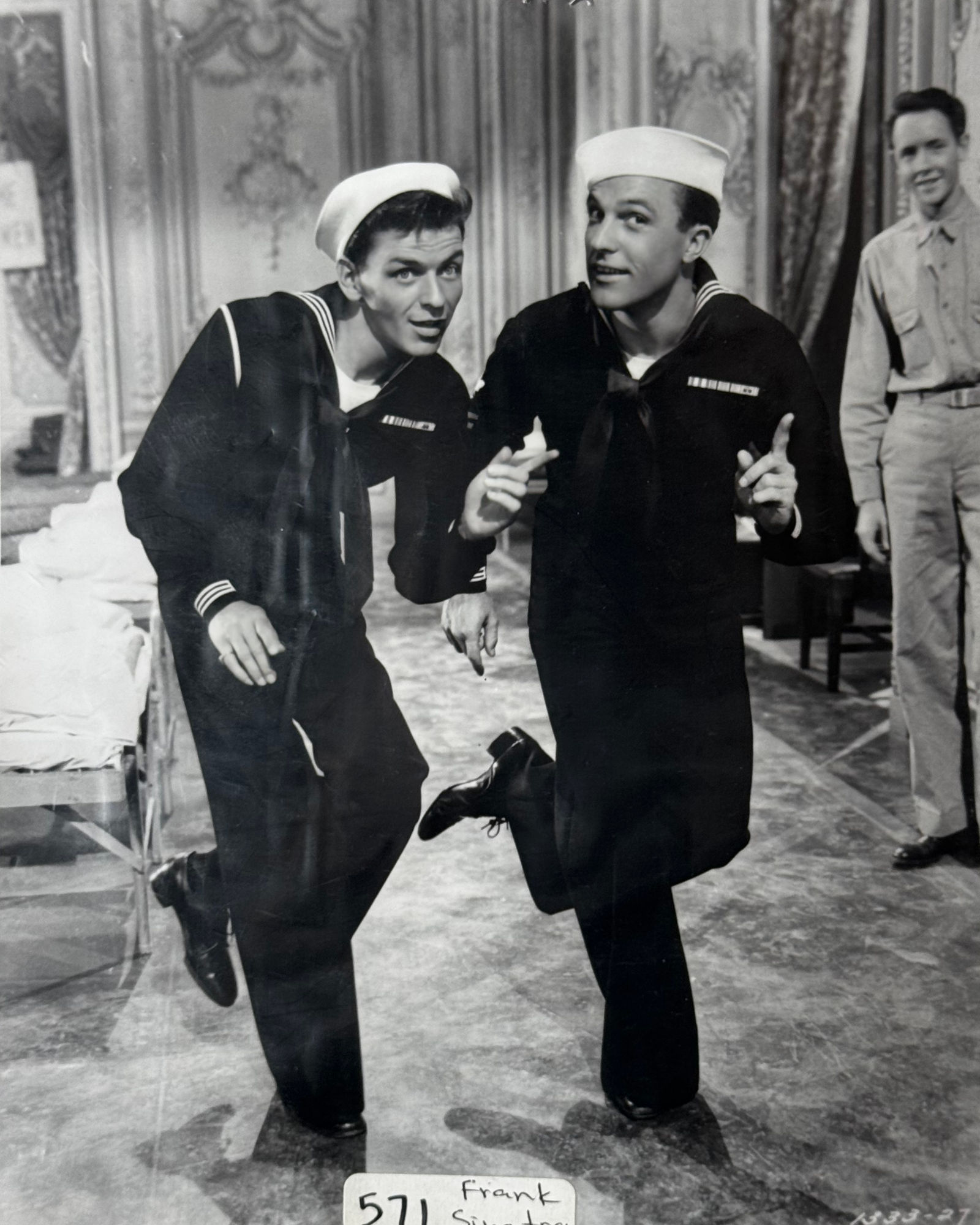
Anchors Aweigh
With Gene Kelly
As Clarence Doolittle and Joseph Brady Hollywood Blvd Gift Shop Photos
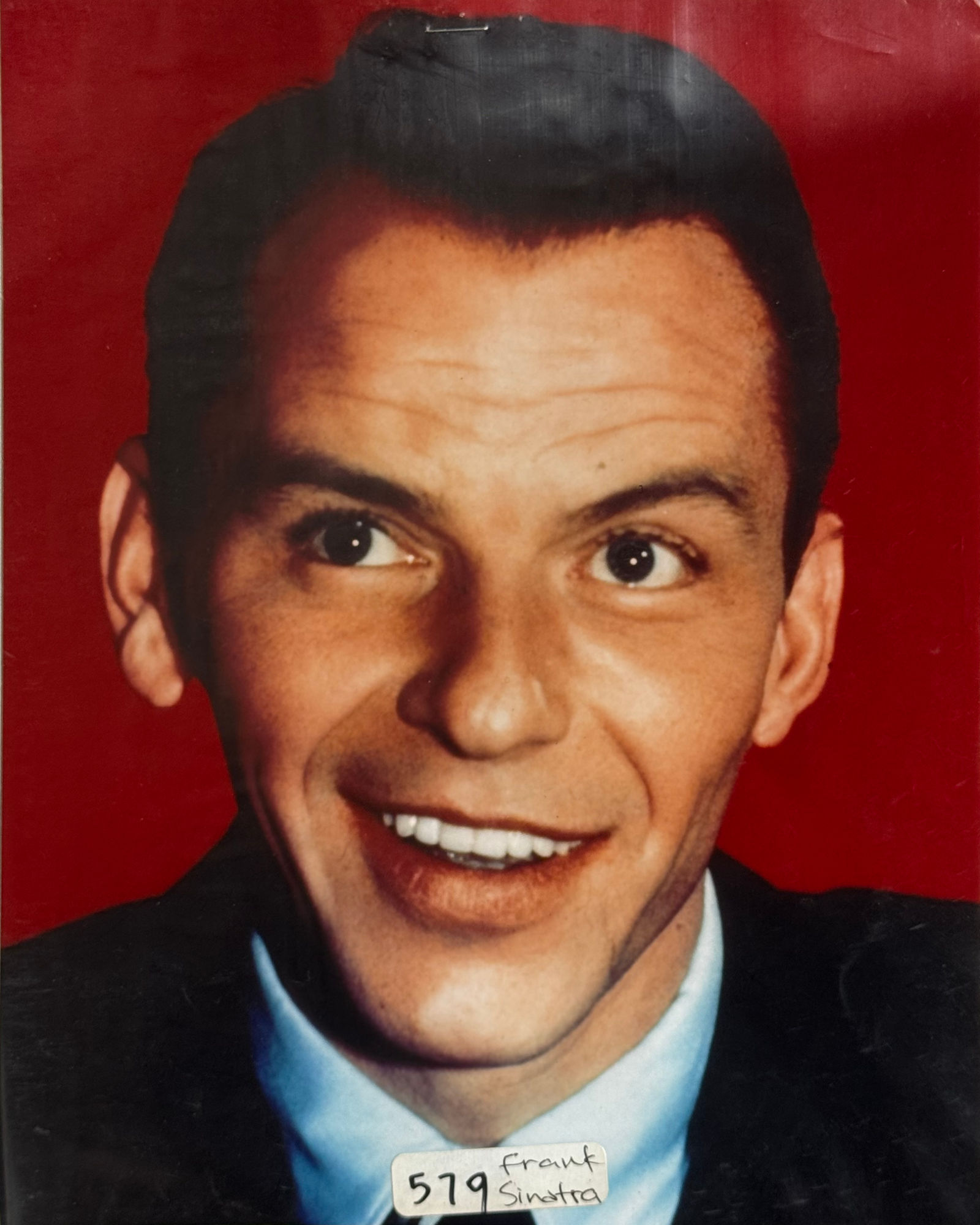
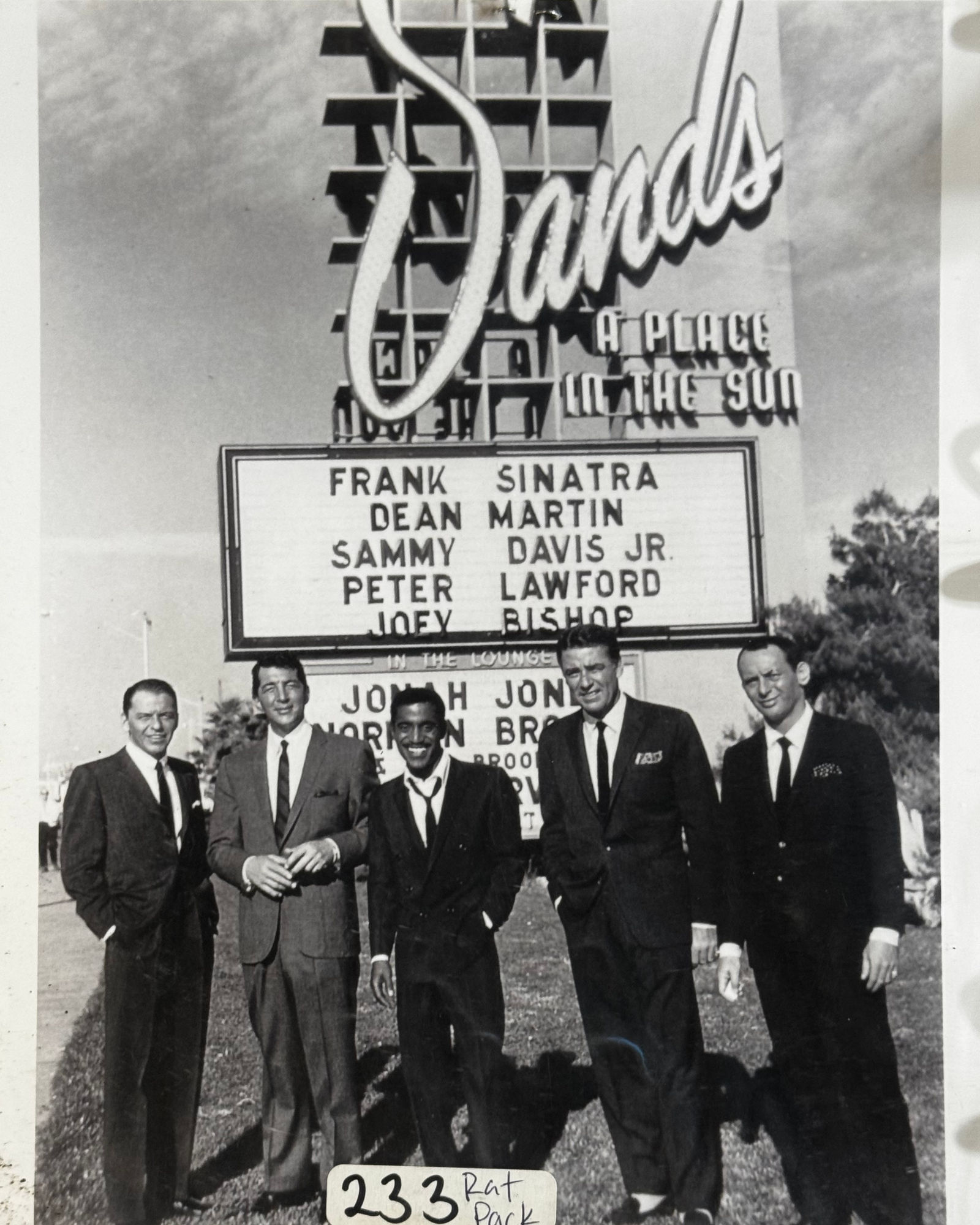
The Rat Pack
Frank, Dean Martin, Sammy Davis Jr, Peter Lawford, and Joey Bishop
The Sands Hotel in Las Vegas Hollywood Blvd Gift Shop Photos
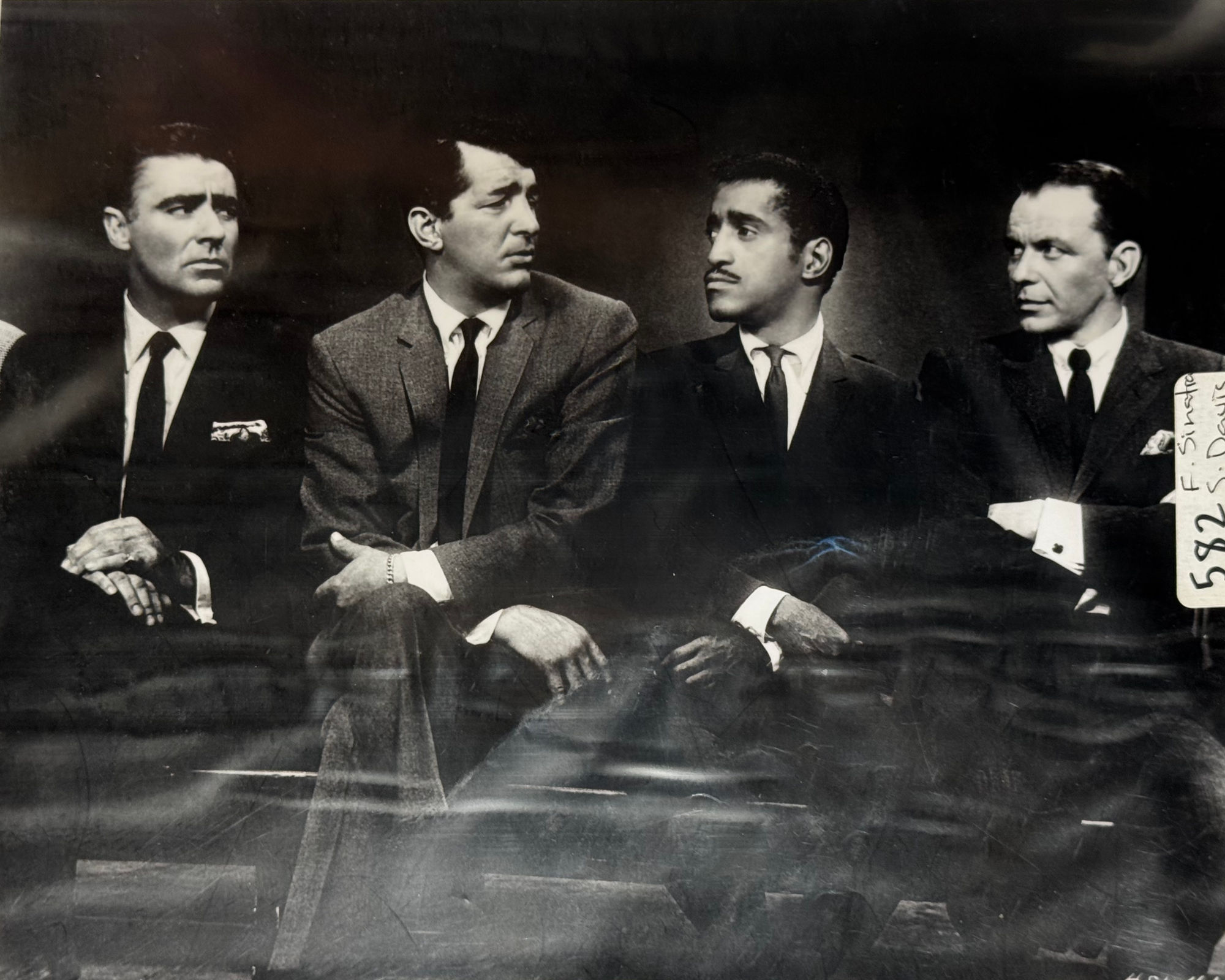
Ocean's 11
Peter Lawford, Dean Martin, Sammy Davis Jr., and Frank
As Jimmy Foster, Sam Harmon, Josh Howard, and Danny Ocean Hollywood Blvd Gift Shop Photos
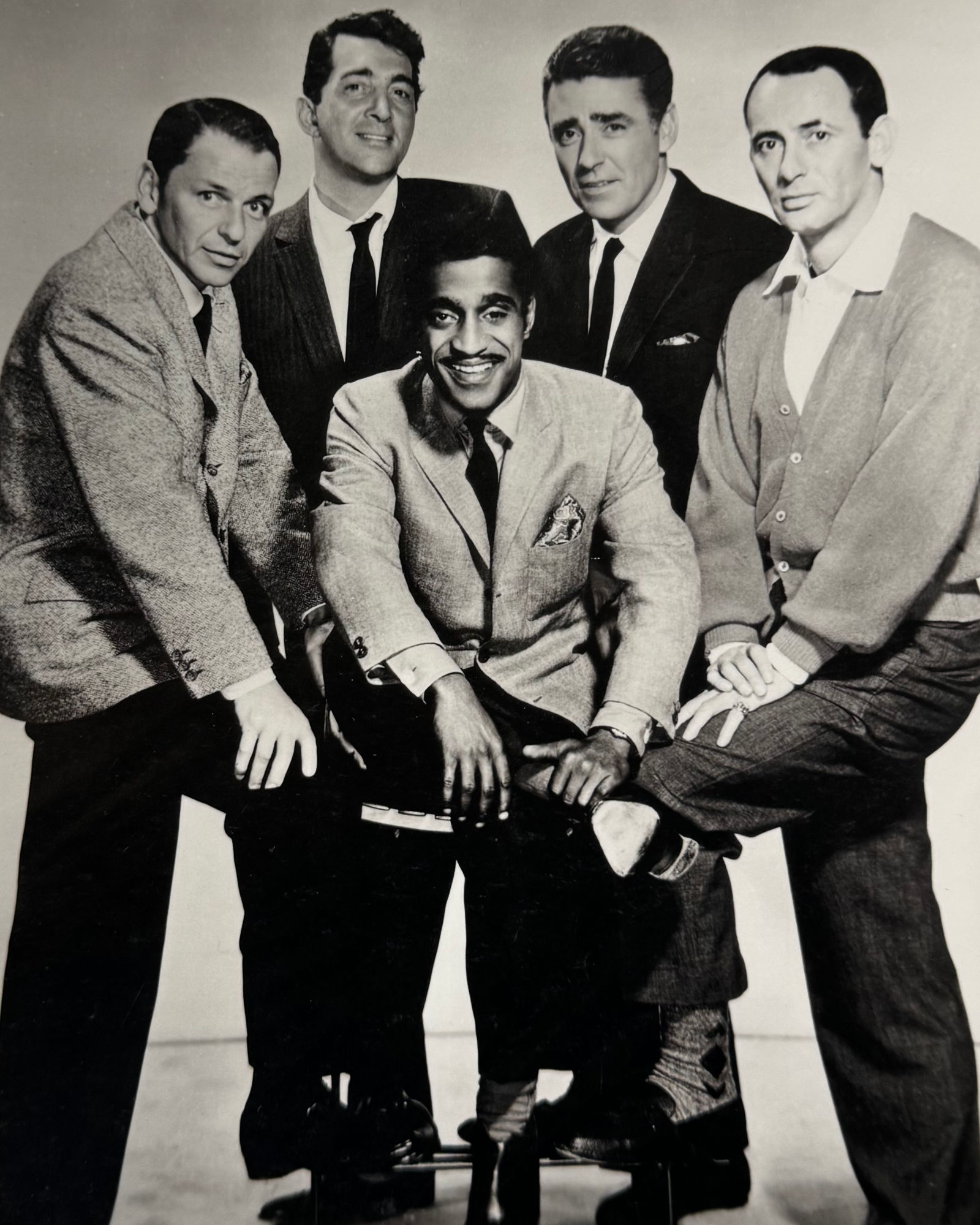
Ocean's Eleven
Frank, Dean Martin, Sammy Davis Jr., Peter Lawford, and Joey Bishop
As Danny Ocean, Sam Harmon, Josh Howard, Jimmy Foster, and Mushy O'Connors Hollywood Blvd Gift Shop Photos
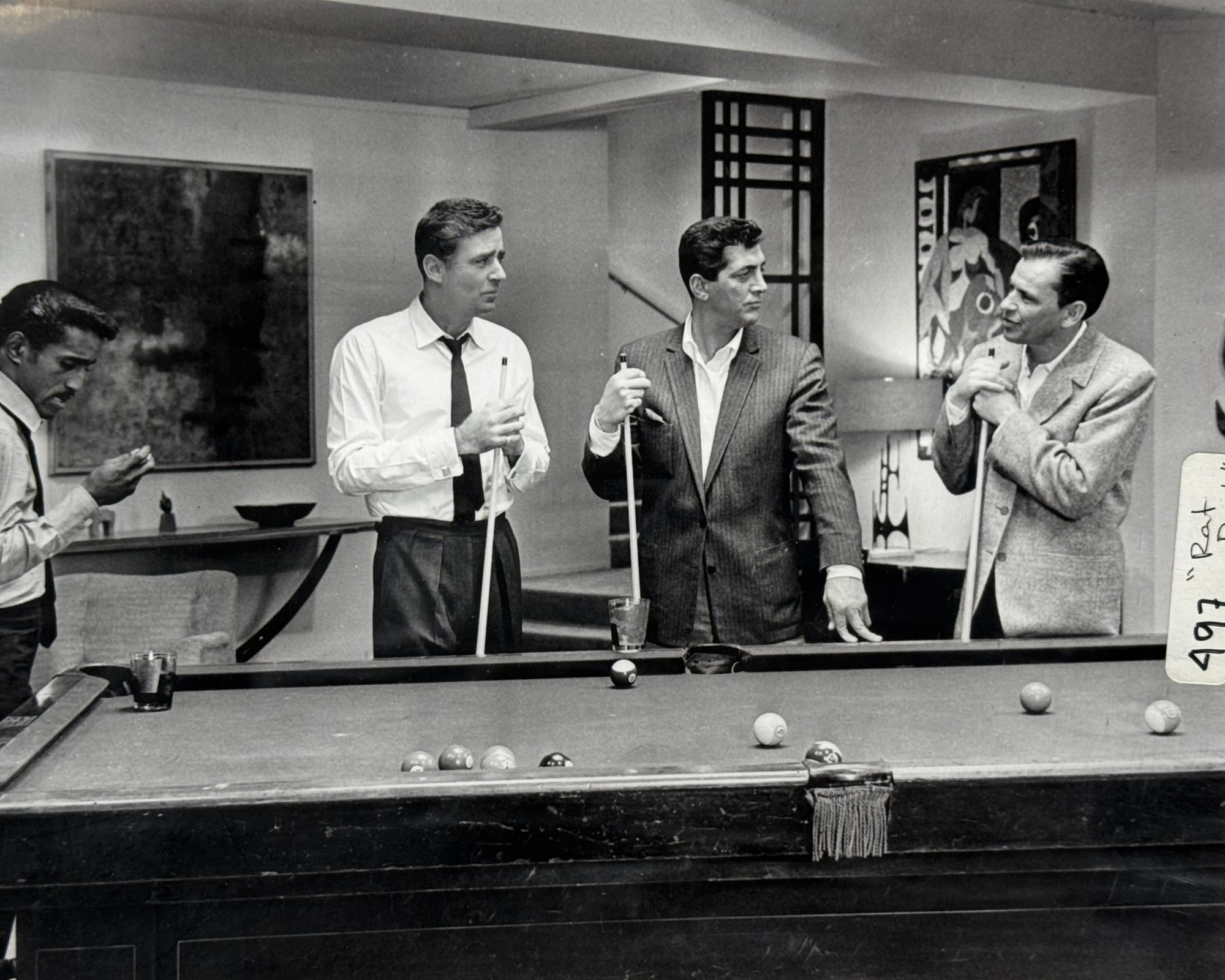
Ocean's 11
Sammy Davis Jr., Peter Lawford, Dean Martin, and Frank
As Josh Howard, Jimmy Foster, Sam Harmon, and Danny Ocean playing pool Hollywood Blvd Gift Shop Photos
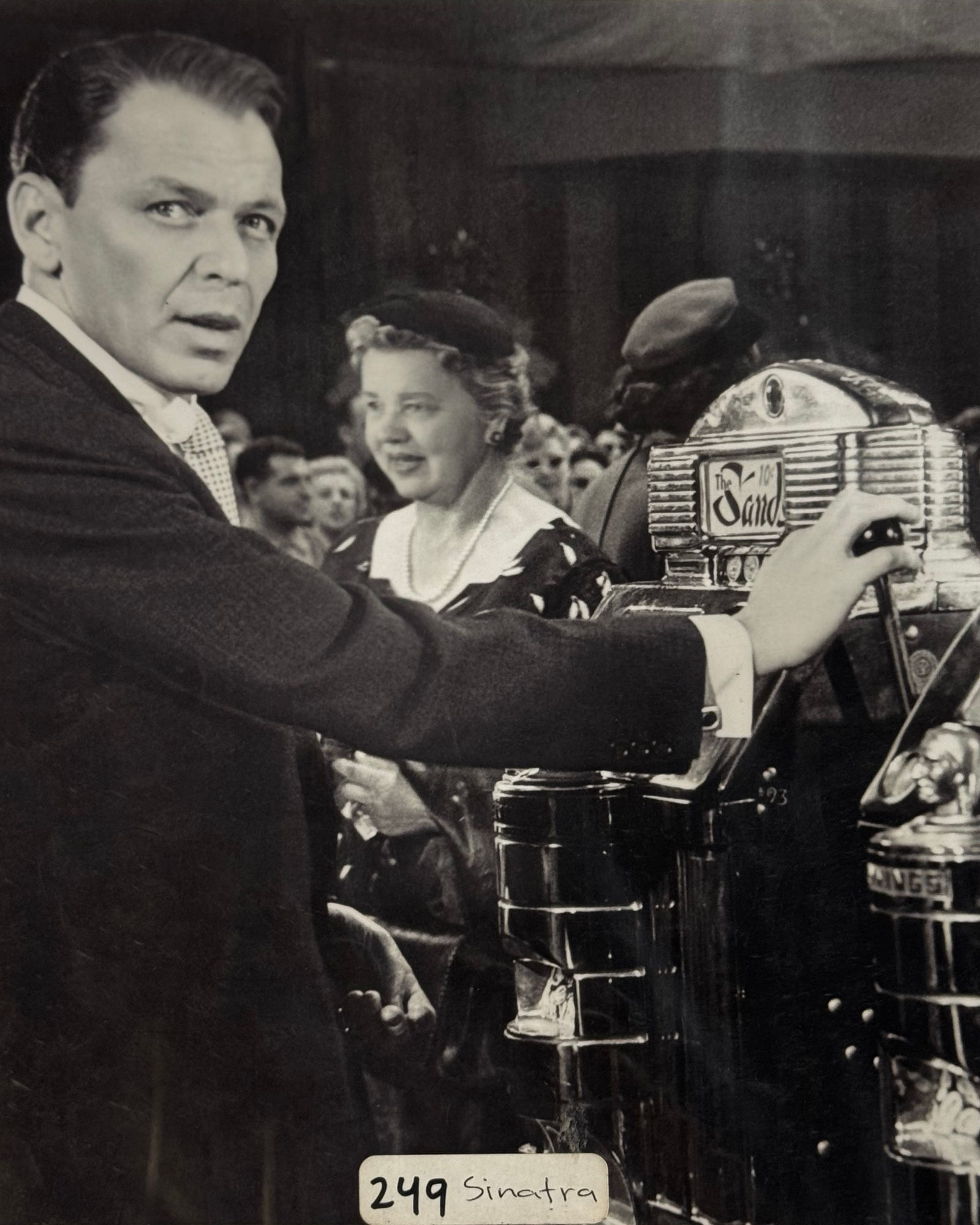
Ocean's Eleven
As Danny Ocean Hollywood Blvd Gift Shop Photos
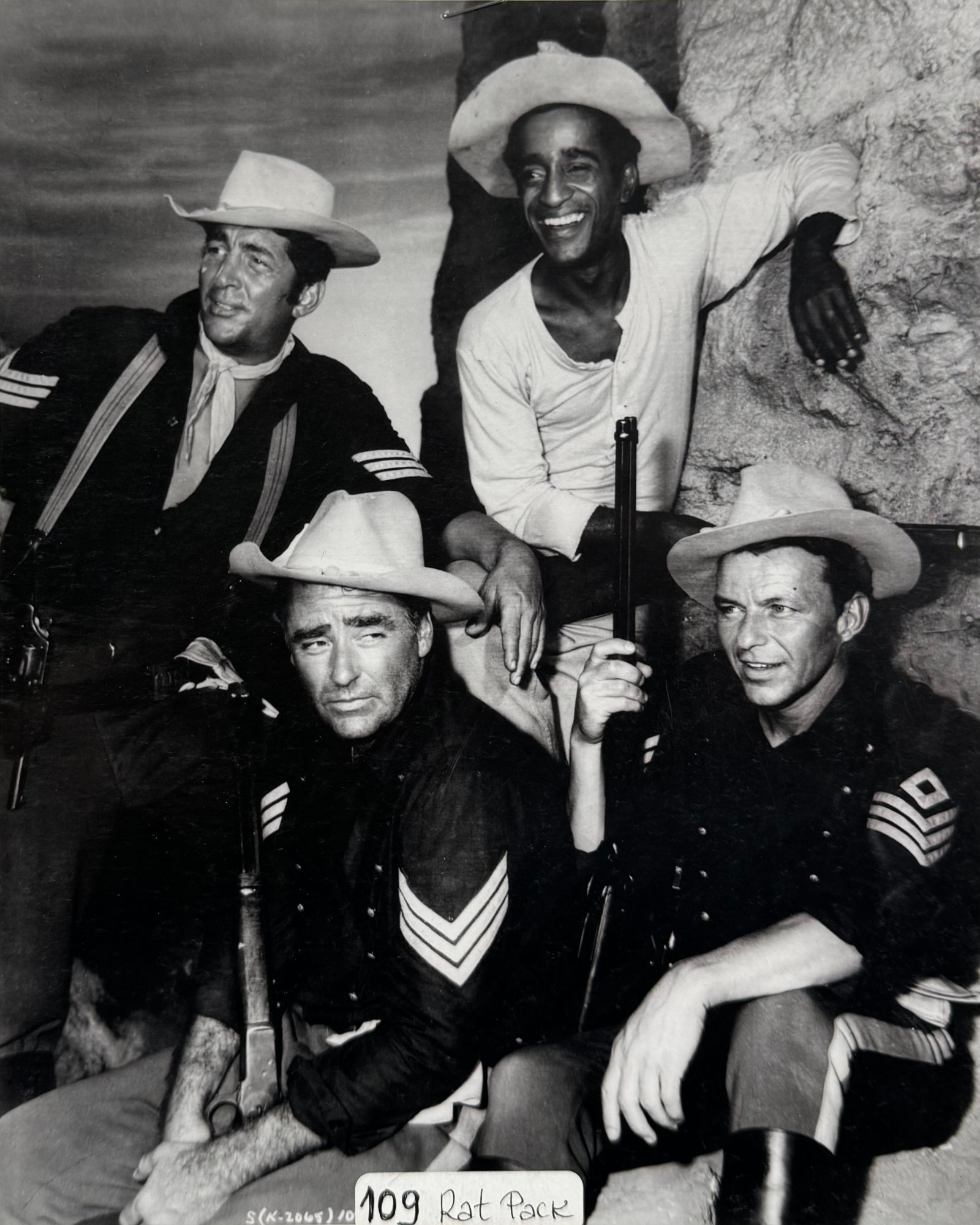
Sergeants 3
Dean Martin, Sammy Davis Jr., Peter Lawford, and Frank
As Sgt. Chip Deal, Jonah Williams, Sgt. Larry Barrett, and First Sgt. Mike Merry Hollywood Blvd Gift Shop Photos
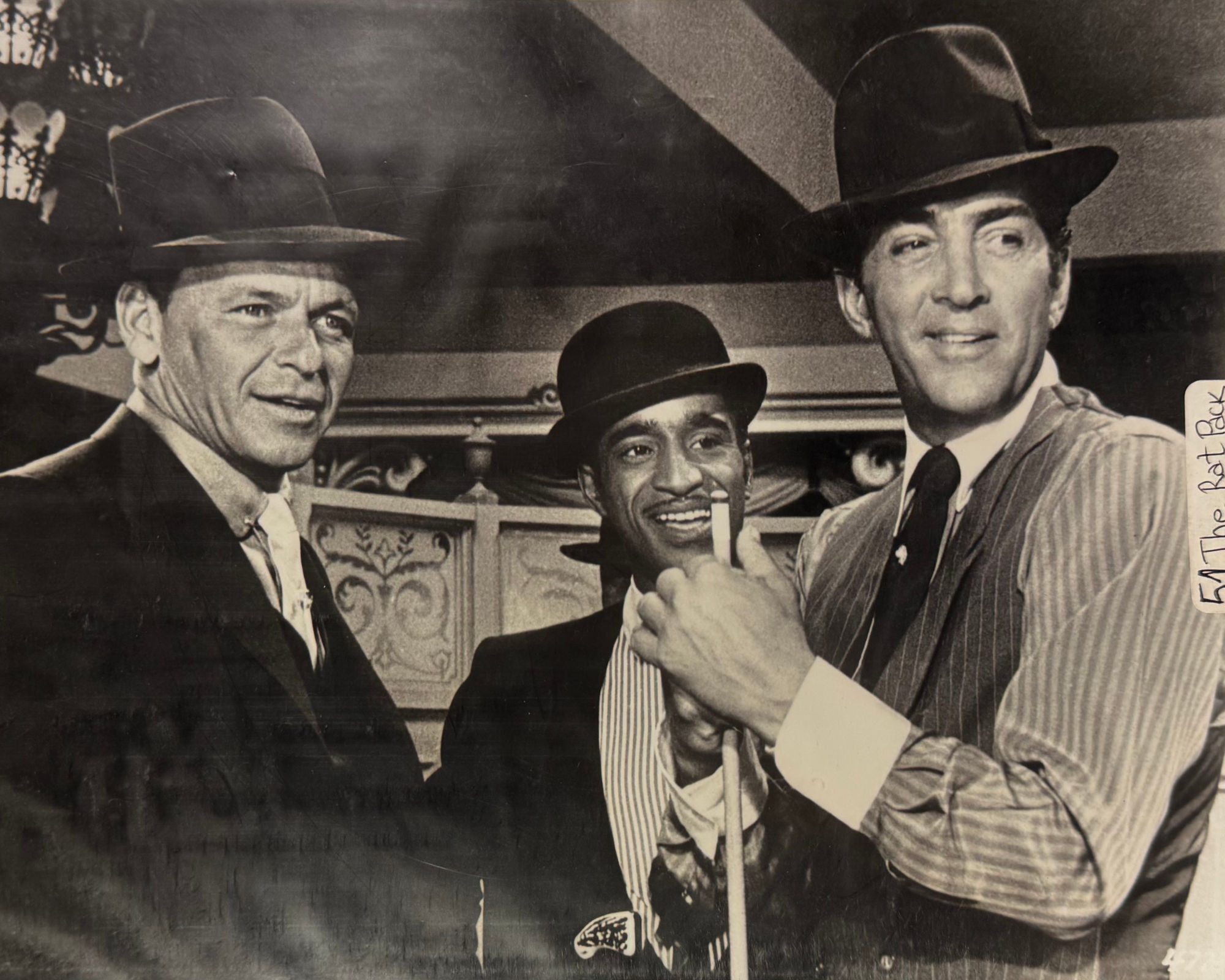
Robin and the 7 Hoods
Frank, Sammy Davis Jr. and Dean Martin
As Will, Robbo, and John Hollywood Blvd Gift Shop Photos
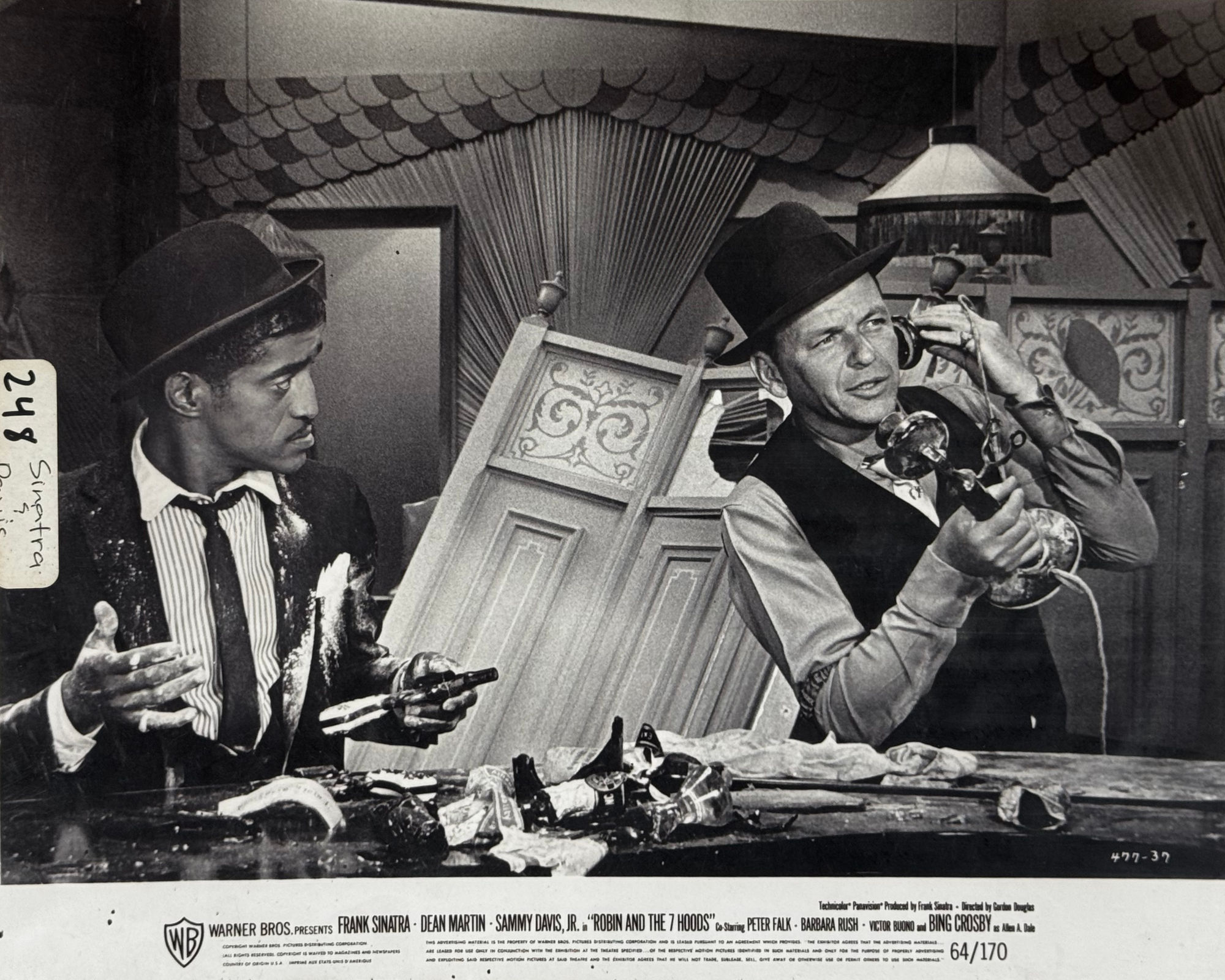
Robin and the 7 Hoods
With Sammy Davis Jr.
As Will and Robbo Hollywood Blvd Gift Shop Photos
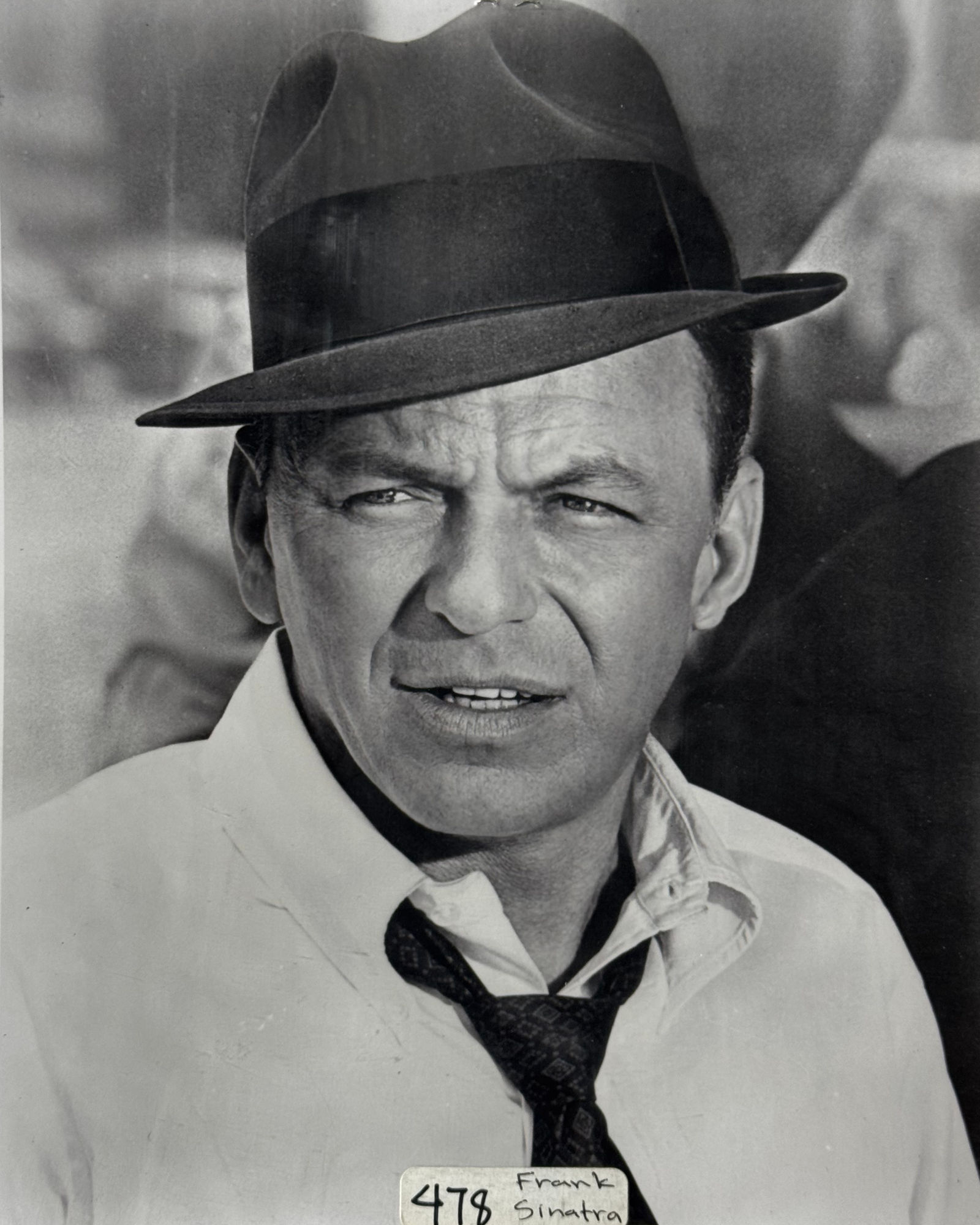
Tony Rome
Hollywood Blvd Gift Shop Photos
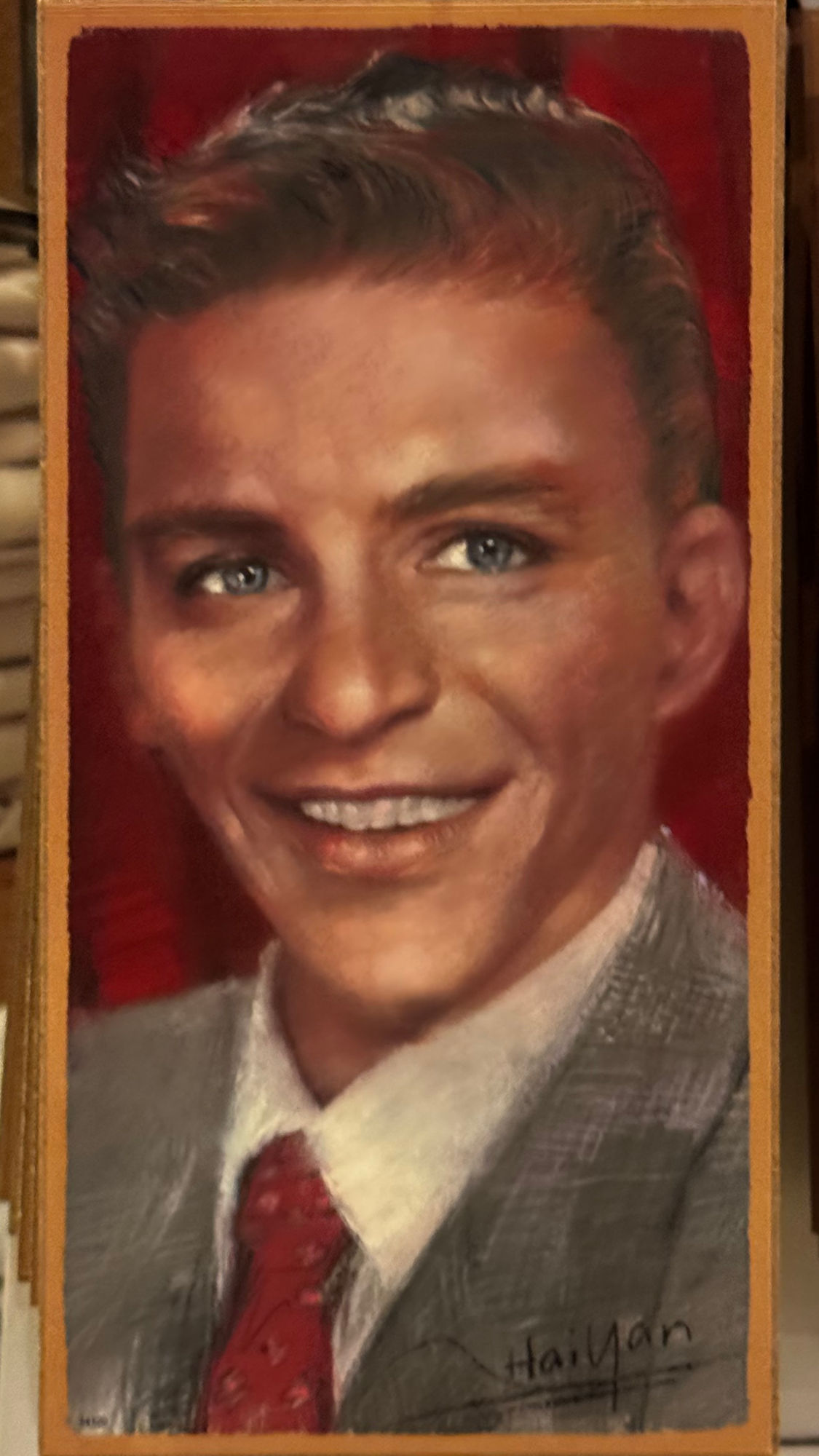
Frank Sinatra
Art Plaque by Haiyan
Based off a 1940s studio publicity portrait Hollywood Blvd Gift Shops
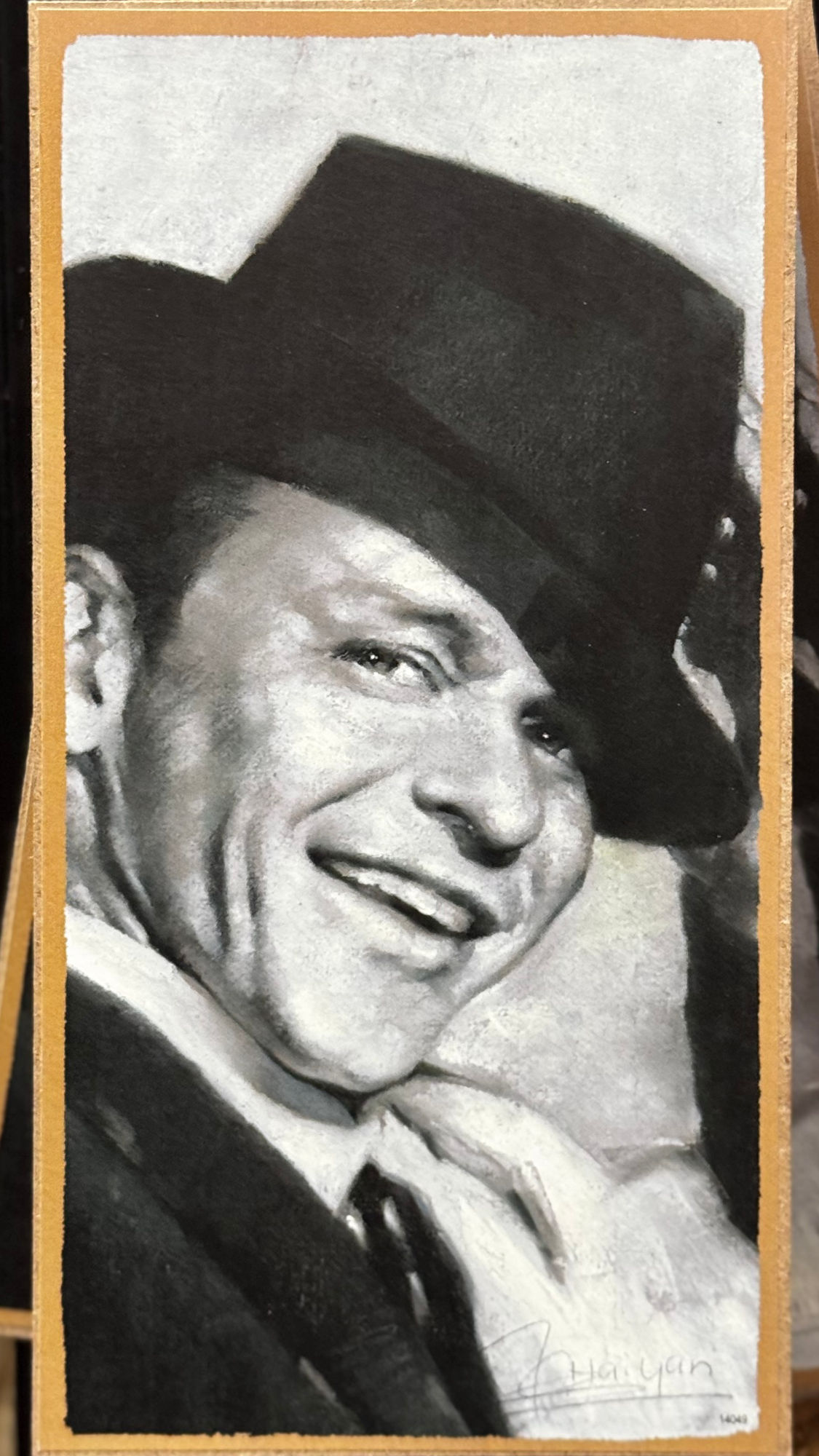
Ol' Blue Eyes
Art Plaque by Haiyan Hollywood Blvd Gift Shops